| The career handoff: Intentional sharing of knowledge and wisdom
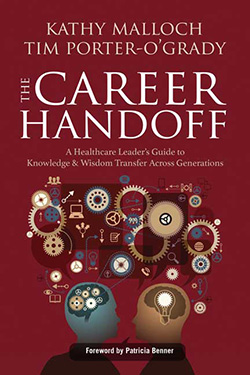
Chapter from The Career Handoff, an STTI book.
|
| By Kathy Malloch and Tim Porter-O'Grady |
|
This chapter from The Career Handoff: A Healthcare Leader's Guide to Knowledge & Wisdom Transfer Across Generations examines the
critical components of successful communication, transition, handing
off, and succession planning in the healthcare profession.
“Tell me and I forget, teach me and I may remember, involve me and I learn.”
–Benjamin Franklin
 Every
year, Tim and I schedule time for a retreat to plan what we are going
to focus on in the next year. We select a special place where we can
both think and play and do something special. At our latest retreat at
the Ojai Valley Inn & Spa in California, we found ourselves
wondering how many more revisions of our work we could do—and how much
longer our ideas and strategies would be relevant for healthcare
organizations. And then came the even tougher question: What would
happen to our textbooks? Would Quantum Leadership just sail
into the sunset? We humbly wanted the information that would be
meaningful to future generations not to be lost; we did not want future
generations to rediscover what we had already identified and shared.
These questions got us to think about how to hand off our successful
ideas to younger colleagues and selectively discard that which is no
longer relevant. From that conversation, we began to strategize and
learn about how to hand off knowledge and wisdom to younger generations,
and this book is a result of those ideas. Every
year, Tim and I schedule time for a retreat to plan what we are going
to focus on in the next year. We select a special place where we can
both think and play and do something special. At our latest retreat at
the Ojai Valley Inn & Spa in California, we found ourselves
wondering how many more revisions of our work we could do—and how much
longer our ideas and strategies would be relevant for healthcare
organizations. And then came the even tougher question: What would
happen to our textbooks? Would Quantum Leadership just sail
into the sunset? We humbly wanted the information that would be
meaningful to future generations not to be lost; we did not want future
generations to rediscover what we had already identified and shared.
These questions got us to think about how to hand off our successful
ideas to younger colleagues and selectively discard that which is no
longer relevant. From that conversation, we began to strategize and
learn about how to hand off knowledge and wisdom to younger generations,
and this book is a result of those ideas.
We realized from our consulting practices that highly successful
professionals are often reluctant to consider retirement, and many
people avoid the thought of moving away from active engagement with
colleagues in sharing knowledge and wisdom. It is even more challenging
to figure out how to hand off or give one’s intellectual property to
another colleague. As an unprecedented number of baby boomers move
closer to retirement, there is much to share with succeeding
generations. There is also some content or intellectual property that
might not be applicable in future generations. We believe a formalized
process for sharing and designating intellectual property and products
would be helpful to not only our baby boomer colleagues but also to
other generations of colleagues.
The Need for Generational Sharing
Our professional consulting focus has been on the importance of leadership and in helping others to learn as much as possible about leadership—to embrace new ideas to become the most successful leaders possible. Our belief has always been that everyone is a leader, regardless of whether they have a formal leadership title. Whenever two individuals are together, one person begins the dialogue or movement in the simplest way, and leadership is evident. Each one of us has some special knowledge and expertise that future generations should or might want. Creating a culture as well as validating the science that assists others in handing off and nourishing our colleagues with our wisdom is important to both of us. Cultivating a culture of giving to others with minimal expectations of receiving something in return will allow future generations to grow and move on with what is vital to them. Our focus has shifted from figuring out what to give and how to instruct them to “love our stuff” to identifying interested colleagues and turning our work over to them to sort out and retain what is deemed valuable. It is also time for us to get out of the way of future leaders and shift from driving the boat to creating a safe space for others learning how to manage the boat’s journey!
Soon after our retreat, I was invited to keynote a leadership
summit group; my focus was on this topic of generational sharing.
Participants at this meeting included successful professionals from
three generations, including chief executive officers, nurse executives,
consultants, real estate executives, and physicians. As part of the
keynote, I presented the plan Tim and I developed to hand off two of our
books (see the feature that follows) and the discussion began to flow.
Participants were highly interested in learning more and becoming
involved in advancing the science of both giving and receiving
intellectual property and the wisdom of ages.
Reflecting on these ideas, we created a book proposal with the interested retreat participants. We now had a team of wisdom experts to join us on this journey and, most importantly, the authors represented three generations of interested professionals. We realized quickly that the importance of sharing generational wisdom was significant and that there was much interest from younger generations in learning more about our work and how to keep the useful knowledge alive and contemporary. Rather than seeing ourselves as the fading generation, it is time to see ourselves as a generation who now has much to share with the younger generations! We believe we created a talented team of wisdom managers to assist in this work.
Further dialogue with the contributing authors
provided clarification and enhancement of our ideas and solidified the
importance of documenting and sharing generational wisdom, successes,
and strategies that we would not repeat. We believe formalizing this
process and providing guidelines for colleagues will be an important
contribution to professional nursing practice. Each one of our authors
has included specific discussion on what the handoff is, some practical
tips for sharing knowledge, and exemplars to demonstrate personal
experiences (and, of course, some irreverent humor; we all need to laugh
and enjoy the nuances of our journey!).
This book reflects our commitment to professional
coaching, mentoring, and assuring that our young nurses are not chewed
up by the system but are supported proactively. Mentoring is a vital
professional behavior and an ethical obligation to our profession; we
need to nourish our young rather than engage in the proverbial “eating
our young.” In the next section, we share our personal and scholarly
connections to the art and science of mentoring.
Life Journey: Membership in the Profession
Transitions and transformations are a fundamental part of the journey of life. Naturally, as we age and grow, we gather information, skill, insight, and wisdom that accumulate and aggregate in a way that becomes a part of our characters and personalities. As professionals, one of the most important considerations is the responsibility that membership in the nursing profession brings. Who we are and what we are become a part of our professional identity such that our person and profession become one and the same thing (Malloch & Porter-O’Grady, 2010). As we journey through our careers and our lives and are recognized as professional nurses, we essentially become the “person of the nurse.” As professionals, we integrate our work, our relationships, and our individual persona in a way that creates the frame for who we are and provides the substance of the image we present to the world. Consider a notice you might see in a newspaper about the appointment of a position to an administrative or public role—the writer acknowledges the relationship between the person and profession by identifying the particular individual as a “physician.” However, when a nurse is appointed in a similar fashion to an administrative or public role, he or she will more frequently be identified as a “former nurse.” For the physician the identity is singular; for the nurse the same identity is dual (a nurse is a job different from the administrative or public role and, therefore, cannot be identified in singular terms).
“I am not a teacher, but an awakener.”
–Robert Frost
One of the joys of this life journey is the
increased knowledge, insight, and skill we develop as we aggregate
experiences and learning relationships. If we have had an open attitude
in all these arenas, we have been available to the opportunities to
deepen our insights and understandings and broaden our awareness in a
way that helps us develop expertise that advances our talent as
professionals. One of the urges this dynamic generates is the desire to
share and to extend these insights and talents in a way that benefits
others who are also eager for learning and personal development. This
desire to share knowledge and skill is an outgrowth of our own openness
and availability to learning and personal development. Those individuals
who understand this dynamic also recognize that embedded in it is the
give-and-take reflected in the interaction of all who share a commitment
to growing, learning, and deepening their knowledge and understanding.
|
Showing posts with label #RN. Show all posts
Showing posts with label #RN. Show all posts
Monday, June 13, 2016
Taking the Next Steps...Planned Succession

Monday, June 6, 2016
Poetry by Nurse Monique A. Shaw
Molestation,
a sad plight
It's
not enough to keep me up at night.
Projects,
shelters, even evictions
Is
that enough to make me lose my conviction?
The
witness of a horrible stabbing,
Domestic
abuse and a kidnapping.
She’s
your mom! Yes, I know!
But the
paperwork said she let me go!
All
this before the age of ten
At
what age will this tragedy end?
Brighter
days must soon be near
Off
to San Diego where the skies are clear.
Is
it here that this will all end
Is
my triumph about to begin?
No,
not now I’ll have to wait
Let’s
pile some more upon my plate.
ADDICTION!
Why mom? Why did you choose
Drugs
will surely make you lose.
Our
home, our friends, our money, our things
You
smoked them, you snorted and shot them up.
Walking
the Downtown streets late at night
Nowhere
to go, we spot a light.
Is
that a sign? A vacancy?
Yale
Hotel on F Street, our new home to be.
It
is here where friends become family
And,
of course, more tragedy.
NO!
STOP IT! IT ISN'T SO! MY MOM DOES NOT HAVE HIV!
STOP
TALKING! I'M NOT LISTENING! STOP LYING TO ME!
Off
we move and leave our friends
The
family that stays with me through thick and thin.
Now,
In-Home Nurses and medication
I’m
only in Junior High School, I need a vacation.
The
drugs, they’re just too strong
She
can’t let go and continues to succumb.
Now
three little letters turn into four
AIDS
came tapping at my mother’s door.
DEATH!
Two times in a one year span
First
dad now mom, it’s too much man!
Junior
High, High School and College is the future for me
Constantly
holding a 3.0 to a 3.33.
Life
has many twists and turns and crooked paths
As
we often learn.
Love
provides an interruption
But
abandoning college was never my solution.
Marriage
at age twenty and a new place to call home
Military
life in Illinois is where I'll roam.
Also
Virginia and Mississippi
The
love is now gone, there’s nothing here for me.
Back
to San Diego from where I came.
Time
to pack up and start again.
Now
a single mother, I must go back to school
Go
back to the path which I always knew was cool.
A
Medical Assistant I’ll quickly become
To
make decent money to try and move on.
Child,
work and school that’s my daily routine
Working
hard to fulfill my lifelong dream.
Along
comes the news I’ve patiently waited for
Two
long years or maybe more.
Monique,
you’ve made it, your name has come up
Are
you ready for Nursing School? Of course, there’s a but.
But
I’m pregnant with another child, over ten years later.
Its
OK, we’ll see you next year but not any greater.
The
year came and went quick as a flash
Nursing
School is here, time to attend class.
The
toughest two years I really must say
But
I remember my past and what I endured many days.
I
persevered and progressed and completed the program
And
walked across the stage with my kids looking on.
And
knew that although life sometimes seemed bleak
That
this was the TRIUMPH I always did seek.
So you
may ask, “Do you think this scholarship can help you live your dream?”
Yes
in many ways, one can only imagine
Higher
education is the goal and is my passion.
From
RN to BSN this is now my desire
This
scholarship will help me live my dreams and aspire.
Monique A. Shaw, R.N.
Monique is a registered nurse in the Southern California area. She is currently working on her BSN while balancing the busy life of work and mom.
Monday, May 23, 2016
Celebrating Nurses with a Little Bit of Poetry
IF MY
STETHOSCOPE COULD TALK
by Kimberley
Ensor, MSN, RN
If my stethoscope could talk what
would it say about me today?
Would it say that I rushed
through my assessment so I could scope out a place at the nurses’ station?
Would it say that I was thorough
or going through the motions?
Did I just kill time until break?
Lunch? End of my shift?
What would my stethoscope say?
If my stethoscope could talk how
would my listening skills be evaluated?
Did I actually hear my
patient? When medications were refused
or when the patient expressed they had enough, would I actually listen?
As my stethoscope moved across
their body, did I notice a change that needed to be addressed in the plan of care
or did I just do business as usual?
Was I listening to my patient and
their family members’ concerns or did I just perform lip service as from a
script.
What would my stethoscope say?
If my stethoscope could talk
would it say that I had my eyes open as I took care of my patient?
Did I completely understand the
physician’s orders? When my patient
addressed me did I provide eye contact or was I too busy looking at monitors
and equipment?
Did I notice something and speak
up as an advocate for my patient or did I leave it for the next shift to
handle?
What would my stethoscope say?
If my stethoscope could talk
would it say I half-heartedly gave education and explanations about
medications?
Would what I speak actually come
from a desire to be a help to my patient or just to look good as an authority
figure?
Did I form my words to be culturally sensitive or did I disregard my
patient’s views, beliefs and preferences?
When I spoke to colleagues or
interacted with the multi-disciplinary staff was I a source of encouragement.
Did I include my unit assistants
in the plan of care for the patient? Did
I recognize my charge nurse as a valuable resource? Did I appreciate my unit clerk for their
invaluable help?
What would my stethoscope say?
If my stethoscope could talk,
would it say that I am an example of patient centered care?
Did my care come from my passion
to be a nurse or am I just hanging around for a paycheck?
Did my body language speak I care
about you or was I stand offish and couldn’t be bothered?
Was I first to the room when an
IV or bed alarm sounded or did I say ‘that’s not my patient and turn a deaf ear
and go about my day?
Did I make myself available to my
colleagues, to my patient or was I nowhere to be found during busy periods?
Did I take a moment to step
outside and let the sun touch my skin, reminding me of why I wanted to be a
nurse in the first place?
What would my stethoscope say?
My stethoscope would say,
I bring my joy and positive
spirit with me each time I step on the unit.
It would say I strive to listen
with open ears and see with both eyes.
It would say I try to be an asset
to my unit and an instrument of excellent care.
It would say I utilize evidence
based practices when answering patient questions and use simple languages.
It would say I work daily to be
an advocate, a hand to hold, and an empathetic ear.
My stethoscope would say I am a
nurse and I put my heart into everything I do.
I wear my stethoscope with pride.
Monday, April 18, 2016
Smarter Alarm Management Fights Alarm Fatigue Jeanne J. Venella, DNP, MS, RN, CEN, CPEN
Note from Nurse Kim:
This is a huge issue right up there with compassion fatigue and violence in the workplace. Patient Safety is a priority strategy for healthcare providers. Our vigilance will reap great rewards for patients and staff when we make sure to not let this issue fall by the wayside.
Alarm Management Goes Into High Gear
"The failure to recognize and respond to actionable clinical alarms... in a timely manner" was the second highest-ranked patient safety risk identified in the ECRI Institute's Top 10 Health Technology Hazards for 2016.[1] These threats include actionable alarms that are not detected, as well as alarms that are not handled appropriately by clinical staff owing to miscommunication and alarm fatigue.The lack of hospital-wide clinical alarm management policies and procedures, and the dangers inherent to alarm mismanagement, achieved prominence in 2013 with the release of the Joint
Commission's National Patient Safety Goals on clinical alarm safety.[2] This initiative mandates that hospitals must identify and prioritize alarms based on internal considerations by January 1, 2016. In phase 2, which also begins in January, "hospitals will be expected to develop and implement specific components of policies and procedures. Education of those in the organization about alarm system management will also be required."[2]
Although hospitals and health systems have made progress in solutions development, missed alarms resulting from poor communication or alarm fatigue continue to pose clear and present threats to patient safety. The increase in the number of medical devices with alarm capabilities has only exacerbated the problem, as has the lack of standards on the proper configuration of alarm parameters.
Technology will play a critical role in getting alarms under control, but it is not enough. Without input from the workforce, technology solutions can fail owing to lack of adoption. Nurses and nursing leaders must get out ahead of this issue or solutions will not have representation from the correct stakeholders. Clinical and information technology (IT) leadership, including nurses, respiratory therapists (RTs), biomedical engineers, and IT staff, must come together to develop the policies and standards necessary to prioritize and reduce the number of alarms, as well as to establish protocols for altering current or default alarm parameters.
This article describes how two different hospitals achieved their alarm management goals using both technology and interdisciplinary expertise.
An Interdisciplinary Approach
In explaining why technology alone is not enough to solve the riddle of clinical alarm management, The Joint Commission said, "It is important for a hospital to understand its own situation and to develop a systematic, coordinated approach to clinical alarm system management. Standardization contributes to safe alarm system management, but it is recognized that solutions may have to be customized for specific clinical units, groups of patients, or individual patients."[2]In other words, each hospital has its own unique characteristics and needs. Identifying and documenting those attributes is critical to a successful alarm management program. Achieving measurable progress in clinical alarm management requires hospitals to identify direct clinical staff as internal champions.
Wesley Medical Center (Wichita, Kansas) surveyed every nurse in the facility to determine which alarms they considered "clinically relevant" and which they considered "nuisance alarms." On the basis of 200 responses, the hospital was able to evaluate which alarms were most important to them as providers of care and compare findings with the most frequent alarms that occurred in a baseline study.
Wesley Medical Center was able to reduce and prioritize more than 10,000 daily alarms, reduce alarm incidence in its coronary care unit by 78%, and capture and distribute data from more than 600 medical devices for enhanced clinical surveillance by leveraging a combination of interdisciplinary input and alarm management technology.[3] The baseline evaluation enabled Wesley's clinical leadership to begin the process of mapping alarm trends, as well as classifying alarms by:
- Frequency, alarm type, and device;
- Variations by time and day as well as by rooms and units;
- Alarm parameters and thresholds; and
- Physiologic vs technical alarms.
The highly specific data generated by the baseline study and analysis helped Wesley's clinical staff develop a more effective alarm management system that will reduce the number of nuisance alarms requiring no action and will allow them to measure improvement over time to meet patient safety goals. An evaluation was conducted using a variety of factors, including:
- Setting a predetermined number of days (eg, 30 days or 90 days) for analysis;
- Analyzing alarm type by alarm category;
- Identifying which alarms are most frequent;
- Identifying changes in type and frequency of alarms by unit;
- Identifying variations in alarm type and frequency by device (eg, patient monitor, ventilator, infusion pump, etc.);
- Analyzing variations in alarm response behavior based on technical and physiologic categories, including time, day of week, room, and unit; and
- Analyzing common alarm limit violations to determine how potential changes in current limits may alter alarm frequencies.
For example, Wesley now has the flexibility to determine which events will trigger alarms as well as where and how clinicians will be notified. Uniquely, Wesley's system provides staff with high-fidelity, real-time, intelligent data from myriad devices to improve patient monitoring and allow staff to intervene before a patient's condition turns critical—offering point-of-care clinical decision support and enhancing patient outcomes.
Nuisance Alarms
A major challenge in alarm management is sorting clinically relevant alarms from nuisance alarms (for example, an alarm caused by a sensor on a patient being momentarily detached or the Wi-Fi connection being momentarily lost). Hospitals need to develop a standard approach to alarms and have a strategy to reduce alarm frequency, alarm noise, and alarm fatigue. Moreover, providers must guard against the overuse of monitoring when it is not indicated, because this just adds to the number of nonactionable alarms.The problem with attenuating alarm data is achieving the balance between communicating the essential, patient-safety specific information that will provide proper notification to clinical staff while minimizing the excess, spurious and nonurgent events that do not threaten patient safety. In the absence of contextual information, the option is usually to err on the side of excess because the risk of missing an alarm or notification carries with it the potential for high cost in terms of patient harm or death.[4]
Wesley's clinical leadership was able to establish separate alarm thresholds as well as combination, trending, and frequency alarms to eliminate nonactionable alarms from being sent to the clinicians carrying phones outside of patients' rooms. For example, instead of an alarm based on a single vital sign, such as the ECG heart rate, a combination alarm might also look at the heart rate from the pulse oximeter or an invasive blood pressure wave to make sure the alarm is real and not just artifact. Overall, Wesley was able to reduce the number of these alarms daily in the coronary care unit from 1285 to 281—a 78% reduction.
The Table shows the reduction in the number of alarms sent to the nurses' phones. The "device alarms" column represents alarms generated by bedside devices and sent to nurses' phones. The "smart alarms" column shows the number of alarms that actually passed to the phones after implementing the smart alarm solution.
Table. Reduction in Number of Alarms With Smart Alarm Platform
| Alarm Type | Device Alarms | Smart Alarms | Reduction |
|---|---|---|---|
| Respiratory rate - low/high | 428 | 212 | 50% |
| SpO2 - low | 508 | 61 | 88% |
| Heart rate – low/high | 349 | 8 | 98% |
| Asystole | 15 | 15 | 0a |
| V-tach | 13 | 13 | 0a |
| V-fib | 2 | 2 | 0a |
V-tach: ventricular tachycardia
V-fib: ventricular fibrillation
aCritical pass-through alarms from the device
Medical Device Connectivity
In a 2013 survey, 9 of 10 hospitals indicated that they would increase their use of patient monitoring, particularly of capnography and pulse oximetry, if false alarms could be reduced.[5] A tremendous amount of data is being generated by monitoring technology and needs to be viewed across the entire continuum of patient care.The Hospital for Special Care (HSC), located in New Britain and Hartford, Connecticut, is nationally recognized for advanced care and rehabilitation in pulmonary care, acquired brain and spinal cord injury, medically complex adults and pediatrics, neuromuscular disorders, and cardiac disease. In addition to reducing or eliminating nonactionable alarms, HSC's goals for alarm management included collecting and distributing real-time data from more than 100 ventilators (each with its own set of alarms), as well as pulse oximeters, for enhanced, continuous patient surveillance, and analyzing objective, comprehensive clinical data after any patient incident to assess response processes and preventive measures.[6]
The critical nature of ventilators as life-support devices and the number of alarms they produced were major drivers in HSC implementing a solution that would enable HSC's team of RTs to provide continuous surveillance monitoring of patients while reducing nonactionable alarms and enhancing patient safety. The solution allows HSC's team of RTs to provide continuous monitoring of vital patient information and intervene before a situation becomes critical, enhancing patient safety.
Networked laptop and desktop computers, as well as scrolling message bars, were deployed at key locations throughout the pediatric unit, providing RTs with access to data and alarms from all ventilated patients. In addition, ventilator alarms were routed through pagers to the specific RT assigned to each patient. The system also automates processes that were previously done manually, such as manual ventilator checks, which frees up the RT to focus on the patient rather than the ventilator.
HSC's platform achieved real-time surveillance of patients on ventilation support and reduced the number of ventilator alarms by an estimated 80%, helping achieve compliance with The Joint Commission National Patient Safety Goals on alarm management. Clinical alarm management also helped HSC with quality and reporting data. Before implementing the platform, HSC was dependent on individual recollections from the clinical responders after an alarm incident. Today, HSC has a clearer picture of every event. HSC can use the data provided by its platform to sort out the story behind any incident, increasing accuracy on occurrence reporting and resolution. Moreover, the data collected are used by the performance management audit committee, which monitors ventilator management performance and helps identify potential areas of need.
"Alarm management is already a fundamental part of what we do," said Connie Dills, MBA, RRT, RPFT, respiratory practice manager for HSC. "It's made a big difference in our staff's efficiency and effectiveness, and has reduced stress for our patients and their families."
Lessons Learned
Alarm management is constantly changing. It must evolve with the needs of the hospital's patients and clinical staff. The nursing leadership and staff at Wesley continue to make adjustments to the alarm management process and configuration. "Alarm parameters should be part of our nurses' practice, and setting actionable alarms will increase their ability to care for patients," said Free. "Alarm management—and the parameters—have to be based on an individualized approach to your patient. Attention to this process have given us ownership."Wesley is also looking at how it can use alarm data for predictive analytics, collecting physiologic data from multiple devices to create a holistic picture of a patient's condition. For example, taken individually, a slight drop in heart rate, a gradual rise in end tidal CO2, or a slight reduction in respiratory rate may not indicate anything critical in a patient's condition. However, data aggregated from those individual parameters could provide the caregiver with a more accurate, predictive picture of the patient's condition—in this case, an emerging risk for respiratory depression.
Addressing clinical alarm hazards in all their forms requires a comprehensive approach, free of the well-known departmental and data silos that hinder patient care and optimal clinical workflows. Technology certainly plays a critical role in alarm reduction and prioritization, but alarm management is a classic example of interdisciplinary leadership, involving clinical, IT, biomedical engineering, and other departments.
References
- ECRI Institute. Top 10 Technology Hazard for 2016. November 2015. https://www.ecri.org/press/Pages/Dirty_Endoscopes_Top_ECRI_Institutes_2016_Technology_Hazards_List.aspx Accessed January 7, 2016.
- The Joint Commission. The Joint Commission announces 2014 National Patient Safety Goal. http://www.jointcommission.org/assets/1/18/jcp0713_announce_new_nspg.pdf Accessed January 7, 2016.
- Wesley Medical Center. Beyond Alarm Management. Bernoulli. October 2015. www.cardiopulmonarycorp.com/wp-content/uploads/2015/10/Bernoulli-Wesley-Case-Study-AM-01-vA-10-15.pdf Accessed January 7, 2016.
- Zaleski JR. Alarm fatigue? What a nuisance! [Blog post]. October 4, 2014. www.medicinfotech.com/2014/10/mathematical-techniques-mitigating-alarm-fatigue Accessed January 7, 2016.
- Wong M, Mabuyi A, Gonzalez B. First National Survey of Patient-Controlled Analgesia Practices. March-April 2013. A Promise to Amanda Foundation and the Physician-Patient Alliance for Health & Safety. http://www.premiersafetyinstitute.org/wp-content/uploads/PPAHS-national-survey-patient-controlled-analgesia.pdf Accessed January 7, 2016.
- Hospital for Special Care. Achieving Clinical Clarity from Ventilator Overload. Bernoulli. October 2015. www.cardiopulmonarycorp.com/wp-content/uploads/2015/10/Bernoulli-HSC-Case-Study-LT-01-vA-10-15.pdf Accessed January 7, 2016.
Subscribe to:
Posts (Atom)