Challenges Facing Nursing Students Today
Dec 12, 2017 | Blog, Magazine, Nursing Mentorship, Nursing Students
There have always been challenges facing nursing students. What are the biggest ones today, and how can students deal with and overcome them? Some experts weigh in.
Frederick Richardson, a BSN student and the Breakthrough to Nursing director for the National Student Nurses’ Association, had no doubt about how much of his time would be taken up when he began attending nursing school. Yet, he says, this seems to be one of the toughest aspects of attending nursing school that students struggle with.
“One of the biggest issues that nursing students face is time—making time for everything,” explains Richardson. “Nursing school is very demanding, and when you add in the coursework, reading for homework, and the clinical work, there usually isn’t time for anything else.”
Richardson says that he was fortunate enough to learn about this before choosing to attend nursing school. His older brother had attended nursing school, and Richardson saw firsthand how often he didn’t see his brother during that time. “He would be at the library studying, at class, or at clinicals,” recalls Richardson. “When I’d see him, it would be late at night. And he would be out of the door first thing in the morning. At the time, I recognized that when I would get to nursing school, I would probably have a similar schedule, and sure enough, it’s been exactly the same way.”
To overcome this, Richardson says that students need to have perspective and be realistic regarding what they can accomplish in their lives while attending such vigorous programs. “Our schedules can get really hectic. But I think that when you get into nursing school, you have to recognize that you’re going to devote the majority of your time to your nursing program. A lot of students don’t realize that,” he says.
Students need to set their priorities straight and decide how they are going to organize their time. Richardson, for example, says that he had to learn how to plan his time, organize his life and tasks on a calendar, and then follow that calendar every single day. From his perspective, quite a lot of students expect to attend nursing school and still have an active social life and do everything they did before, like watch all their favorite television shows.
“I think that the trouble students run into is they believe they can have everything—do well in nursing school, have an active social life, et cetera. If they go in with that kind of view, I don’t think they’re going to survive nursing school,” says Richardson. “They’re going to have to sacrifice a lot of that time, but once you get into it, it gets a bit easier.”
Martha A. Dawson, DNP, MSN, FACHE, assistant professor and coordinator of Nursing and Health Systems Administration at the University of Alabama at Birmingham School of Nursing, as well as the current historian for the National Black Nurses Association, agrees that having enough time can be an issue for nursing students. Traditional nursing students still face challenges that relate to study time, finances, and part-time work. In addition to the challenges of traditional students, however, second degree nursing students, such as those in a BSN to MSN bridge or other accelerated degree program, may also have immediate family obligations, explains Dawson. For instance, some may be primary caregivers for older parents. “Many students in these new and emerging programs are older, and these added life demands can lead to both high stress and exhaustion,” she adds.
Money, Money, Money
Richardson and Dawson agree that financial issues can also be a big challenge for nursing students. Dawson says that with the varying nursing programs and the older student population in them, these students may have greater financial obligations besides school, like a mortgage. “The current economic climate is making it more difficult for students to gain access to scholarships, trainee grants, and other forms of funding without going further into debt,” says Dawson.
In addition to taking out loans to attend nursing school, Richardson says that there are a number of scholarships available for students. Believe it or not, though, not a lot of students are applying for them. “There are a good number of scholarships available,” says Richardson. “After speaking with some people who have scholarships or who fund scholarships for students, I’ve discovered that they’re not getting a lot of applications. One reason is because of the time. A lot of students don’t know that the scholarships exist, and a lot who know they exist feel like they don’t have the time to fill out the applications because of the high demand of nursing school.”
The reality, Richardson says, is that studying takes up so much of the students’ days that many don’t think they could take the time to do what some scholarships may require in their applications—like get a letter of recommendation, write three essays, get transcripts, and the like.
Recently, Richardson had a heart-to-heart talk with a student who was frustrated because of going to school, clinicals, and a part-time job. “I said, ‘If you took about three hours applying for a scholarship, you would get more money to help you out with your school fees,’” says Richardson. He continued to explain to the student that he was working twice as hard and putting in twice as many hours at his part-time job to make the same amount of money that he could get if he applied for a scholarship—which would ultimately free up more of his time. “It would help the student more in the long run,” says Richardson.
Family Support
Along with not getting enough financial support, some nursing students don’t have as much family support, says Rebecca Harris-Smith, EdD, MSN, BA, dean of Nursing and Allied Health at South Louisiana Community College. “Nursing classrooms across the nation are filled with an intergenerational, multicultural group of students that range from millennials to baby boomers,” explains Harris-Smith. “This nontraditional classroom of students has many that are parents who frequently do not have siblings, parents, or other relatives to assist them with child care. The expense of child care, transportation, and after-hours coverage often impacts the nursing student’s classroom, clinical, and study time.”
Richardson says that family support and encouragement is often needed, but not every student has it. “I noticed immediately that I needed a lot of support,” says Richardson.
Communication
“In my personal experience, soft skills as they relate to interpersonal people skills have become an issue for nursing students. The ability to communicate both verbally and in writing appears to be a challenge,” says Harris-Smith. She says that because Gen Xers and millennials have grown up with a lot of technology, they have spent a lot of their early years communicating that way.
“Basic socialization has changed in that the younger generations would prefer to text over having a verbal conversation. The lack of appropriate communication skills has an impact on the students’ ability to work collaboratively with physicians, fellow nurses, and other members of the health care team,” explains Harris-Smith.
“Effective communication is essential due to the intra- and interprofessional team collaboration essential in the health care arena,” Harris-Smith explains. “Additionally, nursing students must learn flexibility, professionalism, and a strong work ethic—which are essential to the development of the new nurse graduate. Being able to adapt to an ever-changing environment is important as health care facilities have staffing issues often requiring nurses to work beyond their shifts.”
Challenges for Minority Students
Although the challenges for nursing students are often the same for students of color and those who aren’t, “students from underrepresented groups in the nursing profession and in society . . . have them on a much larger scale,” says Dawson. “There are barriers and biases that these students experience such as academic skills, perceived perceptions about their abilities, lack of faculty role models, limited peer support, and major financial issues that ‘majority’ students do not have to deal with on a daily basis. Many minority students also struggle with the very basics of housing and food.”
An additional burden that minority students face, says Harris-Smith, is that of access and equity in education. “A selective admission process is used by schools of nursing across the nation, and this very process can serve as a barrier for students of color. Academic profiling of students ensures admission of the most academically prepared students that rank highest among their peers, but students from underrepresented populations are often the first-generation college students that struggle with the issues of being the first in the family to attend college. This situation places a heavy burden on the student because s/he may be dealing with the pressure of being the ‘savior’ for the family. These students are generally not savvy enough to apply for multiple college programs, have difficulty completing financial aid forms, and generally come to college with limited resources,” says Harris-Smith.
“Nursing programs tend to address diversity in their mission statements but fail to explain how this is accomplished. Merely placing the statement in the mission statement does not explain how the school of nursing addresses the issue. To ensure transparency, each school of nursing could better address this issue by providing information on the way in which this mission is accomplished,” says Harris-Smith. For example, she says, schools could use a statement that’s more explanatory: This school of nursing addresses diversity via academic profiling of students but is careful to admit a diverse student body that resembles the demographics of the community in which we live.
“There is a need for schools of nursing to restructure their admission process to address the lack of the underrepresented students in attendance at their colleges and universities,” Harris-Smith adds.
Richardson says that’s why he is a part of the Breakthrough to Nursing committee because its goal is to increase diversity in the nursing profession. Another challenge he’s seen is that some minority students don’t last in nursing school because they have different ways of learning. “Culturally, students from different backgrounds learn differently. I’m a kinesthetic learner. If you show me how to start an IV, I will know how to start an IV more efficiently than reading three chapters about how to start an IV,” Richardson explains. “A lot of nursing school is geared toward your textbook. But a lot of students are visual, auditory, and kinesthetic learners.”
He says that there are also students from various cultural backgrounds who don’t know how to study. “For students who come from the other side of the world to America to learn, their views are different from yours, and when you have a different perspective, you’re able to become more aware. You’re able to see a different view. It actually makes us stronger and allows us to become smarter to look at the way that other people do things,” suggests Richardson.
“With diversity, we need to recognize and communicate to understand what the other person’s thinking is and allow them to realize that though their culture is different, it’s not a bad thing,” says Richardson. “It’s just a different view and perspective for them.”
Michele Wojciechowski is an award-winning writer and author of the humor book Next Time I Move, They’ll Carry Me Out in a Box.
Showing posts with label #minoritynurse. Show all posts
Showing posts with label #minoritynurse. Show all posts
Thursday, March 15, 2018

Monday, June 13, 2016
Taking the Next Steps...Planned Succession
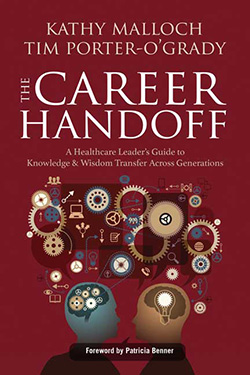
| The career handoff: Intentional sharing of knowledge and wisdom
Chapter from The Career Handoff, an STTI book.
|
| By Kathy Malloch and Tim Porter-O'Grady |
|
This chapter from The Career Handoff: A Healthcare Leader's Guide to Knowledge & Wisdom Transfer Across Generations examines the
critical components of successful communication, transition, handing
off, and succession planning in the healthcare profession.
“Tell me and I forget, teach me and I may remember, involve me and I learn.”
–Benjamin Franklin
 Every
year, Tim and I schedule time for a retreat to plan what we are going
to focus on in the next year. We select a special place where we can
both think and play and do something special. At our latest retreat at
the Ojai Valley Inn & Spa in California, we found ourselves
wondering how many more revisions of our work we could do—and how much
longer our ideas and strategies would be relevant for healthcare
organizations. And then came the even tougher question: What would
happen to our textbooks? Would Quantum Leadership just sail
into the sunset? We humbly wanted the information that would be
meaningful to future generations not to be lost; we did not want future
generations to rediscover what we had already identified and shared.
These questions got us to think about how to hand off our successful
ideas to younger colleagues and selectively discard that which is no
longer relevant. From that conversation, we began to strategize and
learn about how to hand off knowledge and wisdom to younger generations,
and this book is a result of those ideas. Every
year, Tim and I schedule time for a retreat to plan what we are going
to focus on in the next year. We select a special place where we can
both think and play and do something special. At our latest retreat at
the Ojai Valley Inn & Spa in California, we found ourselves
wondering how many more revisions of our work we could do—and how much
longer our ideas and strategies would be relevant for healthcare
organizations. And then came the even tougher question: What would
happen to our textbooks? Would Quantum Leadership just sail
into the sunset? We humbly wanted the information that would be
meaningful to future generations not to be lost; we did not want future
generations to rediscover what we had already identified and shared.
These questions got us to think about how to hand off our successful
ideas to younger colleagues and selectively discard that which is no
longer relevant. From that conversation, we began to strategize and
learn about how to hand off knowledge and wisdom to younger generations,
and this book is a result of those ideas.
We realized from our consulting practices that highly successful
professionals are often reluctant to consider retirement, and many
people avoid the thought of moving away from active engagement with
colleagues in sharing knowledge and wisdom. It is even more challenging
to figure out how to hand off or give one’s intellectual property to
another colleague. As an unprecedented number of baby boomers move
closer to retirement, there is much to share with succeeding
generations. There is also some content or intellectual property that
might not be applicable in future generations. We believe a formalized
process for sharing and designating intellectual property and products
would be helpful to not only our baby boomer colleagues but also to
other generations of colleagues.
The Need for Generational Sharing
Our professional consulting focus has been on the importance of leadership and in helping others to learn as much as possible about leadership—to embrace new ideas to become the most successful leaders possible. Our belief has always been that everyone is a leader, regardless of whether they have a formal leadership title. Whenever two individuals are together, one person begins the dialogue or movement in the simplest way, and leadership is evident. Each one of us has some special knowledge and expertise that future generations should or might want. Creating a culture as well as validating the science that assists others in handing off and nourishing our colleagues with our wisdom is important to both of us. Cultivating a culture of giving to others with minimal expectations of receiving something in return will allow future generations to grow and move on with what is vital to them. Our focus has shifted from figuring out what to give and how to instruct them to “love our stuff” to identifying interested colleagues and turning our work over to them to sort out and retain what is deemed valuable. It is also time for us to get out of the way of future leaders and shift from driving the boat to creating a safe space for others learning how to manage the boat’s journey!
Soon after our retreat, I was invited to keynote a leadership
summit group; my focus was on this topic of generational sharing.
Participants at this meeting included successful professionals from
three generations, including chief executive officers, nurse executives,
consultants, real estate executives, and physicians. As part of the
keynote, I presented the plan Tim and I developed to hand off two of our
books (see the feature that follows) and the discussion began to flow.
Participants were highly interested in learning more and becoming
involved in advancing the science of both giving and receiving
intellectual property and the wisdom of ages.
Reflecting on these ideas, we created a book proposal with the interested retreat participants. We now had a team of wisdom experts to join us on this journey and, most importantly, the authors represented three generations of interested professionals. We realized quickly that the importance of sharing generational wisdom was significant and that there was much interest from younger generations in learning more about our work and how to keep the useful knowledge alive and contemporary. Rather than seeing ourselves as the fading generation, it is time to see ourselves as a generation who now has much to share with the younger generations! We believe we created a talented team of wisdom managers to assist in this work.
Further dialogue with the contributing authors
provided clarification and enhancement of our ideas and solidified the
importance of documenting and sharing generational wisdom, successes,
and strategies that we would not repeat. We believe formalizing this
process and providing guidelines for colleagues will be an important
contribution to professional nursing practice. Each one of our authors
has included specific discussion on what the handoff is, some practical
tips for sharing knowledge, and exemplars to demonstrate personal
experiences (and, of course, some irreverent humor; we all need to laugh
and enjoy the nuances of our journey!).
This book reflects our commitment to professional
coaching, mentoring, and assuring that our young nurses are not chewed
up by the system but are supported proactively. Mentoring is a vital
professional behavior and an ethical obligation to our profession; we
need to nourish our young rather than engage in the proverbial “eating
our young.” In the next section, we share our personal and scholarly
connections to the art and science of mentoring.
Life Journey: Membership in the Profession
Transitions and transformations are a fundamental part of the journey of life. Naturally, as we age and grow, we gather information, skill, insight, and wisdom that accumulate and aggregate in a way that becomes a part of our characters and personalities. As professionals, one of the most important considerations is the responsibility that membership in the nursing profession brings. Who we are and what we are become a part of our professional identity such that our person and profession become one and the same thing (Malloch & Porter-O’Grady, 2010). As we journey through our careers and our lives and are recognized as professional nurses, we essentially become the “person of the nurse.” As professionals, we integrate our work, our relationships, and our individual persona in a way that creates the frame for who we are and provides the substance of the image we present to the world. Consider a notice you might see in a newspaper about the appointment of a position to an administrative or public role—the writer acknowledges the relationship between the person and profession by identifying the particular individual as a “physician.” However, when a nurse is appointed in a similar fashion to an administrative or public role, he or she will more frequently be identified as a “former nurse.” For the physician the identity is singular; for the nurse the same identity is dual (a nurse is a job different from the administrative or public role and, therefore, cannot be identified in singular terms).
“I am not a teacher, but an awakener.”
–Robert Frost
One of the joys of this life journey is the
increased knowledge, insight, and skill we develop as we aggregate
experiences and learning relationships. If we have had an open attitude
in all these arenas, we have been available to the opportunities to
deepen our insights and understandings and broaden our awareness in a
way that helps us develop expertise that advances our talent as
professionals. One of the urges this dynamic generates is the desire to
share and to extend these insights and talents in a way that benefits
others who are also eager for learning and personal development. This
desire to share knowledge and skill is an outgrowth of our own openness
and availability to learning and personal development. Those individuals
who understand this dynamic also recognize that embedded in it is the
give-and-take reflected in the interaction of all who share a commitment
to growing, learning, and deepening their knowledge and understanding.
|
Monday, June 6, 2016
Poetry by Nurse Monique A. Shaw
Molestation,
a sad plight
It's
not enough to keep me up at night.
Projects,
shelters, even evictions
Is
that enough to make me lose my conviction?
The
witness of a horrible stabbing,
Domestic
abuse and a kidnapping.
She’s
your mom! Yes, I know!
But the
paperwork said she let me go!
All
this before the age of ten
At
what age will this tragedy end?
Brighter
days must soon be near
Off
to San Diego where the skies are clear.
Is
it here that this will all end
Is
my triumph about to begin?
No,
not now I’ll have to wait
Let’s
pile some more upon my plate.
ADDICTION!
Why mom? Why did you choose
Drugs
will surely make you lose.
Our
home, our friends, our money, our things
You
smoked them, you snorted and shot them up.
Walking
the Downtown streets late at night
Nowhere
to go, we spot a light.
Is
that a sign? A vacancy?
Yale
Hotel on F Street, our new home to be.
It
is here where friends become family
And,
of course, more tragedy.
NO!
STOP IT! IT ISN'T SO! MY MOM DOES NOT HAVE HIV!
STOP
TALKING! I'M NOT LISTENING! STOP LYING TO ME!
Off
we move and leave our friends
The
family that stays with me through thick and thin.
Now,
In-Home Nurses and medication
I’m
only in Junior High School, I need a vacation.
The
drugs, they’re just too strong
She
can’t let go and continues to succumb.
Now
three little letters turn into four
AIDS
came tapping at my mother’s door.
DEATH!
Two times in a one year span
First
dad now mom, it’s too much man!
Junior
High, High School and College is the future for me
Constantly
holding a 3.0 to a 3.33.
Life
has many twists and turns and crooked paths
As
we often learn.
Love
provides an interruption
But
abandoning college was never my solution.
Marriage
at age twenty and a new place to call home
Military
life in Illinois is where I'll roam.
Also
Virginia and Mississippi
The
love is now gone, there’s nothing here for me.
Back
to San Diego from where I came.
Time
to pack up and start again.
Now
a single mother, I must go back to school
Go
back to the path which I always knew was cool.
A
Medical Assistant I’ll quickly become
To
make decent money to try and move on.
Child,
work and school that’s my daily routine
Working
hard to fulfill my lifelong dream.
Along
comes the news I’ve patiently waited for
Two
long years or maybe more.
Monique,
you’ve made it, your name has come up
Are
you ready for Nursing School? Of course, there’s a but.
But
I’m pregnant with another child, over ten years later.
Its
OK, we’ll see you next year but not any greater.
The
year came and went quick as a flash
Nursing
School is here, time to attend class.
The
toughest two years I really must say
But
I remember my past and what I endured many days.
I
persevered and progressed and completed the program
And
walked across the stage with my kids looking on.
And
knew that although life sometimes seemed bleak
That
this was the TRIUMPH I always did seek.
So you
may ask, “Do you think this scholarship can help you live your dream?”
Yes
in many ways, one can only imagine
Higher
education is the goal and is my passion.
From
RN to BSN this is now my desire
This
scholarship will help me live my dreams and aspire.
Monique A. Shaw, R.N.
Monique is a registered nurse in the Southern California area. She is currently working on her BSN while balancing the busy life of work and mom.
Subscribe to:
Posts (Atom)