Showing posts with label #nursing. Show all posts

Monday, June 6, 2016

Poetry by Nurse Monique A. Shaw


Molestation, a sad plight
It's not enough to keep me up at night.

Projects, shelters, even evictions
Is that enough to make me lose my conviction?

The witness of a horrible stabbing,
Domestic abuse and a kidnapping.

She’s your mom! Yes, I know!
But the paperwork said she let me go!

All this before the age of ten
At what age will this tragedy end?

Brighter days must soon be near
Off to San Diego where the skies are clear.

Is it here that this will all end
Is my triumph about to begin?

No, not now I’ll have to wait
Let’s pile some more upon my plate.

ADDICTION! Why mom? Why did you choose
Drugs will surely make you lose.

Our home, our friends, our money, our things
You smoked them, you snorted and shot them up.

Walking the Downtown streets late at night
Nowhere to go, we spot a light.

Is that a sign? A vacancy?
Yale Hotel on F Street, our new home to be.

It is here where friends become family
And, of course, more tragedy.


NO! STOP IT! IT ISN'T SO! MY MOM DOES NOT HAVE HIV!
STOP TALKING! I'M NOT LISTENING! STOP LYING TO ME!

Off we move and leave our friends
The family that stays with me through thick and thin.

Now, In-Home Nurses and medication
I’m only in Junior High School, I need a vacation.

The drugs, they’re just too strong
She can’t let go and continues to succumb.

Now three little letters turn into four
AIDS came tapping at my mother’s door.

DEATH! Two times in a one year span
First dad now mom, it’s too much man!

Junior High, High School and College is the future for me
Constantly holding a 3.0 to a 3.33.

Life has many twists and turns and crooked paths
As we often learn.

Love provides an interruption
But abandoning college was never my solution.

Marriage at age twenty and a new place to call home
Military life in Illinois is where I'll roam.

Also Virginia and Mississippi
The love is now gone, there’s nothing here for me.

Back to San Diego from where I came.
Time to pack up and start again.

Now a single mother, I must go back to school
Go back to the path which I always knew was cool.


A Medical Assistant I’ll quickly become
To make decent money to try and move on.

Child, work and school that’s my daily routine
Working hard to fulfill my lifelong dream.


Along comes the news I’ve patiently waited for
Two long years or maybe more.

Monique, you’ve made it, your name has come up
Are you ready for Nursing School? Of course, there’s a but.

But I’m pregnant with another child, over ten years later.
Its OK, we’ll see you next year but not any greater.

The year came and went quick as a flash
Nursing School is here, time to attend class.

The toughest two years I really must say
But I remember my past and what I endured many days.

I persevered and progressed and completed the program
And walked across the stage with my kids looking on.

And knew that although life sometimes seemed bleak
That this was the TRIUMPH I always did seek.

So you may ask, “Do you think this scholarship can help you live your dream?”

Yes in many ways, one can only imagine
Higher education is the goal and is my passion.

From RN to BSN this is now my desire
This scholarship will help me live my dreams and aspire.

Monique A. Shaw, R.N.
 Monique is a registered nurse in the Southern California area. She is currently working on her BSN while balancing the busy life of work and mom.


Monday, May 23, 2016

Celebrating Nurses with a Little Bit of Poetry


IF MY STETHOSCOPE COULD TALK
by Kimberley Ensor, MSN, RN
If my stethoscope could talk what would it say about me today?
Would it say that I rushed through my assessment so I could scope out a place at the nurses’ station?
Would it say that I was thorough or going through the motions?
Did I just kill time until break? Lunch? End of my shift?
What would my stethoscope say?

If my stethoscope could talk how would my listening skills be evaluated?
Did I actually hear my patient?  When medications were refused or when the patient expressed they had enough, would I actually listen?
As my stethoscope moved across their body, did I notice a change that needed to be addressed in the plan of care or did I just do business as usual?
Was I listening to my patient and their family members’ concerns or did I just perform lip service as from a script.
What would my stethoscope say?

If my stethoscope could talk would it say that I had my eyes open as I took care of my patient?
Did I completely understand the physician’s orders?  When my patient addressed me did I provide eye contact or was I too busy looking at monitors and equipment?
Did I notice something and speak up as an advocate for my patient or did I leave it for the next shift to handle?
What would my stethoscope say?

If my stethoscope could talk would it say I half-heartedly gave education and explanations about medications?
Would what I speak actually come from a desire to be a help to my patient or just to look good as an authority figure?
Did I form my words to be culturally sensitive or did I disregard my patient’s views, beliefs and preferences?
When I spoke to colleagues or interacted with the multi-disciplinary staff was I a source of encouragement.
Did I include my unit assistants in the plan of care for the patient?  Did I recognize my charge nurse as a valuable resource?  Did I appreciate my unit clerk for their invaluable help?
What would my stethoscope say?

If my stethoscope could talk, would it say that I am an example of patient centered care?
Did my care come from my passion to be a nurse or am I just hanging around for a paycheck?
Did my body language speak I care about you or was I stand offish and couldn’t be bothered?
Was I first to the room when an IV or bed alarm sounded or did I say ‘that’s not my patient and turn a deaf ear and go about my day?
Did I make myself available to my colleagues, to my patient or was I nowhere to be found during busy periods?
Did I take a moment to step outside and let the sun touch my skin, reminding me of why I wanted to be a nurse in the first place?
What would my stethoscope say?

My stethoscope would say,
I bring my joy and positive spirit with me each time I step on the unit.
It would say I strive to listen with open ears and see with both eyes.
It would say I try to be an asset to my unit and an instrument of excellent care.
It would say I utilize evidence based practices when answering patient questions and use simple languages.
It would say I work daily to be an advocate, a hand to hold, and an empathetic ear.
My stethoscope would say I am a nurse and I put my heart into everything I do.
I wear my stethoscope with pride.

Monday, May 2, 2016

Celebrating Nurses with a little Blast from the Past!

10 Old-School Nursing Skills You Don’t See Anymore


vintage-nurse-and-patient-crop
Nursing, along with the rest of the medical field, is constantly evolving to ensure better patient outcomes. Nursing skills, in particular, have changed quite a bit over the last several decades. Some skills have even been discarded completely for the sake of safety or efficiency. Here are 10 interesting examples of old-school nursing skills that have either drastically changed or are no longer practiced:
  1. Reusing syringes and urinary catheters
Believe it or not, new nurses, many of today’s disposable medical items, like urinary catheters and syringes, were made to be reused in the not-too-distant past. These items were sterilized between uses, a process that was eventually deemed too costly as disposable items became more common.
  1. Charting patient care on paper
While it’s still possible to find rural and small-scale clinics that utilize paper charting, the majority of health-care facilities these days chart electronically. In addition to providing all members of the health-care team with easier access to patients’ charts, electronic charting is typically more efficient and more accurate.
  1. Using urine dipsticks with sliding-scale insulin
Sliding-scale insulin has been in use longer than glucose meters. Before these meters were used to determine how much, if any, insulin to administer to a diabetic patient, nurses had to rely on urine dipsticks. Urine-dipstick results aren’t as accurate as those provided by glucose meters, so it’s no surprise that they aren’t used in this manner anymore.
  1. Regulating IV fluids manually
Before infusion pumps were invented, it was necessary to manually regulate IV fluids. To do this, nurses had to count drops and calculate drip rates for each and every patient receiving IV fluids. Now, thanks to infusion pumps, administering IV fluids is easier, more accurate, and much faster.
  1. Palpating for blood pressure
The vast majority of health-care facilities throughout the United States take patients’ blood-pressure measurements automatically, but this wasn’t always the case. Nurses used to rely on palpation to obtain blood-pressure measurements. To obtain a patient’s blood pressure in this manner, nurses would inflate and deflate a compression cuff while feeling for the disappearance and reemergence of the radial pulse.
  1. Shaving patients prior to surgery
Up until fairly recently, hairy patients had their incision sites shaved prior to surgery. New evidence suggests that this leads to an increased risk of infection, and many hospitals have eliminated this practice. Now, instead of using a razor, nurses use clippers to cut away excessive hair as a part of their preoperative preparations.
  1. Shaking mercury thermometers
Now that digital thermometers are used to obtain patients’ temperatures, the sight of a nurse shaking a mercury thermometer is extremely rare. In the past, however, nurses could be seen shaking mercury thermometers in hospitals on a daily basis. The reason that these old-school thermometers were shaken is that the mercury would often cling to the inner sides of the thermometer. Prior to taking a new temperature reading, bringing the majority of the mercury back down into the bulb by shaking the thermometer was the best way to ensure accuracy.
  1. Cutting urinary catheters during removal
While cutting urinary catheters during removal is not recommended, some nurses and doctors still utilize this practice. It’s considered unsafe for two reasons primarily. Firstly, traction on the catheter could cause it to retract into the bladder if it’s cut. Secondly, the balloon might not deflate, which turns a simple catheter removal into something much more difficult and costly.
  1. Irrigating NG tubes with Coca-Cola
Many old-school nurses swear by Coca-Cola for NG tube flushing. In theory, this is due to the coke’s acidity. Regardless of the reason behind this method’s supposed effectiveness, it’s not recommended as it can affect the plastic tubing. Before using coke, juice, or something similar to flush an NG tube, refer to your facility’s guidelines. More likely than not, using water when flushing an NG tube will be the preferred method.
  1. Treating congestive heart failure (CHF) with rotating tourniquets
CHF patients used to be treated with rotating tourniquets. Essentially, these tourniquets were applied to the lower limbs to diminish venous return. These days, however, we have a wide variety of effective diuretics that can be used to help decrease the strain that excess fluid volume puts on the heart. Not only is this treatment more comfortable for patients than applying tourniquets, it’s much more effective.
Are there any old-school nurses working with you on your unit? If so, do they still practice a few of the skills mentioned in this article? Leave a comment below and let us know!

Monday, April 4, 2016

How To Finally Stop Procrastinating (For Real This Time) by Bob Nease, PhD

Note from Nurse Kim:
I found this very interesting. As a strong type A, I hated working in groups because I knew I would have to work with at least one person that thought tomorrow was better than today. Ugh! Anyway these suggestions would have been great to help me motivate, um encourage my teammates when important deadlines were on the horizon. 

How To Finally Stop Procrastinating (For Real This Time)

Your brain has a neocortex and a limbic system, and sometimes they fight. Here's how to get them to play nice.

Think about all the stuff you've been putting off—really, go ahead. Chances are you've been putting off thinking about the stuff you've been putting off, right? It's not that you don't think those things are important, or even that you believe they’ll go away if you ignore them. So why are you procrastinating, and how can you stop that?

It Isn't As Bad As You Think

For starters, you probably procrastinate far less than you think. If we stop to think about it, there are lots of things that need to get done that almost always do get done, some way or another: eating when we’re hungry, drinking when we’re thirsty, going to sleep when we’re tired—you get the idea.
No one has to nag us to eat, drink, or nap. These are all things that are good for us in the long run. But so are turning that report in on time and changing the oil in the car. In other words, not every beneficial behavior causes us to procrastinate.


There’s only one factor that seems to separate the good behaviors that we do easily from those we routinely put off doing: how good they feel. In other words, we seem to have no problem doing things that are in our our long-term interest as long as they feel good in the here and now. It's only once those behaviors impose upfront effort or unpleasantness that the jig is up. It’s as if all our brains care about is whether something feels good right this moment than whether it will turn out to be good for us later.

This Is Your Brain Procrastinating

And indeed, that's pretty close to the truth, cognitively speaking, and it matters when we get down to figuring out a lasting solution to procrastination. To simplify things slightly (but only slightly), there’s a part of the brain that accurately weighs the benefits of a behavior against its costs. This is your neocortex, and it’s one of the newest and shiniest parts of our brains. Very often, the neocortex comes to quite reasonable conclusions—that, for instance, the benefits of exercising outweigh the costs.


But there’s another part of your brain that’s been around for millions of years—the limbic system—and it only seems to care about what’s happening right now. So if a behavior incurs more upfront hassles than upfront benefits, the limbic system isn’t interested in participating.
It's usually only when something that’s good in the long run is also good in the present that these two systems agree with each other. Hungry? Eating seems right to both systems—no problem. When they disagree, the neocortex plays the role of the angel on one shoulder ("Exercise, it’s good for you!") while the limbic system plays the tempting devil ("Relax pal, that exercise sounds like a lot of work").


Things get even more interesting when you look into how the brain works when it's planning on good behavior later. For example, when you’re making a decision about whether to exercise in the future, the limbic system couldn’t care less, and leaves that issue up to the neocortex. But when it actually comes time to make good on that choice, the limbic system is suddenly very interested—and usually not too happy.
The interplay and occasional competition between these two systems explains why we earnestly plan to behave better and just as earnestly put off doing so when the time comes. When it comes to planning, the neocortex calmly notes that the benefits outweigh the costs, while the limbic system takes a nap. And when it comes to doing, the limbic system screams so loudly about the present costs that the neocortex has little chance of pulling through.

How To Help Your Neocortex Help You

So how can you give your neocortex a leg up over a recalcitrant limbic system in order to break the cycle of procrastination? Try these three strategies.
1. Outsource the upfront hassles of a beneficial behavior. Sometimes it's easy: If you're always late paying your utility bill because it just never makes it to the top of your to-do list, sign up for automatic billing. Ditto when it comes to saving for retirement. The more routines and processes you don't look forward to that you can automate, do it.


2. Change the present-day stakes. Remember: As far as one really powerful part of your brain is concerned, it’s all about the present. Make the right behavior more attractive in the here and now, and the tempting but undesirable choice less so. For example, to boost your chances of exercising, listen to music while you work out, join a group that exercises together, or play a sport where your team relies on you. That way the beneficial behavior—exercise—becomes a side effect of something inherently fun. You can also try to make a contract with a friend that will force you to pay a penalty each time you fail to engage in the behavior you desire. Don't want to enlist a friend? Just download an app like stikK, Pact, or Beeminder.
3. Aim low, then ramp up. Reduce the upfront cost of doing the right thing by scaling back the immediate goal a little bit at first. For example, if your plan is to run four miles, and you’re having a tough time rolling out of bed and hitting the pavement, focus instead on running just two. That can increase the likelihood that you’ll get started and decrease the amount of pain you'll experience that might make you fall short. You’ll also find that once you’ve started down the path, re-upping the goal (a couple extra miles after the two you committed to) will be a lot easier.

Bob Nease, PhD, is the former chief scientist of Express Scripts, and the author of The Power of Fifty Bits: The New Science of Turning Good Intentions into Positive Results (HarperCollins) as well as over 70 peer-reviewed papers.

Thursday, January 21, 2016

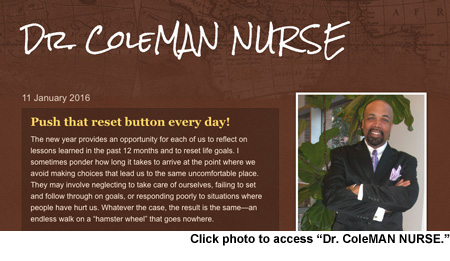
From ‘Dr. ColeMAN NURSE,’ an RNL blog, Push that reset button every day!


Why be content with going nowhere?
By Christopher Lance Coleman


Blog by Christopher Coleman
The new year provides an opportunity for each of us to reflect on lessons learned in the past 12 months and to reset life goals. I sometimes ponder how long it takes to arrive at the point where we avoid making choices that lead us to the same uncomfortable place. They may involve neglecting to take care of ourselves, failing to set and follow through on goals, or responding poorly to situations where people have hurt us. Whatever the case, the result is the same—an endless walk on a “hamster wheel” that goes nowhere.
For me, this past year has brought increased awareness of how quickly time is passing and how easy it is to not make the most of the time we have. I remember my beloved grandmother who firmly believed that taking time for granted is an irreversible mistake. By the time we realize our mistake, we find ourselves on the other side of an event that has disrupted our foundations. Clearly, we cannot stop time or reverse events that have already occurred.
Tragic world events of 2015 remind us all that we cannot take life for granted. Time is a gift we should use for good, not for engaging in unproductive or destructive activities. Perhaps you are among those who pledged at the beginning of 2015 to use your talents and gifts to improve lives around you. Or you made a commitment to exercise more or eat better. If you’re like most, the result has been a mixed bag of successes and failures. The point is, we often find ourselves pivoting away from life-improving goals toward places of familiarity that do not move us forward.


How do we stay engaged in working toward goals that move us forward? We push the reset button every day! Each day, we resolve to be our best, fully committing ourselves to excellence in all we do, whether it’s exercise, work, developing friendships, or nurturing family relationships. Like you, I have learned many lessons over the years. One is, if I don’t take care of myself, I can’t improve the lives of those around me.
As you ponder what you want to accomplish in 2016, remember to invest in yourself so you can be that change agent who positively impacts the lives of others. RNL
Christopher Lance Coleman, PhD, MS, MPH, FAAN, is Fagin Term Associate Professor of Nursing and Multicultural Diversity and associate professor of nursing in psychiatry at the University of Pennsylvania (UPenn) School of Nursing. He is senior fellow in the Center for Public Health Initiatives at UPenn and Institute on Aging Fellows in the Family and Community Health Division, Department of Psychiatry, School of Medicine at UPenn. He is also the author of Man Up! A Practical Guide for Men in Nursing, published by the Honor Society of Nursing, Sigma Theta Tau International.