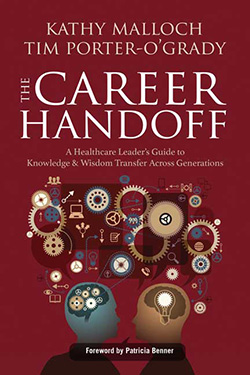
| The career handoff: Intentional sharing of knowledge and wisdom
Chapter from The Career Handoff, an STTI book.
|
| By Kathy Malloch and Tim Porter-O'Grady |
|
This chapter from The Career Handoff: A Healthcare Leader's Guide to Knowledge & Wisdom Transfer Across Generations examines the
critical components of successful communication, transition, handing
off, and succession planning in the healthcare profession.
“Tell me and I forget, teach me and I may remember, involve me and I learn.”
–Benjamin Franklin
 Every
year, Tim and I schedule time for a retreat to plan what we are going
to focus on in the next year. We select a special place where we can
both think and play and do something special. At our latest retreat at
the Ojai Valley Inn & Spa in California, we found ourselves
wondering how many more revisions of our work we could do—and how much
longer our ideas and strategies would be relevant for healthcare
organizations. And then came the even tougher question: What would
happen to our textbooks? Would Quantum Leadership just sail
into the sunset? We humbly wanted the information that would be
meaningful to future generations not to be lost; we did not want future
generations to rediscover what we had already identified and shared.
These questions got us to think about how to hand off our successful
ideas to younger colleagues and selectively discard that which is no
longer relevant. From that conversation, we began to strategize and
learn about how to hand off knowledge and wisdom to younger generations,
and this book is a result of those ideas. Every
year, Tim and I schedule time for a retreat to plan what we are going
to focus on in the next year. We select a special place where we can
both think and play and do something special. At our latest retreat at
the Ojai Valley Inn & Spa in California, we found ourselves
wondering how many more revisions of our work we could do—and how much
longer our ideas and strategies would be relevant for healthcare
organizations. And then came the even tougher question: What would
happen to our textbooks? Would Quantum Leadership just sail
into the sunset? We humbly wanted the information that would be
meaningful to future generations not to be lost; we did not want future
generations to rediscover what we had already identified and shared.
These questions got us to think about how to hand off our successful
ideas to younger colleagues and selectively discard that which is no
longer relevant. From that conversation, we began to strategize and
learn about how to hand off knowledge and wisdom to younger generations,
and this book is a result of those ideas.
We realized from our consulting practices that highly successful
professionals are often reluctant to consider retirement, and many
people avoid the thought of moving away from active engagement with
colleagues in sharing knowledge and wisdom. It is even more challenging
to figure out how to hand off or give one’s intellectual property to
another colleague. As an unprecedented number of baby boomers move
closer to retirement, there is much to share with succeeding
generations. There is also some content or intellectual property that
might not be applicable in future generations. We believe a formalized
process for sharing and designating intellectual property and products
would be helpful to not only our baby boomer colleagues but also to
other generations of colleagues.
The Need for Generational Sharing
Our professional consulting focus has been on the importance of leadership and in helping others to learn as much as possible about leadership—to embrace new ideas to become the most successful leaders possible. Our belief has always been that everyone is a leader, regardless of whether they have a formal leadership title. Whenever two individuals are together, one person begins the dialogue or movement in the simplest way, and leadership is evident. Each one of us has some special knowledge and expertise that future generations should or might want. Creating a culture as well as validating the science that assists others in handing off and nourishing our colleagues with our wisdom is important to both of us. Cultivating a culture of giving to others with minimal expectations of receiving something in return will allow future generations to grow and move on with what is vital to them. Our focus has shifted from figuring out what to give and how to instruct them to “love our stuff” to identifying interested colleagues and turning our work over to them to sort out and retain what is deemed valuable. It is also time for us to get out of the way of future leaders and shift from driving the boat to creating a safe space for others learning how to manage the boat’s journey!
Soon after our retreat, I was invited to keynote a leadership
summit group; my focus was on this topic of generational sharing.
Participants at this meeting included successful professionals from
three generations, including chief executive officers, nurse executives,
consultants, real estate executives, and physicians. As part of the
keynote, I presented the plan Tim and I developed to hand off two of our
books (see the feature that follows) and the discussion began to flow.
Participants were highly interested in learning more and becoming
involved in advancing the science of both giving and receiving
intellectual property and the wisdom of ages.
Reflecting on these ideas, we created a book proposal with the interested retreat participants. We now had a team of wisdom experts to join us on this journey and, most importantly, the authors represented three generations of interested professionals. We realized quickly that the importance of sharing generational wisdom was significant and that there was much interest from younger generations in learning more about our work and how to keep the useful knowledge alive and contemporary. Rather than seeing ourselves as the fading generation, it is time to see ourselves as a generation who now has much to share with the younger generations! We believe we created a talented team of wisdom managers to assist in this work.
Further dialogue with the contributing authors
provided clarification and enhancement of our ideas and solidified the
importance of documenting and sharing generational wisdom, successes,
and strategies that we would not repeat. We believe formalizing this
process and providing guidelines for colleagues will be an important
contribution to professional nursing practice. Each one of our authors
has included specific discussion on what the handoff is, some practical
tips for sharing knowledge, and exemplars to demonstrate personal
experiences (and, of course, some irreverent humor; we all need to laugh
and enjoy the nuances of our journey!).
This book reflects our commitment to professional
coaching, mentoring, and assuring that our young nurses are not chewed
up by the system but are supported proactively. Mentoring is a vital
professional behavior and an ethical obligation to our profession; we
need to nourish our young rather than engage in the proverbial “eating
our young.” In the next section, we share our personal and scholarly
connections to the art and science of mentoring.
Life Journey: Membership in the Profession
Transitions and transformations are a fundamental part of the journey of life. Naturally, as we age and grow, we gather information, skill, insight, and wisdom that accumulate and aggregate in a way that becomes a part of our characters and personalities. As professionals, one of the most important considerations is the responsibility that membership in the nursing profession brings. Who we are and what we are become a part of our professional identity such that our person and profession become one and the same thing (Malloch & Porter-O’Grady, 2010). As we journey through our careers and our lives and are recognized as professional nurses, we essentially become the “person of the nurse.” As professionals, we integrate our work, our relationships, and our individual persona in a way that creates the frame for who we are and provides the substance of the image we present to the world. Consider a notice you might see in a newspaper about the appointment of a position to an administrative or public role—the writer acknowledges the relationship between the person and profession by identifying the particular individual as a “physician.” However, when a nurse is appointed in a similar fashion to an administrative or public role, he or she will more frequently be identified as a “former nurse.” For the physician the identity is singular; for the nurse the same identity is dual (a nurse is a job different from the administrative or public role and, therefore, cannot be identified in singular terms).
“I am not a teacher, but an awakener.”
–Robert Frost
One of the joys of this life journey is the
increased knowledge, insight, and skill we develop as we aggregate
experiences and learning relationships. If we have had an open attitude
in all these arenas, we have been available to the opportunities to
deepen our insights and understandings and broaden our awareness in a
way that helps us develop expertise that advances our talent as
professionals. One of the urges this dynamic generates is the desire to
share and to extend these insights and talents in a way that benefits
others who are also eager for learning and personal development. This
desire to share knowledge and skill is an outgrowth of our own openness
and availability to learning and personal development. Those individuals
who understand this dynamic also recognize that embedded in it is the
give-and-take reflected in the interaction of all who share a commitment
to growing, learning, and deepening their knowledge and understanding.
|
Showing posts with label #goal. Show all posts
Showing posts with label #goal. Show all posts
Monday, June 13, 2016
Taking the Next Steps...Planned Succession

Monday, April 4, 2016
How To Finally Stop Procrastinating (For Real This Time) by Bob Nease, PhD
Note from Nurse Kim:
I found this very interesting. As a strong type A, I hated working in groups because I knew I would have to work with at least one person that thought tomorrow was better than today. Ugh! Anyway these suggestions would have been great to help me motivate, um encourage my teammates when important deadlines were on the horizon.
How To Finally Stop Procrastinating (For Real This Time)
Your brain has a neocortex and a limbic system, and sometimes they fight. Here's how to get them to play nice.
Think about all the stuff you've been putting off—really, go ahead. Chances are you've been putting off thinking about the stuff you've been putting off, right? It's not that you don't think those things are important, or even that you believe they’ll go away if you ignore them. So why are you procrastinating, and how can you stop that?
It Isn't As Bad As You Think
For starters, you probably procrastinate far less than you think. If we stop to think about it, there are lots of things that need to get done that almost always do get done, some way or another: eating when we’re hungry, drinking when we’re thirsty, going to sleep when we’re tired—you get the idea.No one has to nag us to eat, drink, or nap. These are all things that are good for us in the long run. But so are turning that report in on time and changing the oil in the car. In other words, not every beneficial behavior causes us to procrastinate.
There’s only one factor that seems to separate the good behaviors that we do easily from those we routinely put off doing: how good they feel. In other words, we seem to have no problem doing things that are in our our long-term interest as long as they feel good in the here and now. It's only once those behaviors impose upfront effort or unpleasantness that the jig is up. It’s as if all our brains care about is whether something feels good right this moment than whether it will turn out to be good for us later.
This Is Your Brain Procrastinating
And indeed, that's pretty close to the truth, cognitively speaking, and it matters when we get down to figuring out a lasting solution to procrastination. To simplify things slightly (but only slightly), there’s a part of the brain that accurately weighs the benefits of a behavior against its costs. This is your neocortex, and it’s one of the newest and shiniest parts of our brains. Very often, the neocortex comes to quite reasonable conclusions—that, for instance, the benefits of exercising outweigh the costs.But there’s another part of your brain that’s been around for millions of years—the limbic system—and it only seems to care about what’s happening right now. So if a behavior incurs more upfront hassles than upfront benefits, the limbic system isn’t interested in participating.
It's usually only when something that’s good in the long run is also good in the present that these two systems agree with each other. Hungry? Eating seems right to both systems—no problem. When they disagree, the neocortex plays the role of the angel on one shoulder ("Exercise, it’s good for you!") while the limbic system plays the tempting devil ("Relax pal, that exercise sounds like a lot of work").
Things get even more interesting when you look into how the brain works when it's planning on good behavior later. For example, when you’re making a decision about whether to exercise in the future, the limbic system couldn’t care less, and leaves that issue up to the neocortex. But when it actually comes time to make good on that choice, the limbic system is suddenly very interested—and usually not too happy.
The interplay and occasional competition between these two systems explains why we earnestly plan to behave better and just as earnestly put off doing so when the time comes. When it comes to planning, the neocortex calmly notes that the benefits outweigh the costs, while the limbic system takes a nap. And when it comes to doing, the limbic system screams so loudly about the present costs that the neocortex has little chance of pulling through.
How To Help Your Neocortex Help You
So how can you give your neocortex a leg up over a recalcitrant limbic system in order to break the cycle of procrastination? Try these three strategies.1. Outsource the upfront hassles of a beneficial behavior. Sometimes it's easy: If you're always late paying your utility bill because it just never makes it to the top of your to-do list, sign up for automatic billing. Ditto when it comes to saving for retirement. The more routines and processes you don't look forward to that you can automate, do it.
2. Change the present-day stakes. Remember: As far as one really powerful part of your brain is concerned, it’s all about the present. Make the right behavior more attractive in the here and now, and the tempting but undesirable choice less so. For example, to boost your chances of exercising, listen to music while you work out, join a group that exercises together, or play a sport where your team relies on you. That way the beneficial behavior—exercise—becomes a side effect of something inherently fun. You can also try to make a contract with a friend that will force you to pay a penalty each time you fail to engage in the behavior you desire. Don't want to enlist a friend? Just download an app like stikK, Pact, or Beeminder.
3. Aim low, then ramp up. Reduce the upfront cost of doing the right thing by scaling back the immediate goal a little bit at first. For example, if your plan is to run four miles, and you’re having a tough time rolling out of bed and hitting the pavement, focus instead on running just two. That can increase the likelihood that you’ll get started and decrease the amount of pain you'll experience that might make you fall short. You’ll also find that once you’ve started down the path, re-upping the goal (a couple extra miles after the two you committed to) will be a lot easier.
Bob Nease, PhD, is the former chief scientist of Express Scripts, and the author of The Power of Fifty Bits: The New Science of Turning Good Intentions into Positive Results (HarperCollins) as well as over 70 peer-reviewed papers.
Monday, March 14, 2016
Healthy Nurse and Your Weight Goals
How long have you dreamed of losing weight and
keeping it off—of what it would feel like to be healthier and have more
energy for your nursing job and your personal life?
University of Maryland nursing researchers found 55% of nurses surveyed were overweight or obese. For many nurses, weight loss remains an elusive dream that never becomes a reality. Weight loss and weight management can drive you up the wall and down the other side. It’s easy to slip into negativity and end up sabotaging yourself. To stop struggling with your weight, you need to know the three critical factors for unpacking the pounds that weigh you down, and create a list of priorities to help you manage your weight.
The third major factor contributing to overweight is fear: Fear of disappointing others if you don’t take care of their needs first. Fear of having to give up your favorite comfort foods on a diet. Fear of committing your time and energy to weight loss. Fear of failing to lose weight. Fear of losing weight but gaining it back.
Fear is an emotional trap that holds you back from a healthier weight. A nurse wrote to me about how her fear, challenging work environment, and Type E personality contributed to her weight gain. She explained, “Since I was a child, I’ve never been somebody who could easily put myself before other people. I can read other people well and adjust my behavior to please them and get their needs met….As a nurse, I have a difficult time setting boundaries. ‘Sure, I can pick up the 12-hour shift after working my own shift. Take care of an extra patient? No problem!’ It doesn’t stop there. It carries over to my second shift of responsibilities when I get home, taking care of my family’s needs. The result is I constantly feel overwhelmed and burnt out, and I eat unhealthy comfort food to ease my stress…I’ve always sabotaged myself when I try to lose weight because of my fear of failure, caused by my yo-yo dieting over the years and my fear that if I give up comfort foods, I won’t be able to cope with my stress.”
Sound familiar?
These patients transform their lives by being fully committed to integrating what I call their N.E.W. priorities. You can apply the hard lessons they’ve learned to help rise above your own weight-management struggles. To manage your weight, reconnect with yourself and be the person you were meant to be.
N stands for Nurturing self-care
E stands for Exercise, nutrition, and sleep
W stands for Work empowerment.
Managing your weight successfully means integrating these priorities into your life. It doesn’t mean you should make weight an obsession.
Here are two examples of nurses who lost weight by integrating
self-care, exercise, nutrition, and proper sleep into their lives. When
her granddaughter was born, Kim, age 45, started thinking about her
weight and the things she might miss out on if she didn’t lose weight.
She didn’t want to be a grandmother who couldn’t play with her
grandchild, so after years of yo-yo dieting, she set out to create a
healthier lifestyle by nurturing herself and integrating daily exercise,
healthier nutrition, and plentiful sleep. She implemented her “Couch to
5K Plan” by jogging 3 miles several times a week and lifting weights.
She lost 150 lb.
Josephine, a trauma nurse, also lost 150 lb—and has kept it off for 2 years. She started eating healthier and taking Zumba (dance fitness) lessons. Eventually she became a Zumba instructor. She went from viewing healthy living as a punishment to seeing it as a form of enjoyment.
An overweight nurse complained to me about her unhealthy eating
habits, but wouldn’t take responsibility for them. I asked her, “Who
does the grocery shopping in your family?” She replied, “I do.” “Who
does the cooking?” She replied, “I do.” “And who puts the unhealthy food
in your mouth?” She said, “I do.” Then I asked, “So whose
responsibility is it that you eat an unhealthy diet?” Without hesitation
she replied, “It’s my husband’s fault because he drives me crazy!”
While this story makes you laugh, it also drives home the point that we
all need to take responsibility for our actions—including those that
jeopardize weight management.
You become what you believe. Choose to believe you can make a shift toward healthier weight management by modeling the N.E.W. priorities of patients who’ve transformed their lives.
Gary Scholar is a health and wellness consultant, wellness coach, speaker, and author of Fit Nurse: Your Total Plan for Getting Fit and Living Well.

University of Maryland nursing researchers found 55% of nurses surveyed were overweight or obese. For many nurses, weight loss remains an elusive dream that never becomes a reality. Weight loss and weight management can drive you up the wall and down the other side. It’s easy to slip into negativity and end up sabotaging yourself. To stop struggling with your weight, you need to know the three critical factors for unpacking the pounds that weigh you down, and create a list of priorities to help you manage your weight.
Getting unstuck
The first critical factor that keeps you stuck at the same number on the scale is the emotional and physically demanding nature of your job. For many nurses, the second factor is the huge disconnect between overperforming in your job and underperforming when it comes to your own self-care. This disconnect stems from what I call the Nurse Type E Personality—you do Everything for Everybody, ignoring your own needs.The third major factor contributing to overweight is fear: Fear of disappointing others if you don’t take care of their needs first. Fear of having to give up your favorite comfort foods on a diet. Fear of committing your time and energy to weight loss. Fear of failing to lose weight. Fear of losing weight but gaining it back.
Fear is an emotional trap that holds you back from a healthier weight. A nurse wrote to me about how her fear, challenging work environment, and Type E personality contributed to her weight gain. She explained, “Since I was a child, I’ve never been somebody who could easily put myself before other people. I can read other people well and adjust my behavior to please them and get their needs met….As a nurse, I have a difficult time setting boundaries. ‘Sure, I can pick up the 12-hour shift after working my own shift. Take care of an extra patient? No problem!’ It doesn’t stop there. It carries over to my second shift of responsibilities when I get home, taking care of my family’s needs. The result is I constantly feel overwhelmed and burnt out, and I eat unhealthy comfort food to ease my stress…I’ve always sabotaged myself when I try to lose weight because of my fear of failure, caused by my yo-yo dieting over the years and my fear that if I give up comfort foods, I won’t be able to cope with my stress.”
Sound familiar?
Patients as role models
To rise above the factors that stymie successful weight management, think of the ill patients you’ve known who’ve successfully transformed their lives. Have you ever witnessed how illness seems to give some patients a new lease on life, how it gives them a strong sense of priorities and clarifies what’s really important? Suddenly they feel more alive and engaged, as if they’ve been given a second chance. Illness forces them to take a hard look at their past, present, and future. It gives them a chance to reconnect with themselves and be the person they were meant to be by rising above their fears, procrastination, and skewed priorities.These patients transform their lives by being fully committed to integrating what I call their N.E.W. priorities. You can apply the hard lessons they’ve learned to help rise above your own weight-management struggles. To manage your weight, reconnect with yourself and be the person you were meant to be.
The N.E.W. approach
To kick-start your weight-management campaign, you need to fully commit to your N.E.W. priorities and set specific goals in line with them. The N.E.W. approach centers on what I call the weight-management triage list:N stands for Nurturing self-care
E stands for Exercise, nutrition, and sleep
W stands for Work empowerment.
Managing your weight successfully means integrating these priorities into your life. It doesn’t mean you should make weight an obsession.
N: Nurturing self-care
When patients commit to transforming themselves to be healthier, they put nurturing self-care at the top of their priorities. Nurturing self-care helps you rise above your Type E personality and conquer your fear by helping you see that you deserve to succeed in managing your weight so you’ll be healthier.E: Exercise, nutrition, and sleep
Daily exercise, healthy nutrition, and proper sleep are essential for ill patients hoping to regain their health. Similarly, to manage your weight, you need to integrate these three elements into your lifestyle. (See Power grocery shopping below.)
Power grocery shoppingOn your next shopping trip, use these tips to help fill your cart with healthy food choices.
|
Josephine, a trauma nurse, also lost 150 lb—and has kept it off for 2 years. She started eating healthier and taking Zumba (dance fitness) lessons. Eventually she became a Zumba instructor. She went from viewing healthy living as a punishment to seeing it as a form of enjoyment.
W: Work empowerment
When patients return to work after an illness, one of their priorities is to be assertive in getting their needs met and creating a supportive work environment. Otherwise, stress and an unhealthy environment could negatively affect their health and well-being. The same is true for you as a nurse trying to integrate healthier weight management into your daily life. To become more empowered and promote your own and your colleagues’ weight-management efforts, advocate for effective support initiatives in your workplace. (See Workplace strategies that promote weight management below.)
Workplace strategies that promote weight managementNurse administrators and managers might want to consider implementing the following strategies to help staff nurses manage their weight.“Let’s do lunch” initiativesQuality-time meal breaks can promote healthy eating. Too many nurses skip meals because they are busy or feel guilty taking time out to eat. But when you skip a meal, your blood glucose level drops and your metabolism shuts down (what I call “nurse glycemia”). As a result, you go into your next meal famished and eat more than you should.Quick, healthy food choicesNurses need quick, healthy food choices. Providing onsite healthy snack carts at nurses’ stations can help you sustain your energy level by maintaining adequate blood glucose levels throughout your shift.Wellfood cafeteriaTransforming unhealthy hospital cafeterias to wellfood cafeterias makes healthier foods available to shift nurses. Wellfood cafeterias also can serve as healthier-nutrition outreach models for patients and the family members and friends who visit them.Healthy food zonesTo create a healthy food zone, encourage workers, patients, and visitors to only bring healthy foods to the hospital.Fitness activitiesOnsite yoga, tai chi, and Zumba classes can help nurses raise their endorphin levels, metabolism, and energy levels, which in turn aids weight-loss efforts.Chair massagesStress can cause unhealthy comfort-food eating. A chair massage program, where nurses can get a 10-minute chair massage several days a week, can reduce stress.Education on adapting to long shift hoursTopics might include how to integrate meals into the shift, the best foods to eat during long shifts, the most effective types of exercise for shift workers, and how to create proper sleep patterns.Emotional support programsWhen a patient dies, many nurses “suck up” their emotions. This can exacerbate stress, which can cause nurses to pack on the pounds. Instituting an emotional support program can help reverse this trend. In one hospital’s pilot program, when a cancer patient died, the charge nurse conducted an emotional needs assessment of that patient’s nurse. The nurse was permitted to take 20 minutes off to meet with an “emotional support” nurse—a nurse who volunteered to provide emotional support to colleagues on that unit. |
You become what you believe. Choose to believe you can make a shift toward healthier weight management by modeling the N.E.W. priorities of patients who’ve transformed their lives.
Gary Scholar is a health and wellness consultant, wellness coach, speaker, and author of Fit Nurse: Your Total Plan for Getting Fit and Living Well.
Monday, March 7, 2016
RN and a Healthy Lifestyle

As nurses, we know how to check blood pressure, administer medications, and counsel patients about healthy living. But let’s face it—some of us don’t practice what we preach. At the end of a long shift taking care of others, we sometimes fail to take the best care of ourselves.
It doesn’t have to be that way. Take it from me—a busy practicing nurse, chief executive officer of a women’s website, a wife, and the mom of a 1-year-old boy: You can fit healthy habits into your life. You just have to want to. And once you do, you’ll see how much better you feel, physically and emotionally. As a bonus, exercise and healthy eating habits improve your cardiovascular health—a major concern as we age. (Heart disease is the #1 killer of women.) If improving your own health and well-being isn’t reason enough, keep in mind that getting healthier can help you take even better care of patients.
The power of exercise: Working out your body and your stress
I learned at a young age I’m not one of those women who can eat whatever they want and stay thin. I also discovered I can’t simply cut calories to lose weight; I need to exercise, too. For weight and overall fitness, I can’t stress enough the importance of physical activity. As a country, we exercise more today than we did 10 years ago—yet obesity rates are higher than ever. Why? Researchers suggest diet and other lifestyle changes are also components to maintaining a healthy weight.Most people need to exercise (and eat well) to keep weight off and stay fit. The American Heart Association recommends at least 150 minutes of moderate exercise or 75 minutes of vigorous exercise each week, or a combination. This comes to at least 30 minutes, 5 days a week—a good goal.
What form of exercise is right? Like me, you might want to mix up your workouts to keep your mind and body challenged. I run one day, do kickboxing the next, and go to boot camp the next. (Kickboxing and boot camp are great ways to relieve work stress, by the way.) I also do strength training a few times a week.
To stay motivated, I exercise with friends. It’s much harder to make excuses for skipping an exercise session when you know others are counting on you. Once you show up, friends will push you to give it your all. I run with a group of 40+ moms every Saturday morning. Last year, I trained with the group and completed a half-marathon and three triathlons. Running is a great therapy session, too. One of us might say, “Hey, I’ve been having this problem at work”—and get great feedback from friends while running.
During the week, I fit my workouts in early—at 5:30 in the morning, while my husband stays home with the baby. He gets his turn to work out at night. It’s all about juggling and balancing your schedule to fit exercise into your life.
Nurse Nutrition 101
I plan my meals ahead of time. Healthy eating is crucial to controlling weight and promoting cardiovascular health. Research has deemed the Mediterranean diet a winner for a healthy heart. With this diet, you consume a lot of vegetables, fruits, beans, whole grains, and olive oil, plus a weekly intake of fish as the primary protein—but very little red meat or other sources of saturated fat.To follow both the Mediterranean diet and U.S. nutritional guidelines, try to eat fish high in omega-3 fatty acids, such as tuna, salmon, or mackerel, at least two or three times a week. As an added bonus to its heart-healthy benefits, fish may improve brain function and fight depression. (And in nursing, we all know the power of a clear head and a positive mood.)
Here are more nutrition tips:
- Always eat breakfast. To be on your feet all day taking care of patients, you need the proper fuel. I never miss breakfast. My regular breakfast is instant, high-fiber maple oatmeal with walnuts. If I go out for breakfast, I order an egg-white omelet with cheese and ham.
- Keep healthy snacks with you at all times. Unless you plan ahead, a busy shift can leave you reaching for the worst convenience foods. Mix a pouch of tuna with low-fat Greek yogurt topped with avocados (hold the mayo). Sprinkle this over your lunch salad or make a sandwich packed with super foods. Also, I never leave home without an apple, yogurt, an energy bar, and a package of almonds.
- Don’t set yourself up for a binge. Fight the urge for a peanut-butter cup. If my sweet tooth beckons, I give in—but just a little. If I really feel as if I need something sweet, a few Twizzlers or Swedish fish usually do the trick. (Editor’s note: If you work shifts, read “Nutrition for night-shift nurses” for more ideas on how to eat healthy.)
No need for extremes
You don’t have to go on an extreme fad diet or exercise 3 hours a day to become a model of health for your patients. Healthy living isn’t hard. Go online and bookmark webpages that offer tools on how to eat right and maintain a healthy lifestyle. If you incorporate small, enjoyable steps into your life, before long you’ll see a real difference in how well you work and play.Click here for a list of selected references.
Beth Battaglino is the chief executive officer of Healthywomen.org, a nonprofit organization providing objective, in-depth, medically approved information on a broad range of women’s health issues. In addition to her BSN, she holds degrees in political science, business, and public administration from Marymount University (Virginia) and the University of Oklahoma. Ms. Battaglino currently serves as an educational consultant to the National Fisheries Institute, a nonprofit organization that offers a health-focused website with fish tips and recipes.
Monday, February 29, 2016
Mindful Nursing
Mind/Body/Spirit
Mindfulness is an increasingly common topic in both popular and professional literature. In clinical populations, evidence suggests mindfulness-based interventions (MBIs) can reduce symptoms linked to various conditions, including cardiovascular disease, cancer, and depression. Among healthcare professionals, mindfulness training can reduce psychological and physiologic stress, emotional distress, and burnout while improving empathy, job satisfaction, and sense of well-being. This article gives an overview of mindfulness and MBIs and discusses how mindfulness practices can benefit nurses both personally and professionally.
What exactly is mindfulness? It’s the capacity to intentionally bring awareness to present-moment experience with an attitude of openness and curiosity. It’s being awake to the fullness of your life right now, by engaging the five senses and noticing the changing landscapes of your mind without holding on to or pushing away what you’re experiencing.
Being mindful doesn’t mean stopping your mind from thinking or trying to be relaxed and peaceful. Nonetheless, many people who practice mindfulness regularly report feeling more calm and clearheaded. You can develop the ability to be more mindful in everyday life through mindfulness meditation and other mindfulness practices.
Living on automatic pilot
Throughout our lives, we develop beliefs, judgments, and habitual thinking patterns that may result in living in an automatic or habit-driven way. Many of us are on “automatic pilot,” with our bodies operating in a routine pattern while our minds are somewhere else—usually anticipating future events or ruminating over something that has happened. This “mindless” way of living can limit how we experience life, the choices we make, and the quality of our relationships. It also can exacerbate feelings of stress.Mindfulness practices can help us recognize mental habits that limit our understanding of something or restrict our options for action. Consider, for example, how negative self-talk can grip your attention and circle in your mind like a hamster in a wheel. By being able to notice when your mind is engaged in these common but unhelpful thinking patterns, you can bring attention to the feeling of the breath as it’s moving in and out of your body or noticing the physical sensations of your body as it is right now. This intentional shifting of the mind to present-moment experience can help interrupt stressful thinking and may enhance your sense of calm and centeredness.
How does mindfulness work?
The mind is busy. It constantly processes memories and plans, rehashes past events, and takes in and processes information from the senses and internal body. At the same time, it orchestrates the activities that allow us to function in daily life. The mind also must respond to the challenge of our ever-expanding and complex technological environment, which bombards us with a relentless stream of information from electronic devices and social media—increasing our mental distraction and stress.Neuroscience research shows mindfulness training can enhance the brain regions responsible for attention and executive function (problem-solving and intentional action) while modulating the amygdala, the brain area that identifies threats and triggers such emotional responses as fear and anger. Mindfulness practices can enhance your ability to pay attention and notice what’s actually happening, particularly in stressful situations. This ability to notice attentively and see situations more clearly can help you respond thoughtfully rather than react. This has particular relevance for nurses in terms of self-care and optimal care of patients.
Learning to be more mindful
In 1979, Jon Kabat-Zinn at the University of Massachusetts Medical School developed the seminal mindfulness training program known as mindfulness-based stress reduction (MBSR), in an attempt to reduce suffering in patients with chronic pain. This highly structured, 8-week group program includes training in exercises to increase the capacity to be more mindful. Core mindfulness practices in the MBSR program include the body scan (learning to mentally tune in to body sensations), gentle yoga (moving the body with attention and kindness), and breath awareness (focusing on the sensations and experience of breathing). Research examining the effects of MBSR training found significant improvements in the health and well-being of participants with various medical conditions.Hundreds of hospitals, universities, and community settings across the country and around the world offer MBSR training. Also, MBSR and other related MBIs have been developed to target specific nonclinical populations, such as business leaders, professional sports teams, schoolteachers, and students. Instructional books, websites, compact discs, and personal device applications are available to help people learn more about mindfulness practices.
Mindfulness and nursing
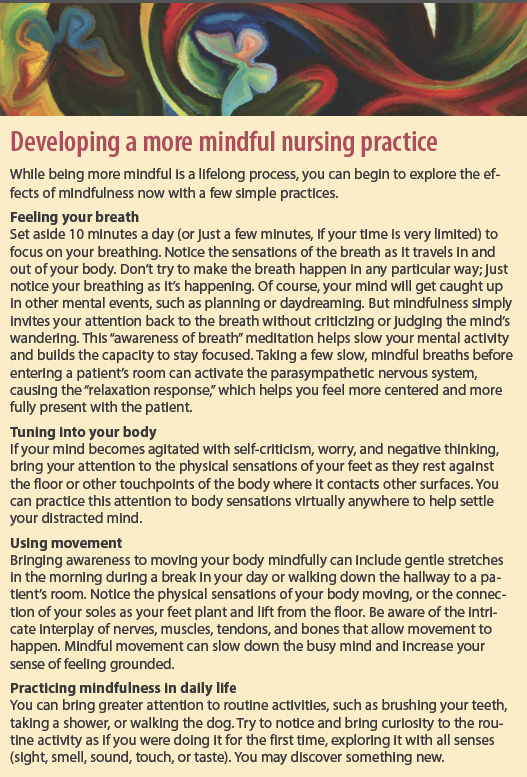
How can mindfulness help nurses? Greater awareness and less distraction in the clinical setting can improve your assessment skills (for instance, allowing you to identify subtle changes in a patient’s condition) and your performance of complex technical procedures that may reduce the risk of clinical errors. Mindfulness can enhance your communication with patients and other healthcare team members by bringing a greater awareness to how and what others are communicating. Listening and speaking with greater attention can lead to more effective communication and better clinical outcomes, particularly in crisis situations.Moreover, research shows mindfulness training can help nurses cope more effectively with stress and reduce the risk of professional burnout. One randomized, controlled trial of nurses found those who participated in an 8-week mindfulness training program had significantly fewer self-reported burnout symptoms, along with increases in relaxation, mindfulness, attention and improved family relations, compared to nurses in a control group. (See Developing a more mindful nursing practice.)
Wiser and more compassionate care
Mindfulness is a way of living with greater attention and intention and less reactivity and judgment. You can learn and develop mindfulness through regular mindfulness practices. Consider integrating mindfulness into your self-care plan to reduce stress and minimize burnout.Being more mindful and bringing receptivity to whatever is happening can deepen your understanding of clinical situations, relationships with colleagues, and ultimately yourself. With this understanding comes the possibility of providing wiser and more compassionate care for your patients and yourself.
Lois C. Howland is an associate professor at the University of San Diego and a senior teacher at the Center for Mindfulness at the University of California, San Diego. Susan Bauer-Wu is the director of the Compassionate Care Initiative and the Tussi & John Kluge Endowed Professor in Contemplative End-of-Life Care at the University of Virginia School of Nursing in Charlottesville.
Monday, February 15, 2016
4 health benefits of reading
Read this: 4 health benefits of reading
Health News Team

Michelle Milles, behavior change expert and wellness coach for Sharp Health Plan, says this should not be the case. “Reading can provide a healthy distraction from life’s day-to-day worries and pressures, while at the same time, making us smarter, happier and even more empathetic toward others.”
These studies show why you should incorporate reading into your daily routine:
Keeps your brain from slowing down
A 2013 study by Rush University Medical Center discovered that adults who spent their free time in intellectual activities such as reading or puzzling experienced a 32 percent slower rate of cognitive decline.
Relieves stress
In a 2009 British study at Sussex University, researchers asked participants to engage in an anxiety-filled activity and then either read, listen to music or play video games for six minutes. The stress levels, heart rate and muscle tension of those who read dropped 68 percent — more than any of the other activities.
Can lessen depression
A University of Manchester analysis published in 2013 showed people with severe depression benefited from low-intensity interventions, such as reading self-help books and interactive websites. Also, an additional study published in PLOS ONE demonstrated that patients who read self-help books in combination with traditional therapy sessions for a year lowered their depression level than those who only sought standard treatment.
Helps stave off Alzheimer’s disease
Like any organ, the brain needs activity to remain strong. In a study published in the journal Proceedings of the National Academy of Sciences, researchers determined adults who engage in brain-based activities like reading are less likely to be diagnosed with Alzheimer’s disease.
Milles offers three ways to build reading into your schedule:
Start a book club at work
Milles suggests bringing the benefits of reading into your work. “In addition to building camaraderie and teamwork among employees, a book club can improve relationships between staff across different departments, encourage continuous learning and offer all employees the opportunity to practice leadership roles by leading the book club. It can also contribute to overall employee satisfaction, motivation and retention,” she says.
Ditch the eReader at night
In a 2014 study, researchers found that evening use of eReaders negatively affected sleep patterns, circadian timing and next-morning alertness. It’s best to use a small light next to the bed and a hard-copy book to rid yourself of the disruptive light from electronic devices.
Try reading for 15 minutes before work
It will help you start your morning focused and prepare you for the rest of your day.
Thursday, January 21, 2016
From ‘Dr. ColeMAN NURSE,’ an RNL blog, Push that reset button every day!
|
Why be content with going nowhere?
|
| By Christopher Lance Coleman |
 The new year provides an opportunity for each of us to reflect on lessons learned in the past 12 months and to reset life goals. I sometimes ponder how long it takes to arrive at the point where we avoid making choices that lead us to the same uncomfortable place. They may involve neglecting to take care of ourselves, failing to set and follow through on goals, or responding poorly to situations where people have hurt us. Whatever the case, the result is the same—an endless walk on a “hamster wheel” that goes nowhere.  For
me, this past year has brought increased awareness of how quickly time
is passing and how easy it is to not make the most of the time we have. I
remember my beloved grandmother who firmly believed that taking time
for granted is an irreversible mistake. By the time we realize our
mistake, we find ourselves on the other side of an event that has
disrupted our foundations. Clearly, we cannot stop time or reverse
events that have already occurred. For
me, this past year has brought increased awareness of how quickly time
is passing and how easy it is to not make the most of the time we have. I
remember my beloved grandmother who firmly believed that taking time
for granted is an irreversible mistake. By the time we realize our
mistake, we find ourselves on the other side of an event that has
disrupted our foundations. Clearly, we cannot stop time or reverse
events that have already occurred.
Tragic world events of 2015 remind us all that we cannot take
life for granted. Time is a gift we should use for good, not for
engaging in unproductive or destructive activities. Perhaps you are
among those who pledged at the beginning of 2015 to use your talents and
gifts to improve lives around you. Or you made a commitment to exercise
more or eat better. If you’re like most, the result has been a mixed
bag of successes and failures. The point is, we often find ourselves
pivoting away from life-improving goals toward places of familiarity
that do not move us forward.
How do we stay engaged in working toward goals that move us
forward? We push the reset button every day! Each day, we resolve to be
our best, fully committing ourselves to excellence in all we do, whether
it’s exercise, work, developing friendships, or nurturing family
relationships. Like you, I have learned many lessons over the years. One
is, if I don’t take care of myself, I can’t improve the lives of those
around me.
As you ponder what you want to accomplish in 2016, remember
to invest in yourself so you can be that change agent who positively
impacts the lives of others. RNL
Christopher Lance Coleman, PhD,
MS, MPH, FAAN, is Fagin Term Associate Professor of Nursing and
Multicultural Diversity and associate professor of nursing in psychiatry
at the University of Pennsylvania (UPenn) School of Nursing. He is
senior fellow in the Center for Public Health Initiatives at UPenn and
Institute on Aging Fellows in the Family and Community Health Division,
Department of Psychiatry, School of Medicine at UPenn. He is also the
author of Man Up! A Practical Guide for Men in Nursing, published by the Honor Society of Nursing, Sigma Theta Tau International.
|
Subscribe to:
Posts (Atom)