Showing posts with label #mindfulness. Show all posts
Showing posts with label #mindfulness. Show all posts
Thursday, April 12, 2018
Adapting to Overnight Shifts: 5 Common Mistakes and How to Avoid Them
Adapting to Overnight Shifts: 5 Common Mistakes and How to Avoid Them
Mar 30, 2018 | Blog, Minority and Community Health
Working overnight shifts is a big change for many nurses, but it’s also extremely common. With the 24-hour demands of the bustling, modern health care system, there’s a good chance you’ll have to work the night shift at some point in your career, especially when you’re starting out. But don’t fret! There are many ways to ensure that the transition from day to night goes as smoothly as possible.
All nurses need to be on their A-game with technical medical skills and emotional resilience no matter what time of day they’re working. Night shift nurses have to shoulder even more burdens because they often work mostly or entirely alone for their shift. While there’s no one “right” way to adapt to the night shift, there are several common mistakes that you’ll want to avoid to build good habits.
Common Mistakes to Avoid When Switching to the Night Shift
Going against your circadian rhythm is no small task. However, resorting to quick fixes will only make your shifts more difficult in the long run. Avoid these five common mistakes and you’ll adapt to the swing of a night shift quickly.
1. Not getting enough rest before starting a shift.
As a nurse, it’s important to always be sharp on the job. The staff at Gurwin Jewish Nursing and Rehabilitation Center emphasize that not getting enough rest is the number one mistake that new night shift workers make, and it’s one of the most dangerous. Since shifts are often upwards of eight hours long, there’s no safe way to “power through” on too little sleep. This goes for both on-shift work and driving when sleep-deprived.
How to Avoid It:
Install blackout curtains where you sleep and get a fan or white noise generator.
Turn off your phone, get a “Do Not Disturb” sign, and inform loved ones of your schedule.
Staying up for a few hours to relax and take care of yourself may be easier for some nurses than going straight to bed at the end of a shift. You’ll figure out what works for you with time, so don’t be afraid to experiment.
Take proper care of your legs and feet while on your shift, so you won’t be troubled by pain or soreness when you’re trying to sleep.
Light soothing candles and practice stretches to relax yourself before bed.
2. Leaning on sugary foods, alcohol, or caffeine instead of proper nutrition.
It can be tempting to snack on chocolate or chug coffee to keep yourself going through your night shift. Keep in mind that, if consumed in excess, coffee can lead to jitters at first, followed by a crash. You’ll be far better off if you instead focus on getting more sleep.
How to Avoid It:
Plan and pack your meals ahead of time to avoid relying on vending machines.
Schedule your heavy meals so they won’t interfere with sleep.
3. Letting your personal life fall into disorder.
Sometimes it’s hard to keep your personal life in order while working the night shift. Errands, social gatherings, and childcare all battle for your attention when you’re not at work. This reduces your ability to get good sleep and, in turn, to focus at work.
How to Avoid It:
Yoga and meditation help you relax and leave work behind so you can be present when you’re engaging with family or friends.
Establish a schedule for sleep, chores, and activities. This will reduce the stress of missing out on things.
Plan gatherings ahead of time with friends and family to ensure you can make it to fun gatherings.
4. Not asking for help or feeling like you have to “do it all.”
Yes, there are fewer resources available overnight at the hospital. This can lead to superhero-esque thinking, where you refuse or even genuinely forget to ask for help. Being honest about needing a hand is better than dropping the ball because you’re juggling while tired.
How to Avoid It:
Get to know the others who work nights so you can trade favors.
Get to know the resources available to you during your shift.
Ensure that your roommates or family are sharing the load with you at home.
Choose sleep over chores when possible at home. Others can help you with chores, but they can’t sleep for you!
5. Missing out on workplace bonding, training, or resources due to night shifts.
It’s easy to feel forgotten when working the night shift. Try not to miss out on opportunities for bonding, continuing education, or extra support because of your schedule. It can be hard to make time or schedule changes for these opportunities, but they’re integral to your career development down the line.
How to Avoid It:
Check announcement boards and learn about opportunities available at your workplace.
Make it known to your boss and coworkers that you’re interested in additional training, support, resources or team bonding even if you work the night shift.
Ask if there are online resources available for any opportunities that you simply cannot attend.
Your job as a nurse is important. Don’t let working the night shift get in the way of providing the best care possible to your patients and yourself. Getting enough sleep is integral to your job performance and personal health, but that’s not always enough. You also need to make sure you’re practicing good self-care and focusing on your health along the way. With these great tips, you’ll adapt to the night shift in no time!
Deborah Swanson is a medical office professional with two decades of experience helping small practices and large hospitals alike improve efficiencies. She recently started consulting with allheart.com providing insight into the daily activities of medical professionals and how best to serve them.

Monday, May 23, 2016
Celebrating Nurses with a Little Bit of Poetry
IF MY
STETHOSCOPE COULD TALK
by Kimberley
Ensor, MSN, RN
If my stethoscope could talk what
would it say about me today?
Would it say that I rushed
through my assessment so I could scope out a place at the nurses’ station?
Would it say that I was thorough
or going through the motions?
Did I just kill time until break?
Lunch? End of my shift?
What would my stethoscope say?
If my stethoscope could talk how
would my listening skills be evaluated?
Did I actually hear my
patient? When medications were refused
or when the patient expressed they had enough, would I actually listen?
As my stethoscope moved across
their body, did I notice a change that needed to be addressed in the plan of care
or did I just do business as usual?
Was I listening to my patient and
their family members’ concerns or did I just perform lip service as from a
script.
What would my stethoscope say?
If my stethoscope could talk
would it say that I had my eyes open as I took care of my patient?
Did I completely understand the
physician’s orders? When my patient
addressed me did I provide eye contact or was I too busy looking at monitors
and equipment?
Did I notice something and speak
up as an advocate for my patient or did I leave it for the next shift to
handle?
What would my stethoscope say?
If my stethoscope could talk
would it say I half-heartedly gave education and explanations about
medications?
Would what I speak actually come
from a desire to be a help to my patient or just to look good as an authority
figure?
Did I form my words to be culturally sensitive or did I disregard my
patient’s views, beliefs and preferences?
When I spoke to colleagues or
interacted with the multi-disciplinary staff was I a source of encouragement.
Did I include my unit assistants
in the plan of care for the patient? Did
I recognize my charge nurse as a valuable resource? Did I appreciate my unit clerk for their
invaluable help?
What would my stethoscope say?
If my stethoscope could talk,
would it say that I am an example of patient centered care?
Did my care come from my passion
to be a nurse or am I just hanging around for a paycheck?
Did my body language speak I care
about you or was I stand offish and couldn’t be bothered?
Was I first to the room when an
IV or bed alarm sounded or did I say ‘that’s not my patient and turn a deaf ear
and go about my day?
Did I make myself available to my
colleagues, to my patient or was I nowhere to be found during busy periods?
Did I take a moment to step
outside and let the sun touch my skin, reminding me of why I wanted to be a
nurse in the first place?
What would my stethoscope say?
My stethoscope would say,
I bring my joy and positive
spirit with me each time I step on the unit.
It would say I strive to listen
with open ears and see with both eyes.
It would say I try to be an asset
to my unit and an instrument of excellent care.
It would say I utilize evidence
based practices when answering patient questions and use simple languages.
It would say I work daily to be
an advocate, a hand to hold, and an empathetic ear.
My stethoscope would say I am a
nurse and I put my heart into everything I do.
I wear my stethoscope with pride.
Monday, February 29, 2016
Mindful Nursing
Mind/Body/Spirit
Mindfulness is an increasingly common topic in both popular and professional literature. In clinical populations, evidence suggests mindfulness-based interventions (MBIs) can reduce symptoms linked to various conditions, including cardiovascular disease, cancer, and depression. Among healthcare professionals, mindfulness training can reduce psychological and physiologic stress, emotional distress, and burnout while improving empathy, job satisfaction, and sense of well-being. This article gives an overview of mindfulness and MBIs and discusses how mindfulness practices can benefit nurses both personally and professionally.
What exactly is mindfulness? It’s the capacity to intentionally bring awareness to present-moment experience with an attitude of openness and curiosity. It’s being awake to the fullness of your life right now, by engaging the five senses and noticing the changing landscapes of your mind without holding on to or pushing away what you’re experiencing.
Being mindful doesn’t mean stopping your mind from thinking or trying to be relaxed and peaceful. Nonetheless, many people who practice mindfulness regularly report feeling more calm and clearheaded. You can develop the ability to be more mindful in everyday life through mindfulness meditation and other mindfulness practices.
Living on automatic pilot
Throughout our lives, we develop beliefs, judgments, and habitual thinking patterns that may result in living in an automatic or habit-driven way. Many of us are on “automatic pilot,” with our bodies operating in a routine pattern while our minds are somewhere else—usually anticipating future events or ruminating over something that has happened. This “mindless” way of living can limit how we experience life, the choices we make, and the quality of our relationships. It also can exacerbate feelings of stress.Mindfulness practices can help us recognize mental habits that limit our understanding of something or restrict our options for action. Consider, for example, how negative self-talk can grip your attention and circle in your mind like a hamster in a wheel. By being able to notice when your mind is engaged in these common but unhelpful thinking patterns, you can bring attention to the feeling of the breath as it’s moving in and out of your body or noticing the physical sensations of your body as it is right now. This intentional shifting of the mind to present-moment experience can help interrupt stressful thinking and may enhance your sense of calm and centeredness.
How does mindfulness work?
The mind is busy. It constantly processes memories and plans, rehashes past events, and takes in and processes information from the senses and internal body. At the same time, it orchestrates the activities that allow us to function in daily life. The mind also must respond to the challenge of our ever-expanding and complex technological environment, which bombards us with a relentless stream of information from electronic devices and social media—increasing our mental distraction and stress.Neuroscience research shows mindfulness training can enhance the brain regions responsible for attention and executive function (problem-solving and intentional action) while modulating the amygdala, the brain area that identifies threats and triggers such emotional responses as fear and anger. Mindfulness practices can enhance your ability to pay attention and notice what’s actually happening, particularly in stressful situations. This ability to notice attentively and see situations more clearly can help you respond thoughtfully rather than react. This has particular relevance for nurses in terms of self-care and optimal care of patients.
Learning to be more mindful
In 1979, Jon Kabat-Zinn at the University of Massachusetts Medical School developed the seminal mindfulness training program known as mindfulness-based stress reduction (MBSR), in an attempt to reduce suffering in patients with chronic pain. This highly structured, 8-week group program includes training in exercises to increase the capacity to be more mindful. Core mindfulness practices in the MBSR program include the body scan (learning to mentally tune in to body sensations), gentle yoga (moving the body with attention and kindness), and breath awareness (focusing on the sensations and experience of breathing). Research examining the effects of MBSR training found significant improvements in the health and well-being of participants with various medical conditions.Hundreds of hospitals, universities, and community settings across the country and around the world offer MBSR training. Also, MBSR and other related MBIs have been developed to target specific nonclinical populations, such as business leaders, professional sports teams, schoolteachers, and students. Instructional books, websites, compact discs, and personal device applications are available to help people learn more about mindfulness practices.
Mindfulness and nursing
How can mindfulness help nurses? Greater awareness and less distraction in the clinical setting can improve your assessment skills (for instance, allowing you to identify subtle changes in a patient’s condition) and your performance of complex technical procedures that may reduce the risk of clinical errors. Mindfulness can enhance your communication with patients and other healthcare team members by bringing a greater awareness to how and what others are communicating. Listening and speaking with greater attention can lead to more effective communication and better clinical outcomes, particularly in crisis situations.Moreover, research shows mindfulness training can help nurses cope more effectively with stress and reduce the risk of professional burnout. One randomized, controlled trial of nurses found those who participated in an 8-week mindfulness training program had significantly fewer self-reported burnout symptoms, along with increases in relaxation, mindfulness, attention and improved family relations, compared to nurses in a control group. (See Developing a more mindful nursing practice.)
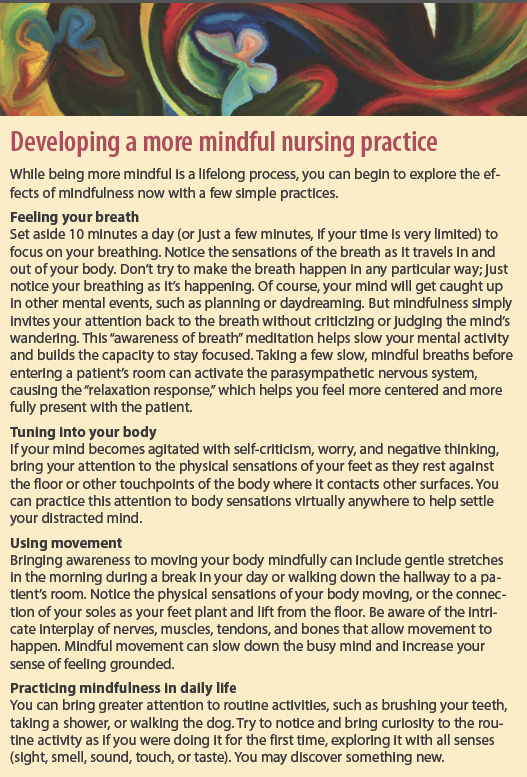
Wiser and more compassionate care
Mindfulness is a way of living with greater attention and intention and less reactivity and judgment. You can learn and develop mindfulness through regular mindfulness practices. Consider integrating mindfulness into your self-care plan to reduce stress and minimize burnout.Being more mindful and bringing receptivity to whatever is happening can deepen your understanding of clinical situations, relationships with colleagues, and ultimately yourself. With this understanding comes the possibility of providing wiser and more compassionate care for your patients and yourself.
Lois C. Howland is an associate professor at the University of San Diego and a senior teacher at the Center for Mindfulness at the University of California, San Diego. Susan Bauer-Wu is the director of the Compassionate Care Initiative and the Tussi & John Kluge Endowed Professor in Contemplative End-of-Life Care at the University of Virginia School of Nursing in Charlottesville.
Monday, February 22, 2016
Nurse staffing and patient experience outcomes: A close connection
Focus on...Quality and Patient Safety
As healthcare providers set and refine their strategies for staying competitive in a value-based delivery and payment system, a sharper understanding of the interplay between inputs and outputs becomes a strategic imperative. Nurse staffing is a key input for acute-care hospitals—key both for its impact on care and its budget prominence. This puts it squarely at the center of hospitals’ efforts to deliver on their value promise.
The relationship between staffing and patient outcomes across quality, safety, and experience domains is appreciated intuitively, if not always precisely understood. The imperative to strike the perfect balance drives considerable interest and research in fine-tuning this understanding. Yet vast scholarship on the topic hasn’t produced a precise staffing formula that will lead predictably to desirable outcomes.
That’s because high-quality nursing care hinges on much more than the number of nurses on the job for a particular patient load. It also depends on multiple under-lying structural and process factors, such as nurses’ skills and education, availability of sufficient supplies and equipment, staff training, facilities, and reliable use of demonstrated best nursing practices—as well as such factors as interprofessional relationships, nurse engagement, and job satisfaction.
To fully understand the impact of staffing levels on patients’ clinical and experience outcomes, we must consider the relationships within and among these variables—something we can do only through data integration and cross-domain analytics.
Value of NDNQI data
In 2014, Press Ganey acquired the National Database of Nursing Quality Indicators® (NDNQI®)—the industry gold standard for assessing nursing excellence—from the American Nurses Association. NDNQI national benchmarking data are invaluable for monitoring key nursing-sensitive structure, process, and outcome measures. Similarly, Press Ganey’s vast patient experience database offers critical insight into patients’ perceptions about the effectiveness of hospital operations, clarity of the care team’s communication, and caregivers’ ability to meet patients’ needs.As with nurse staffing, a growing body of evidence shows associations between patient-experience outcomes and clinical outcomes. Combining NDNQI and patient-
experience data provides unprecedented access to the relationships among key pieces of information. Together, these measures can help nurse leaders identify how performance changes in certain structural and process indicators affect patient safety, experience, and clinical outcomes.
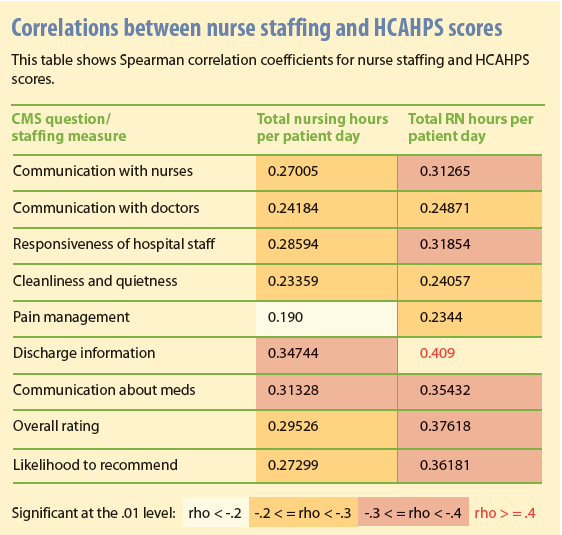
Given the enormous impact of nursing on the patient experience—and because nurse staffing often is a lightning rod in the debate on how to deliver high-value care—using the combined dataset to better understand how the two relate is a research priority. Our early analyses show that performance on both Press Ganey and Hospital Consumer Assessment of Healthcare Providers and Systems (HCAHPS) domains correlates significantly with nursing hours per patient day and RN hours per patient day, with the latter showing stronger associations in every domain. (See Correlations between nurse staffing and HCAHPS scores.) The link between more bedside nurses and a better patient experience isn’t surprising. That the correlations stretch across all experience domains—not just those that examine quality and frequency of nurse-patient interactions—is eye-opening.
Staffing that meets patient needs and reduces suffering
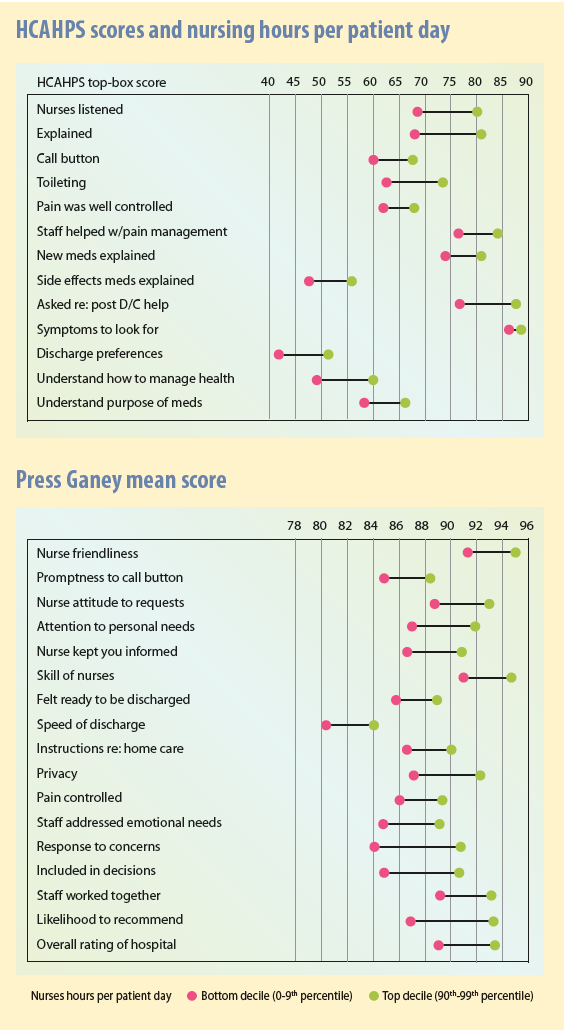
While domain-level correlations confirm long-held beliefs about the relationship between staffing and patient experience, we seek to understand which aspects of the patient experience are most sensitive to staffing. Where do staffing levels make a difference in caregivers’ success in meeting patient needs? Where can staffing serve as a lever to improve performance?Item- and question-level analyses help answer these questions. In the two tables HCAHPS scores and nursing hours per patient day and Press Ganey mean score, we see that for HCAHPS top-box scores and Press Ganey mean scores, every item showed sensitivity to staffing levels. Where the difference in patient experience scores is greatest (meaning when hospitals in the top decile of staffing ratios dramatically out-perform hospitals in the bottom decile), staffing can be viewed as a more powerful performance-improvement lever.
Reducing patient suffering
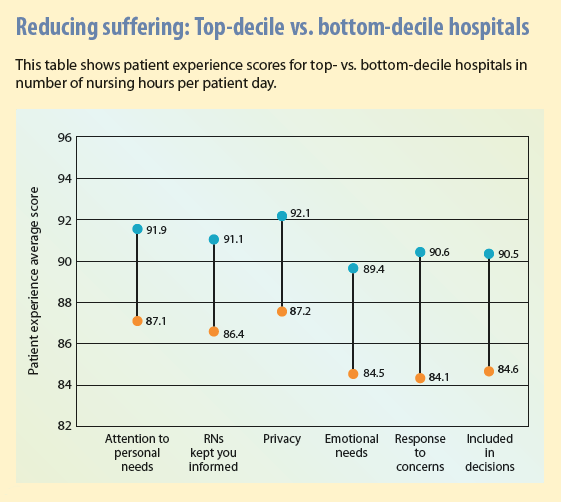
Of particular interest are differences in performance on key patient-experience questions related to patient suffering, which may indicate how effectively an organization provides patient-centered, personalized care. Press Ganey staff believe that relieving suffering should be central to efforts aimed at providing patient-centered care.Patient suffering falls into two categories:
- Inherent suffering results from the patient’s diagnosis, treatment, or both. It can’t be avoided entirely, but it can be mitigated. Some types of inherent suffering are well understood and addressed with some consistency—for instance, using pain control and explaining and managing symptoms. Inherent suffering includes psychosocial suffering, which caregivers are less comfortable with and therefore less practiced at addressing. Such suffering includes fear, anxiety, confusion, loss of dignity and autonomy, and uncertainty about self-care after discharge.
- Avoidable suffering arises from systemic defects, which may include long waits to receive treatment, poor communication, poor coordination among providers, errors, and failure to follow best practices. An important first step in determining how to avoid that kind of suffering is to understand that dysfunction creates additional suffering for people already burdened by inherent suffering.
It’s never just one thing
These findings don’t suggest that increasing nurse-patient ratios will automatically lead to performance improvements. Certainly, adequate nurse staffing is key to a range of outcomes, but changing staffing volume alone won’t produce optimal outcomes. Multiple aspects of structure and process also shape outcomes, and these findings must be leveraged with that in mind.Such factors as demographics of the nursing force, education and certification, engagement, and organizational staffing models are associated with patient-experience outcomes, as are cultural and structural practices and processes. In this regard, answers to the questions below also factor into outcomes:
- Is the nursing staff following best practices associated with better patient experiences?
- Are they executing on those best practices consistently and in the prescribed manner every single time?
- Do nurses have the right resources and training to promote consistency?
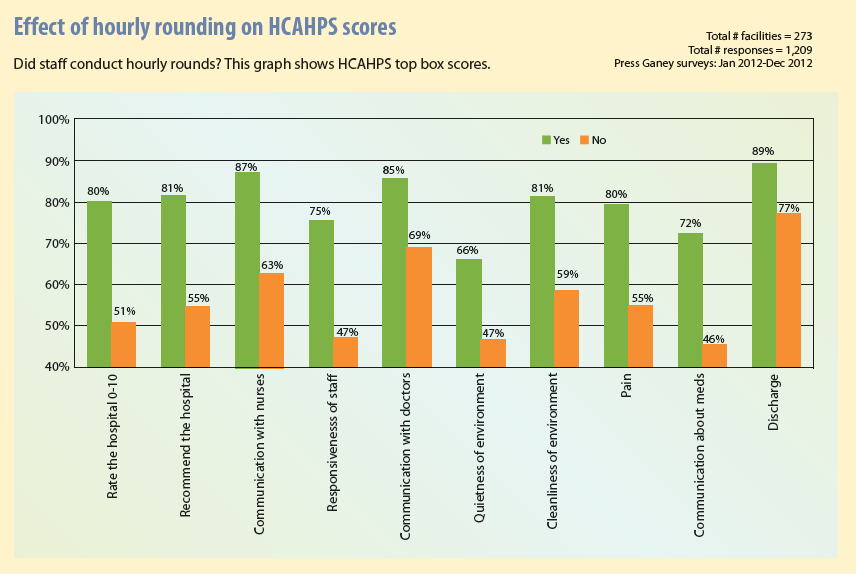
The concept of value over volume extends beyond changes to delivery and payment models. For hospitals, “getting it right” with their nursing organizations is particularly important because nursing care provides much of the value hospitals create. Adequate human resources are critical, but they’re not enough on their own. Nurse leaders must consider the full range of inputs—in addition to adequate human resources—that drive outcomes, including staff quality or caliber, the environment in which they operate, and shared commitment to providing a high-value experience for patients.
Nell Buhlman is senior vice president of Clinical and Quality Solutions at Press Ganey Associates in South Bend, Indiana. Note: Charts are copyrighted by Press Ganey and used with permission.
Selected references
Armstrong K, Laschinger H, Wong C. Workplace empowerment and Magnet hospital characteristics as predictors of patient safety climate. J Nurs Care Qual. 2009;24(1):55-62.
Dempsey C, Reilly B, Buhlman N. Improving the patient experience: real-world strategies for engaging nurses. J Nurs Adm. 2014; 44(3):142-51.
Halm MA. Hourly rounds: what does the evidence indicate? Am J Crit Care. 2009;18(6): 581-84.
Subscribe to:
Posts (Atom)