Showing posts with label #quality. Show all posts

Monday, April 18, 2016

Smarter Alarm Management Fights Alarm Fatigue Jeanne J. Venella, DNP, MS, RN, CEN, CPEN

Note from Nurse Kim:
This is a huge issue right up there with compassion fatigue and violence in the workplace. Patient Safety is a priority strategy for healthcare providers. Our vigilance will reap great rewards for patients and staff when we make sure to not let this issue fall by the wayside.

Alarm Management Goes Into High Gear

"The failure to recognize and respond to actionable clinical alarms... in a timely manner" was the second highest-ranked patient safety risk identified in the ECRI Institute's Top 10 Health Technology Hazards for 2016.[1] These threats include actionable alarms that are not detected, as well as alarms that are not handled appropriately by clinical staff owing to miscommunication and alarm fatigue.
The lack of hospital-wide clinical alarm management policies and procedures, and the dangers inherent to alarm mismanagement, achieved prominence in 2013 with the release of the Joint

Commission's National Patient Safety Goals on clinical alarm safety.[2] This initiative mandates that hospitals must identify and prioritize alarms based on internal considerations by January 1, 2016. In phase 2, which also begins in January, "hospitals will be expected to develop and implement specific components of policies and procedures. Education of those in the organization about alarm system management will also be required."[2]

Although hospitals and health systems have made progress in solutions development, missed alarms resulting from poor communication or alarm fatigue continue to pose clear and present threats to patient safety. The increase in the number of medical devices with alarm capabilities has only exacerbated the problem, as has the lack of standards on the proper configuration of alarm parameters.

Technology will play a critical role in getting alarms under control, but it is not enough. Without input from the workforce, technology solutions can fail owing to lack of adoption. Nurses and nursing leaders must get out ahead of this issue or solutions will not have representation from the correct stakeholders. Clinical and information technology (IT) leadership, including nurses, respiratory therapists (RTs), biomedical engineers, and IT staff, must come together to develop the policies and standards necessary to prioritize and reduce the number of alarms, as well as to establish protocols for altering current or default alarm parameters.

This article describes how two different hospitals achieved their alarm management goals using both technology and interdisciplinary expertise.

An Interdisciplinary Approach

In explaining why technology alone is not enough to solve the riddle of clinical alarm management, The Joint Commission said, "It is important for a hospital to understand its own situation and to develop a systematic, coordinated approach to clinical alarm system management. Standardization contributes to safe alarm system management, but it is recognized that solutions may have to be customized for specific clinical units, groups of patients, or individual patients."[2]

In other words, each hospital has its own unique characteristics and needs. Identifying and documenting those attributes is critical to a successful alarm management program. Achieving measurable progress in clinical alarm management requires hospitals to identify direct clinical staff as internal champions.

Wesley Medical Center (Wichita, Kansas) surveyed every nurse in the facility to determine which alarms they considered "clinically relevant" and which they considered "nuisance alarms." On the basis of 200 responses, the hospital was able to evaluate which alarms were most important to them as providers of care and compare findings with the most frequent alarms that occurred in a baseline study.

Wesley Medical Center was able to reduce and prioritize more than 10,000 daily alarms, reduce alarm incidence in its coronary care unit by 78%, and capture and distribute data from more than 600 medical devices for enhanced clinical surveillance by leveraging a combination of interdisciplinary input and alarm management technology.[3] The baseline evaluation enabled Wesley's clinical leadership to begin the process of mapping alarm trends, as well as classifying alarms by:
  • Frequency, alarm type, and device;
  • Variations by time and day as well as by rooms and units;
  • Alarm parameters and thresholds; and
  • Physiologic vs technical alarms.
"We used a multimember interdisciplinary team, including nurses, respiratory therapists, biomedical staff, and IT staff to formulate a list of alarms that we felt were important," said Deborah Free, RN, stroke program coordinator and quality manager at Wesley's Galichia campus. "At the same time, our [alarm management vendor] sent us a list of our most frequent alarms. We compared the two lists and prioritized the alarms we wanted to address."

The highly specific data generated by the baseline study and analysis helped Wesley's clinical staff develop a more effective alarm management system that will reduce the number of nuisance alarms requiring no action and will allow them to measure improvement over time to meet patient safety goals. An evaluation was conducted using a variety of factors, including:
  • Setting a predetermined number of days (eg, 30 days or 90 days) for analysis;
  • Analyzing alarm type by alarm category;
  • Identifying which alarms are most frequent;
  • Identifying changes in type and frequency of alarms by unit;
  • Identifying variations in alarm type and frequency by device (eg, patient monitor, ventilator, infusion pump, etc.);
  • Analyzing variations in alarm response behavior based on technical and physiologic categories, including time, day of week, room, and unit; and
  • Analyzing common alarm limit violations to determine how potential changes in current limits may alter alarm frequencies.
By changing practice based on evidence, the staff of Wesley was able to reduce the number of alarms caused by nonactionable, brief physiologic changes. By collecting high-resolution physiologic data from medical devices—not just the individual alarm data—the interdisciplinary team was able to measure the potential impact on the number of alarms before making adjustments to alarm settings.

For example, Wesley now has the flexibility to determine which events will trigger alarms as well as where and how clinicians will be notified. Uniquely, Wesley's system provides staff with high-fidelity, real-time, intelligent data from myriad devices to improve patient monitoring and allow staff to intervene before a patient's condition turns critical—offering point-of-care clinical decision support and enhancing patient outcomes.

Nuisance Alarms

A major challenge in alarm management is sorting clinically relevant alarms from nuisance alarms (for example, an alarm caused by a sensor on a patient being momentarily detached or the Wi-Fi connection being momentarily lost). Hospitals need to develop a standard approach to alarms and have a strategy to reduce alarm frequency, alarm noise, and alarm fatigue. Moreover, providers must guard against the overuse of monitoring when it is not indicated, because this just adds to the number of nonactionable alarms.

The problem with attenuating alarm data is achieving the balance between communicating the essential, patient-safety specific information that will provide proper notification to clinical staff while minimizing the excess, spurious and nonurgent events that do not threaten patient safety. In the absence of contextual information, the option is usually to err on the side of excess because the risk of missing an alarm or notification carries with it the potential for high cost in terms of patient harm or death.[4]

Wesley's clinical leadership was able to establish separate alarm thresholds as well as combination, trending, and frequency alarms to eliminate nonactionable alarms from being sent to the clinicians carrying phones outside of patients' rooms. For example, instead of an alarm based on a single vital sign, such as the ECG heart rate, a combination alarm might also look at the heart rate from the pulse oximeter or an invasive blood pressure wave to make sure the alarm is real and not just artifact. Overall, Wesley was able to reduce the number of these alarms daily in the coronary care unit from 1285 to 281—a 78% reduction.

The Table shows the reduction in the number of alarms sent to the nurses' phones. The "device alarms" column represents alarms generated by bedside devices and sent to nurses' phones. The "smart alarms" column shows the number of alarms that actually passed to the phones after implementing the smart alarm solution.

Table. Reduction in Number of Alarms With Smart Alarm Platform
Alarm Type Device Alarms Smart Alarms Reduction
Respiratory rate - low/high 428 212 50%
SpO2 - low 508 61 88%
Heart rate – low/high 349 8 98%
Asystole 15 15 0a
V-tach 13 13 0a
V-fib 2 2 0a
SpO2: pulse oxygen saturation
V-tach: ventricular tachycardia
V-fib: ventricular fibrillation
aCritical pass-through alarms from the device

Medical Device Connectivity

In a 2013 survey, 9 of 10 hospitals indicated that they would increase their use of patient monitoring, particularly of capnography and pulse oximetry, if false alarms could be reduced.[5] A tremendous amount of data is being generated by monitoring technology and needs to be viewed across the entire continuum of patient care.

The Hospital for Special Care (HSC), located in New Britain and Hartford, Connecticut, is nationally recognized for advanced care and rehabilitation in pulmonary care, acquired brain and spinal cord injury, medically complex adults and pediatrics, neuromuscular disorders, and cardiac disease. In addition to reducing or eliminating nonactionable alarms, HSC's goals for alarm management included collecting and distributing real-time data from more than 100 ventilators (each with its own set of alarms), as well as pulse oximeters, for enhanced, continuous patient surveillance, and analyzing objective, comprehensive clinical data after any patient incident to assess response processes and preventive measures.[6]

The critical nature of ventilators as life-support devices and the number of alarms they produced were major drivers in HSC implementing a solution that would enable HSC's team of RTs to provide continuous surveillance monitoring of patients while reducing nonactionable alarms and enhancing patient safety. The solution allows HSC's team of RTs to provide continuous monitoring of vital patient information and intervene before a situation becomes critical, enhancing patient safety.
Networked laptop and desktop computers, as well as scrolling message bars, were deployed at key locations throughout the pediatric unit, providing RTs with access to data and alarms from all ventilated patients. In addition, ventilator alarms were routed through pagers to the specific RT assigned to each patient. The system also automates processes that were previously done manually, such as manual ventilator checks, which frees up the RT to focus on the patient rather than the ventilator.

HSC's platform achieved real-time surveillance of patients on ventilation support and reduced the number of ventilator alarms by an estimated 80%, helping achieve compliance with The Joint Commission National Patient Safety Goals on alarm management. Clinical alarm management also helped HSC with quality and reporting data. Before implementing the platform, HSC was dependent on individual recollections from the clinical responders after an alarm incident. Today, HSC has a clearer picture of every event. HSC can use the data provided by its platform to sort out the story behind any incident, increasing accuracy on occurrence reporting and resolution. Moreover, the data collected are used by the performance management audit committee, which monitors ventilator management performance and helps identify potential areas of need.

"Alarm management is already a fundamental part of what we do," said Connie Dills, MBA, RRT, RPFT, respiratory practice manager for HSC. "It's made a big difference in our staff's efficiency and effectiveness, and has reduced stress for our patients and their families."

Lessons Learned

Alarm management is constantly changing. It must evolve with the needs of the hospital's patients and clinical staff. The nursing leadership and staff at Wesley continue to make adjustments to the alarm management process and configuration. "Alarm parameters should be part of our nurses' practice, and setting actionable alarms will increase their ability to care for patients," said Free. "Alarm management—and the parameters—have to be based on an individualized approach to your patient. Attention to this process have given us ownership."

Wesley is also looking at how it can use alarm data for predictive analytics, collecting physiologic data from multiple devices to create a holistic picture of a patient's condition. For example, taken individually, a slight drop in heart rate, a gradual rise in end tidal CO2, or a slight reduction in respiratory rate may not indicate anything critical in a patient's condition. However, data aggregated from those individual parameters could provide the caregiver with a more accurate, predictive picture of the patient's condition—in this case, an emerging risk for respiratory depression.

Addressing clinical alarm hazards in all their forms requires a comprehensive approach, free of the well-known departmental and data silos that hinder patient care and optimal clinical workflows. Technology certainly plays a critical role in alarm reduction and prioritization, but alarm management is a classic example of interdisciplinary leadership, involving clinical, IT, biomedical engineering, and other departments.


References

  1. ECRI Institute. Top 10 Technology Hazard for 2016. November 2015. https://www.ecri.org/press/Pages/Dirty_Endoscopes_Top_ECRI_Institutes_2016_Technology_Hazards_List.aspx Accessed January 7, 2016.
  2. The Joint Commission. The Joint Commission announces 2014 National Patient Safety Goal. http://www.jointcommission.org/assets/1/18/jcp0713_announce_new_nspg.pdf Accessed January 7, 2016.
  3. Wesley Medical Center. Beyond Alarm Management. Bernoulli. October 2015. www.cardiopulmonarycorp.com/wp-content/uploads/2015/10/Bernoulli-Wesley-Case-Study-AM-01-vA-10-15.pdf Accessed January 7, 2016.
  4. Zaleski JR. Alarm fatigue? What a nuisance! [Blog post]. October 4, 2014. www.medicinfotech.com/2014/10/mathematical-techniques-mitigating-alarm-fatigue Accessed January 7, 2016.
  5. Wong M, Mabuyi A, Gonzalez B. First National Survey of Patient-Controlled Analgesia Practices. March-April 2013. A Promise to Amanda Foundation and the Physician-Patient Alliance for Health & Safety. http://www.premiersafetyinstitute.org/wp-content/uploads/PPAHS-national-survey-patient-controlled-analgesia.pdf Accessed January 7, 2016.
  6. Hospital for Special Care. Achieving Clinical Clarity from Ventilator Overload. Bernoulli. October 2015. www.cardiopulmonarycorp.com/wp-content/uploads/2015/10/Bernoulli-HSC-Case-Study-LT-01-vA-10-15.pdf Accessed January 7, 2016.

Monday, March 21, 2016

Preceptor education: Focusing on quality and safety education for nurses

preceptors

Preceptor education: Focusing on quality and safety education for nurses

Publication Date: Jan 2016 Vol. 11 No. 1
Author: Fidelindo Lim, DNP, CCRN; Kimberly A. Weiss, MSN, FNP-BC; and Ingrid Herrera-Capoziello, MSN, RN, ANP NURSING

The transition from novice to expert nurse has been an important topic in nursing circles for more than 30 years, since Patricia Benner adapted the Dreyfus model of skills acquisition to the nursing profession. The model still serves as an excellent conceptual framework for the professional development of new nurses. Combined with core competencies from the Quality & Safety Education for Nurses (QSEN) initiative as the foundation for preceptor education, the model provides a road map for assessing and evaluating skills acquisition of new nurses or new preceptors. QSEN competencies include patient-centered care, teamwork and collaboration, evidence-based practice, quality improvement, safety, and informatics.
The impetus to anchor preceptor education to a solid framework rests on evidence that prelicensure nursing education, although sufficient for fostering formation of professional identity and ethical comportment, doesn’t provide hands-on clinical experience. By focusing on well-defined competencies such as those outlined in QSEN, preceptors can better guide novice nurses on what skills to focus on and develop.

Preceptor council: Transforming education

Organizations with Magnet® designation have vibrant, robust unit practice councils that address such core safety issues as falls, pressure ulcers, and hospital-acquired infections. At the Hospital for Special Surgery in New York, NY, a robust preceptor council composed of champions from all units and specialties grew out of a staff-identified need. Co-chaired by two clinical nurse specialists and overseen by the senior director of Nursing Excellence, the council meets once a month to discuss challenges and opportunities for quality improvement. It has become the forum for advocating transformational preceptor education, leading to
a redesigned and interactive preceptor education model based on QSEN competencies.

Competency and life-experience osmosis

In the United States, the average age of the practicing nurse is near 50. Contrast this with 31—the average age of nurses graduating with their initial nursing degree (considerably higher than the 1985 average age of 24). Additionally, 52.8% of new RNs received a previous bachelor’s degree and 7.2% hold a master’s degree or higher. The implications of these evolving demographic trends vary and require careful consideration when planning preceptor education. For example, older students with higher qualifications may be more experienced and have more confidence in addressing patient-care issues than traditional nursing students. When planning preceptor education, the overall lived experiences of new RNs must be taken into account.
Considering that preceptors generally are chosen from a pool of more experienced senior nurses, the potential for transferring hard-earned clinical skills and professional comportment is significant. Failing to use this prolific source of human capital to the full potential as knowledge, skills, and attitude transfer agents would result in a great loss. Because a growing majority of new RNs are entering nursing with professional backgrounds, they bring valuable and diverse life experiences that can be harnessed to shape their competencies in clinical judgment and technical proficiency.

Best practices for preceptor education

Situated learning, reflection on action, and outcomes measurement are a few examples of evidence-based practices in high-quality preceptor education.

Situated learning

Situated learning uses contextualized scenarios based on actual events and demands of the nursing unit. Interactive exercises in small group discussions using realistic and unfolding precepting case scenarios engage would-be preceptors in situated learning, helping them analyze and solve practice issues that might arise during preceptorship.
In this type of preceptor education, five carefully designed scenarios dealing with such issues as generational differences, experiential or learning gaps, missed opportunity, safety breaches, and work­around and work ethic issues are appraised and critiqued. Learners are asked to identify safety concerns, handle crucial conversations, suggest a quality-improvement or a research project to address the issues identified, and reflect on the merits of precepting best practices. Learners then present their work to their peers and the facilitator uses reflective questioning to address nuances of the scenario.

Reflection on action

Reflection on action is a deliberate ongoing process of learning from experience that will shape clinical judgment for future situations. Because precepting is a high-stakes interface among staff members and patients, it can cause significant stress. Effective preceptor education should allow exploration of novel precepting challenges, either in carefully designed scenarios or anecdotal reports from participants. The goal of reflection on action is to highlight what preceptors gain from their experience that contributed to their ongoing professional development and to build capacity for clinical judgment in future situations.

Outcomes measurement

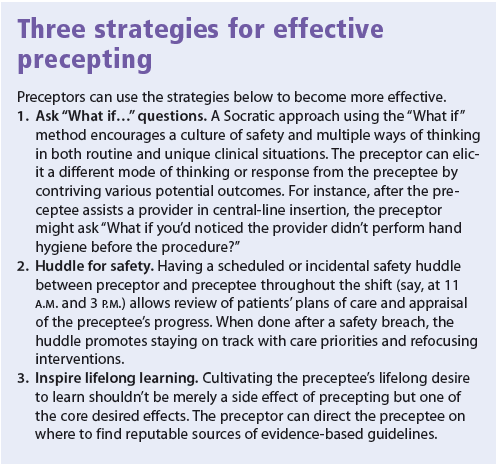
The preceptor council’s deliberation at the Hospital for Special Surgery conducted a pre- and post-training survey to assess how full-day preceptor training was received and to appraise participants’ attitudes toward precepting. Another survey was sent to trained preceptors after they precepted a new staff member. Compared to pre-training survey data, post-training data indicated an improved level of comfort and confidence in precepting and an overwhelmingly positive attitude toward the preceptor role. (See Three strategies for effective precepting.)
Three strategies

Preparing future preceptors

Seen through the lens of the QSEN competencies, preceptor education prepares future preceptors not only as socializers of novice nurses into the profession, but also as guardians of patient safety and quality care. A conceptual or theoretical framework is an essential foundation for a well-designed preceptor education. In organizations with Magnet designation, creating a preceptor unit practice council fosters an impetus to provide evidence on measurable outcomes.

Fidelindo Lim is an assistant clinical professor at New York University College of Nursing in New York, N.Y. Kimberly A. Weiss is a clinical nurse specialist in the postanesthesia care unit and Ingrid Herrara-Capoziello is a clinical education specialist and coordinator in the Office of Professional Development at the Hospital for Special Surgery in New York, NY.

Selected references
American Nurses Association. Fast Facts. The Nursing Workforce 2014: Growth, Salaries, Education, Demographics & Trends. http://goo.gl/uwHPH5
Benner P. From novice to expert. Am J Nurs. 1982;82(3):402-7.
Benner P, Sutphen M, Leonard V, Day L. Educating Nurses: A Call for Radical Transformation. San Francisco, CA: Jossey-Bass; 2010.
Budden JS, Zhong EH, Moulton P, Cimiotti JP. Highlights of the National Workforce Survey of Registered Nurses. J Nurs Regulation. 2013:4(2):5-15.
Dreyfus SE, Dreyfus HL. A Five-Stage Model of the Mental Activities Involved in Directed Skill Acquisition. ORC, 80-2, Operations Research Center, University of California, Berkeley. 1980.
Ramsburg L, Childress R. An initial investigation of the applicability of the Dreyfus skill acquisition model to the professional development of nurse educators. Nurs Educ Perspect. 2012;33(5):312-6.
Tanner CA. Thinking like a nurse: a research-based model of clinical judgment in nursing. J Nurs Educ. 2006;45(6):204-11.
U.S. Department of Health and Human Services. Health Resources and Services Administration. Bureau of Health Professions. National Center for Health Workforce Analysis; April 2013. The U.S. Nursing Workforce: Trends in Supply and Education. http://goo.gl/ZjvLJs
U.S. Department of Health and Human Services. Health Resources and Services Administration. The Registered Nurse Population: Findings from the 2008 National Sample Survey of Registered Nurses. 2010. http://goo.gl/1iyvPO

Monday, February 22, 2016

Nurse staffing and patient experience outcomes: A close connection

Focus on...Quality and Patient Safety

Staffing

Nurse staffing and patient experience outcomes: A close connection

Publication Date: January 2016 Vol. 11 No. 1
Author: Nell Buhlman, MBA

As healthcare providers set and refine their strategies for staying competitive in a value-based delivery and payment system, a sharper understanding of the interplay between inputs and outputs becomes a strategic imperative. Nurse staffing is a key input for acute-care hospitals—key both for its impact on care and its budget prominence. This puts it squarely at the center of hospitals’ efforts to deliver on their value promise.
The relationship between staff­ing and patient outcomes across quality, safety, and experience domains is appreciated intuitively, if not always precisely understood. The imperative to strike the perfect balance drives considerable interest and research in fine-tuning this understanding. Yet vast scholarship on the topic hasn’t produced a precise staffing formula that will lead predictably to desirable outcomes.

That’s because high-quality nursing care hinges on much more than the number of nurses on the job for a particular patient load. It also depends on multiple under­-lying structural and process factors, such as nurses’ skills and education, availability of sufficient supplies and equipment, staff training, facilities, and reliable use of demonstrated best nursing practices—as well as such factors as interprofessional relationships, nurse engagement, and job satisfaction.
To fully understand the impact of staffing levels on patients’ clinical and experience outcomes, we must consider the relationships within and among these variables—something we can do only through data integration and cross-domain analytics.

Value of NDNQI data

In 2014, Press Ganey acquired the National Database of Nursing Quality Indicators® (NDNQI®)—the industry gold standard for assessing nursing excellence—from the American Nurses Association. NDNQI national benchmarking data are invaluable for monitoring key nursing-sensitive structure, process, and outcome measures. Similarly, Press Ganey’s vast patient experience database offers critical insight into patients’ perceptions about the effectiveness of hospital operations, clarity of the care team’s communication, and caregivers’ ability to meet patients’ needs.
As with nurse staffing, a growing body of evidence shows associations between patient-experience outcomes and clinical outcomes. Combining NDNQI and patient-
experience data provides unprecedented access to the relationships among key pieces of information. Together, these measures can help nurse leaders identify how performance changes in certain structural and process indicators affect patient safety, experience, and clinical outcomes.
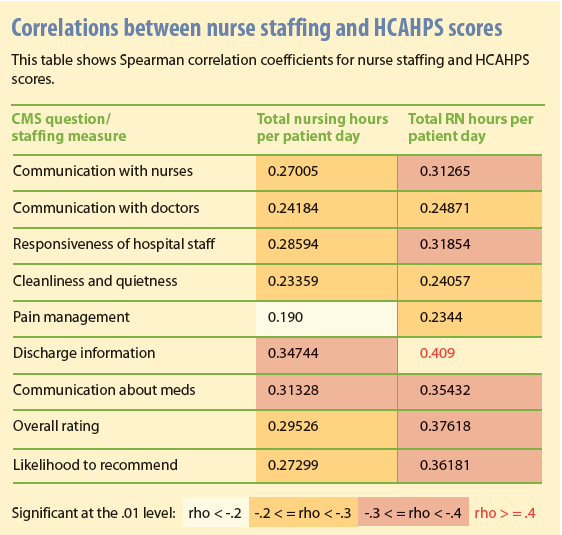
Given the enormous impact of nursing on the patient experience—and because nurse staffing often is a lightning rod in the debate on how to deliver high-value care—using the combined dataset to better understand how the two relate is a research priority. Our early analyses show that performance on both Press Ganey and Hospital Consumer Assessment of Healthcare Providers and Systems (HCAHPS) domains correlates significantly with nursing hours per patient day and RN hours per patient day, with the latter showing stronger associations in every domain. (See Correlations between nurse staffing and HCAHPS scores.) The link between more bedside nurses and a better patient experience isn’t surprising. That the correlations stretch across all experience domains—not just those that examine quality and frequency of nurse-patient interactions—is eye-opening.

Correlations between nurse staffing and HCAHPS scores

Staffing that meets patient needs and reduces suffering

While domain-level correlations confirm long-held beliefs about the relationship between staffing and patient experience, we seek to understand which aspects of the patient experience are most sensitive to staffing. Where do staffing levels make a difference in caregivers’ success in meeting patient needs? Where can staffing serve as a lever to improve performance?
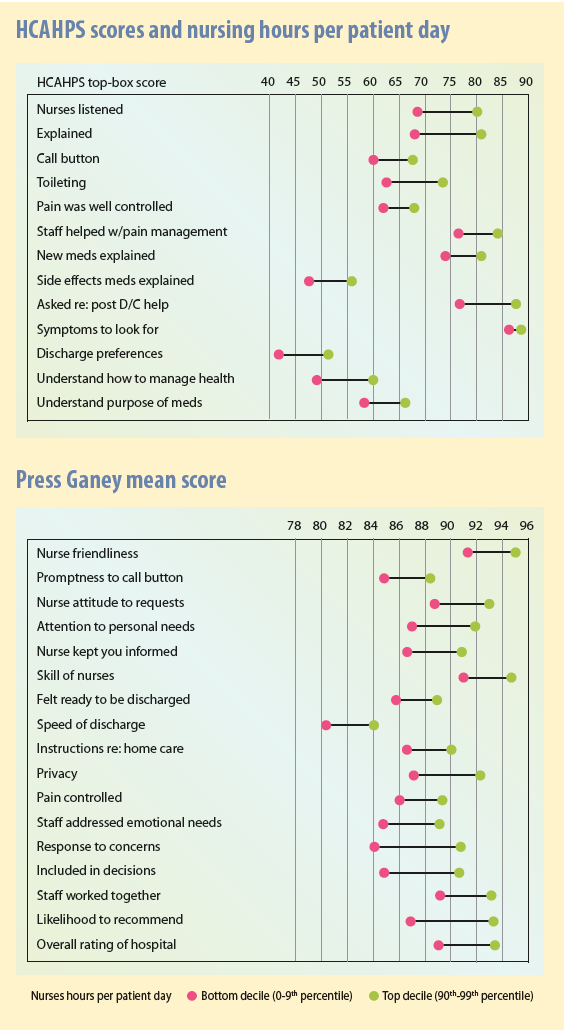
Item- and question-level analyses help answer these questions. In the two tables HCAHPS scores and nursing hours per patient day and Press Ganey mean score, we see that for HCAHPS top-box scores and Press Ganey mean scores, every item showed sensitivity to staffing levels. Where the difference in patient experience scores is greatest (meaning when hospitals in the top decile of staffing ratios dramatically out­-perform hospitals in the bottom decile), staffing can be viewed as a more powerful performance-improvement lever.
HCAHPS scores and nursing hours per patient day

Reducing patient suffering

Of particular interest are differences in performance on key patient-experience questions related to patient suffering, which may indicate how effectively an organization provides patient-centered, personalized care. Press Ganey staff believe that relieving suffering should be central to efforts aimed at providing patient-centered care.
Patient suffering falls into two categories:
  • Inherent suffering results from the patient’s diagnosis, treatment, or both. It can’t be avoided entirely, but it can be mitigated. Some types of inherent suffering are well understood and addressed with some consistency—for instance, using pain control and explaining and managing symptoms. Inherent suffering includes psychosocial suffering, which caregivers are less comfortable with and therefore less practiced at addressing. Such suffering includes fear, anxiety, confusion, loss of dignity and autonomy, and uncertainty about self-care after discharge.
  • Avoidable suffering arises from systemic defects, which may include long waits to receive treatment, poor communication, poor coordination among providers, errors, and failure to follow best practices. An important first step in determining how to avoid that kind of suffering is to understand that dysfunction creates additional suffering for people already burdened by inherent suffering.
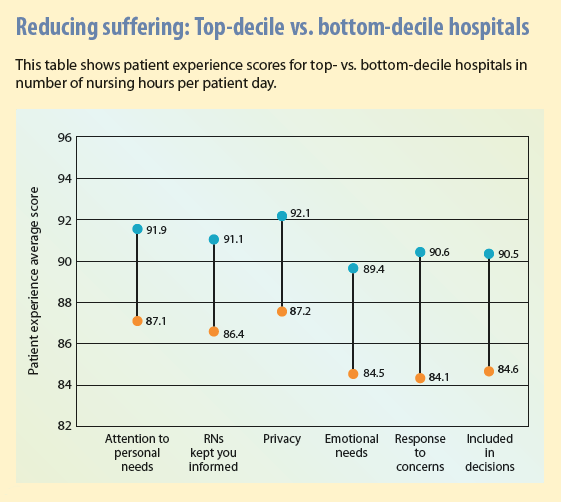
Inherent suffering can be reduced by understanding and meeting inherent patient needs. Performance on certain patient-experience survey questions can tell caregivers much about how well they’re meeting patients’ needs. Examining the relationship between staffing ratios and performance on these questions is illuminating. The table Reducing suffering: Top-decile vs. bottom-decile hospitals illustrates the dramatic differences in performance between top-decile and bottom-decile hospitals on questions relating to patient anxiety, autonomy, and the need to be informed about and involved in their care. These differences speak volumes about the importance of adequately resourced nursing units to give caregivers sufficient time to meet these patient needs.
Reducing suffering Top-decile hospitals

It’s never just one thing

These findings don’t suggest that increasing nurse-patient ratios will automatically lead to performance improvements. Certainly, adequate nurse staffing is key to a range of outcomes, but changing staffing volume alone won’t produce optimal outcomes. Multiple aspects of structure and process also shape outcomes, and these findings must be leveraged with that in mind.
Such factors as demographics of the nursing force, education and certification, engagement, and organizational staffing models are associated with patient-experience outcomes, as are cultural and structural practices and processes. In this regard, answers to the questions below also factor into outcomes:
  • Is the nursing staff following best practices associated with better patient experiences?
  • Are they executing on those best practices consistently and in the prescribed manner every single time?
  • Do nurses have the right resources and training to promote consistency?
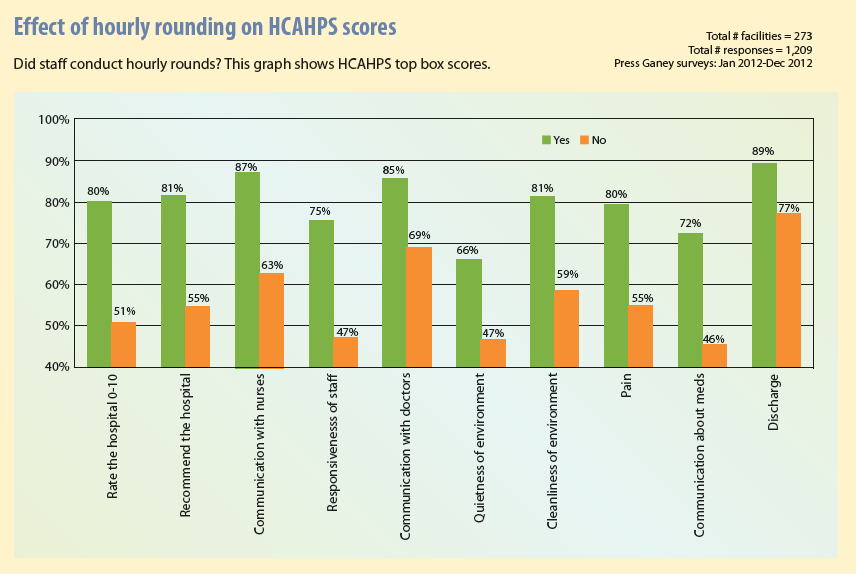
For example, a best practice such as purposeful hourly rounding on patient experience can have a dramatic impact. A 2013 Press Ganey study shows that patients who report they were visited by staff hourly during their hospital stay were much more likely to give top box scores on all HCAHPS questions—a clear sign their needs were being met more consistently. See the table Effect of hourly rounding on HCAHPS scores for details.
Effect of hourly rounding on HCAHPS scores
The concept of value over volume extends beyond changes to delivery and payment models. For hospitals, “getting it right” with their nursing organizations is particularly important because nursing care provides much of the value hospitals create. Adequate human resources are critical, but they’re not enough on their own. Nurse leaders must consider the full range of inputs—in addition to adequate human resources—that drive outcomes, including staff quality or caliber, the environment in which they operate, and shared commitment to providing a high-value experience for patients.

Nell Buhlman is senior vice president of Clinical and Quality Solutions at Press Ganey Associates in South Bend, Indiana. Note: Charts are copyrighted by Press Ganey and used with permission.

Selected references
Armstrong K, Laschinger H, Wong C. Workplace empowerment and Magnet hospital characteristics as predictors of patient safety climate. J Nurs Care Qual. 2009;24(1):55-62.
Dempsey C, Reilly B, Buhlman N. Improving the patient experience: real-world strategies for engaging nurses. J Nurs Adm. 2014; 44(3):142-51.
Halm MA. Hourly rounds: what does the evidence indicate? Am J Crit Care. 2009;18(6): 581-84.