Showing posts with label #advice. Show all posts
Showing posts with label #advice. Show all posts
Monday, May 7, 2018
Happy Nurses Week!
We All Had to Start Somewhere
by Michelle Tanner, MSN, RN | Magazine, Nursing Mentorship, Nursing Students
Did you ever look back upon your career and reflect on those humble beginnings? As educators, we sometimes forget that it was not easy to aspire to the higher academic goals we have been so fortunate to have attained. When we counsel our students, we must not disregard that they too have many barriers to overcome in their journey to be successful. In retrospect, we can embrace the challenges we must face in the effort to ensure our students’ academic success.
One morning during break, I overheard one of my student’s discussion with her colleague regarding how lucky she was that her children would be cared for over the weekend. This would allow her time needed to study for the final exam. Knowing this student, I was aware that she was a single parent and working mom, and more importantly, my student was pursuing a future career in nursing no less. It was a revelation that this fortunate incident for her was not expected, but was a gift. I began to ponder how this student would have prepared for the final if the childcare issues had not been resolved. Upon review, I realized that this student’s grades were not always consistent. During counsel, her excuses for poor grades or incomplete homework assignments were due to illness (whether be it her own or one of her children’s) or because of a busy work schedule, which entailed all shifts conceivable. So, when did she have time to study?
Lack of study time was also noticeable in the part-time evening students. I recall the blank stares on their faces during a Q&A session in preparation for the day’s lesson. Upon inquiry, the group confessed that they had not prepared for the evening’s lecture in their attempt to balance work, family, homework, and study hours. The weekends had been relegated to study time in preparation for the upcoming week’s assignments, albeit incomplete. Add this to childcare, spousal duties, and familial responsibilities and you have one overworked, fatigued, and ill-prepared nursing student.
Many times, as educators we focus on the negative aspects of our students: the fatigue, lack of engagement during lecture or clinical, and the behavioral issues (tardiness, absenteeism, and disputes with colleagues). This can hinder our ability to focus on putting interventions into place to enhance our students’ learning abilities. We might complain about time consumed due to providing an inordinate amount of time with a student that was not responding to intense tutelage. Perhaps we should invest in discussions about the ever-changing policies affecting our curriculum or work hours. Somehow, the drudgery of this negative outlook overshadows a focus on the academic pursuits of those struggling to attain a portion of our accomplishments. We must be sensitive to the vulnerability of this population during their journey. Whether it be in the case of the traditional, the returning, or the recycled adult learner, financial constraints are taxing. Adhering to professional and attendance policies takes effort. Striving to maintain a precarious balancing act to function commendably in multiple roles are all central themes of the adult learner. In acknowledging this, it is incumbent upon us to assist our students in getting past these barriers.
I have contemplated methods to assist nursing students, which have resulted in better outcomes. Some interventions I have put into place have made the difference in my students’ success as evidenced in their test scores. The following interventions are worth noting:
Games: the Millennials love them. Who said learning should be boring? The younger generation thrives off the technological support, which surreptitiously enhances learning. The games can be competitive, informal, and applied individually or after breaking the class into groups. Games are used best when they can be accessed as a resource after classroom sessions as a study tool before testing.
Provide a quick recap at the end of class. Some students may be so attentive during lecture that they do not take notes that were imperative to have as a review for the next test. This is easy to rectify by providing a short review of pertinent facts at the end of the day, paying special attention to the material that will be included on the test. This quick review gives the learner another chance to process and make note of what the instructor was attempting to stress in the previous lecture(s). This may seem redundant, but we cannot forget that this is all new information for the learner.
Remind the student of your availability. I state my office hours on a weekly basis most emphatically after testing. This publicly reinforces my commitment to their learning needs and hopefully abates their reluctance to seek my instruction.
Review one-on-one over the previous tests taken with students who have scored poorly. Allow the student to reflect, write, and question the material covered in the test(s). Educators have gained insight about their students during these sessions (e.g., what type of learner they are, if there are linguistic barriers, and/or if there is a lack of effective study habits). This session also establishes a rapport between you and the learner, which can be motivational.
Allocate extra time to be available for hours before testing. You would be surprised to see how many students will attend for review after a long, clinical day in anticipation of a test pending the next day. Is it more time consuming? Not nearly as much as counseling them one-on-one would be.
These are a few tips I have used to incorporate in teaching my students before I notice a decline in test scores. As I look back on my humble beginnings, I realize that the barriers I encountered are not so different. I am fortunate enough to have had support and encouragement throughout my career as a student and as a practitioner. It is as challenging for both the educator and the learner; diligence is required from all parties. But we are in the trenches together. We all had to start somewhere.
About Latest Posts
Latest posts by Michelle Tanner, MSN, RN

Monday, June 6, 2016
Poetry by Nurse Monique A. Shaw
Molestation,
a sad plight
It's
not enough to keep me up at night.
Projects,
shelters, even evictions
Is
that enough to make me lose my conviction?
The
witness of a horrible stabbing,
Domestic
abuse and a kidnapping.
She’s
your mom! Yes, I know!
But the
paperwork said she let me go!
All
this before the age of ten
At
what age will this tragedy end?
Brighter
days must soon be near
Off
to San Diego where the skies are clear.
Is
it here that this will all end
Is
my triumph about to begin?
No,
not now I’ll have to wait
Let’s
pile some more upon my plate.
ADDICTION!
Why mom? Why did you choose
Drugs
will surely make you lose.
Our
home, our friends, our money, our things
You
smoked them, you snorted and shot them up.
Walking
the Downtown streets late at night
Nowhere
to go, we spot a light.
Is
that a sign? A vacancy?
Yale
Hotel on F Street, our new home to be.
It
is here where friends become family
And,
of course, more tragedy.
NO!
STOP IT! IT ISN'T SO! MY MOM DOES NOT HAVE HIV!
STOP
TALKING! I'M NOT LISTENING! STOP LYING TO ME!
Off
we move and leave our friends
The
family that stays with me through thick and thin.
Now,
In-Home Nurses and medication
I’m
only in Junior High School, I need a vacation.
The
drugs, they’re just too strong
She
can’t let go and continues to succumb.
Now
three little letters turn into four
AIDS
came tapping at my mother’s door.
DEATH!
Two times in a one year span
First
dad now mom, it’s too much man!
Junior
High, High School and College is the future for me
Constantly
holding a 3.0 to a 3.33.
Life
has many twists and turns and crooked paths
As
we often learn.
Love
provides an interruption
But
abandoning college was never my solution.
Marriage
at age twenty and a new place to call home
Military
life in Illinois is where I'll roam.
Also
Virginia and Mississippi
The
love is now gone, there’s nothing here for me.
Back
to San Diego from where I came.
Time
to pack up and start again.
Now
a single mother, I must go back to school
Go
back to the path which I always knew was cool.
A
Medical Assistant I’ll quickly become
To
make decent money to try and move on.
Child,
work and school that’s my daily routine
Working
hard to fulfill my lifelong dream.
Along
comes the news I’ve patiently waited for
Two
long years or maybe more.
Monique,
you’ve made it, your name has come up
Are
you ready for Nursing School? Of course, there’s a but.
But
I’m pregnant with another child, over ten years later.
Its
OK, we’ll see you next year but not any greater.
The
year came and went quick as a flash
Nursing
School is here, time to attend class.
The
toughest two years I really must say
But
I remember my past and what I endured many days.
I
persevered and progressed and completed the program
And
walked across the stage with my kids looking on.
And
knew that although life sometimes seemed bleak
That
this was the TRIUMPH I always did seek.
So you
may ask, “Do you think this scholarship can help you live your dream?”
Yes
in many ways, one can only imagine
Higher
education is the goal and is my passion.
From
RN to BSN this is now my desire
This
scholarship will help me live my dreams and aspire.
Monique A. Shaw, R.N.
Monique is a registered nurse in the Southern California area. She is currently working on her BSN while balancing the busy life of work and mom.
Monday, March 21, 2016
Preceptor education: Focusing on quality and safety education for nurses
The transition from novice to expert nurse has
been an important topic in nursing circles for more than 30 years, since
Patricia Benner adapted the Dreyfus model of skills acquisition to the
nursing profession. The model still serves as an excellent conceptual
framework for the professional development of new nurses. Combined with
core competencies from the Quality & Safety Education for Nurses
(QSEN) initiative as the foundation for preceptor education, the model
provides a road map for assessing and evaluating skills acquisition of
new nurses or new preceptors. QSEN competencies include patient-centered
care, teamwork and collaboration, evidence-based practice, quality
improvement, safety, and informatics.
The impetus to anchor preceptor education to a solid framework rests on evidence that prelicensure nursing education, although sufficient for fostering formation of professional identity and ethical comportment, doesn’t provide hands-on clinical experience. By focusing on well-defined competencies such as those outlined in QSEN, preceptors can better guide novice nurses on what skills to focus on and develop.
a redesigned and interactive preceptor education model based on QSEN competencies.
Considering that preceptors generally are chosen from a pool of more experienced senior nurses, the potential for transferring hard-earned clinical skills and professional comportment is significant. Failing to use this prolific source of human capital to the full potential as knowledge, skills, and attitude transfer agents would result in a great loss. Because a growing majority of new RNs are entering nursing with professional backgrounds, they bring valuable and diverse life experiences that can be harnessed to shape their competencies in clinical judgment and technical proficiency.
In this type of preceptor education, five carefully designed scenarios dealing with such issues as generational differences, experiential or learning gaps, missed opportunity, safety breaches, and workaround and work ethic issues are appraised and critiqued. Learners are asked to identify safety concerns, handle crucial conversations, suggest a quality-improvement or a research project to address the issues identified, and reflect on the merits of precepting best practices. Learners then present their work to their peers and the facilitator uses reflective questioning to address nuances of the scenario.

Fidelindo Lim is an assistant clinical professor at New York University College of Nursing in New York, N.Y. Kimberly A. Weiss is a clinical nurse specialist in the postanesthesia care unit and Ingrid Herrara-Capoziello is a clinical education specialist and coordinator in the Office of Professional Development at the Hospital for Special Surgery in New York, NY.
Selected references
American Nurses Association. Fast Facts. The Nursing Workforce 2014: Growth, Salaries, Education, Demographics & Trends. http://goo.gl/uwHPH5
Benner P. From novice to expert. Am J Nurs. 1982;82(3):402-7.
Benner P, Sutphen M, Leonard V, Day L. Educating Nurses: A Call for Radical Transformation. San Francisco, CA: Jossey-Bass; 2010.
Budden JS, Zhong EH, Moulton P, Cimiotti JP. Highlights of the National Workforce Survey of Registered Nurses. J Nurs Regulation. 2013:4(2):5-15.
Dreyfus SE, Dreyfus HL. A Five-Stage Model of the Mental Activities Involved in Directed Skill Acquisition. ORC, 80-2, Operations Research Center, University of California, Berkeley. 1980.
Ramsburg L, Childress R. An initial investigation of the applicability of the Dreyfus skill acquisition model to the professional development of nurse educators. Nurs Educ Perspect. 2012;33(5):312-6.
Tanner CA. Thinking like a nurse: a research-based model of clinical judgment in nursing. J Nurs Educ. 2006;45(6):204-11.
U.S. Department of Health and Human Services. Health Resources and Services Administration. Bureau of Health Professions. National Center for Health Workforce Analysis; April 2013. The U.S. Nursing Workforce: Trends in Supply and Education. http://goo.gl/ZjvLJs
U.S. Department of Health and Human Services. Health Resources and Services Administration. The Registered Nurse Population: Findings from the 2008 National Sample Survey of Registered Nurses. 2010. http://goo.gl/1iyvPO

The impetus to anchor preceptor education to a solid framework rests on evidence that prelicensure nursing education, although sufficient for fostering formation of professional identity and ethical comportment, doesn’t provide hands-on clinical experience. By focusing on well-defined competencies such as those outlined in QSEN, preceptors can better guide novice nurses on what skills to focus on and develop.
Preceptor council: Transforming education
Organizations with Magnet® designation have vibrant, robust unit practice councils that address such core safety issues as falls, pressure ulcers, and hospital-acquired infections. At the Hospital for Special Surgery in New York, NY, a robust preceptor council composed of champions from all units and specialties grew out of a staff-identified need. Co-chaired by two clinical nurse specialists and overseen by the senior director of Nursing Excellence, the council meets once a month to discuss challenges and opportunities for quality improvement. It has become the forum for advocating transformational preceptor education, leading toa redesigned and interactive preceptor education model based on QSEN competencies.
Competency and life-experience osmosis
In the United States, the average age of the practicing nurse is near 50. Contrast this with 31—the average age of nurses graduating with their initial nursing degree (considerably higher than the 1985 average age of 24). Additionally, 52.8% of new RNs received a previous bachelor’s degree and 7.2% hold a master’s degree or higher. The implications of these evolving demographic trends vary and require careful consideration when planning preceptor education. For example, older students with higher qualifications may be more experienced and have more confidence in addressing patient-care issues than traditional nursing students. When planning preceptor education, the overall lived experiences of new RNs must be taken into account.Considering that preceptors generally are chosen from a pool of more experienced senior nurses, the potential for transferring hard-earned clinical skills and professional comportment is significant. Failing to use this prolific source of human capital to the full potential as knowledge, skills, and attitude transfer agents would result in a great loss. Because a growing majority of new RNs are entering nursing with professional backgrounds, they bring valuable and diverse life experiences that can be harnessed to shape their competencies in clinical judgment and technical proficiency.
Best practices for preceptor education
Situated learning, reflection on action, and outcomes measurement are a few examples of evidence-based practices in high-quality preceptor education.Situated learning
Situated learning uses contextualized scenarios based on actual events and demands of the nursing unit. Interactive exercises in small group discussions using realistic and unfolding precepting case scenarios engage would-be preceptors in situated learning, helping them analyze and solve practice issues that might arise during preceptorship.In this type of preceptor education, five carefully designed scenarios dealing with such issues as generational differences, experiential or learning gaps, missed opportunity, safety breaches, and workaround and work ethic issues are appraised and critiqued. Learners are asked to identify safety concerns, handle crucial conversations, suggest a quality-improvement or a research project to address the issues identified, and reflect on the merits of precepting best practices. Learners then present their work to their peers and the facilitator uses reflective questioning to address nuances of the scenario.
Reflection on action
Reflection on action is a deliberate ongoing process of learning from experience that will shape clinical judgment for future situations. Because precepting is a high-stakes interface among staff members and patients, it can cause significant stress. Effective preceptor education should allow exploration of novel precepting challenges, either in carefully designed scenarios or anecdotal reports from participants. The goal of reflection on action is to highlight what preceptors gain from their experience that contributed to their ongoing professional development and to build capacity for clinical judgment in future situations.Outcomes measurement
The preceptor council’s deliberation at the Hospital for Special Surgery conducted a pre- and post-training survey to assess how full-day preceptor training was received and to appraise participants’ attitudes toward precepting. Another survey was sent to trained preceptors after they precepted a new staff member. Compared to pre-training survey data, post-training data indicated an improved level of comfort and confidence in precepting and an overwhelmingly positive attitude toward the preceptor role. (See Three strategies for effective precepting.)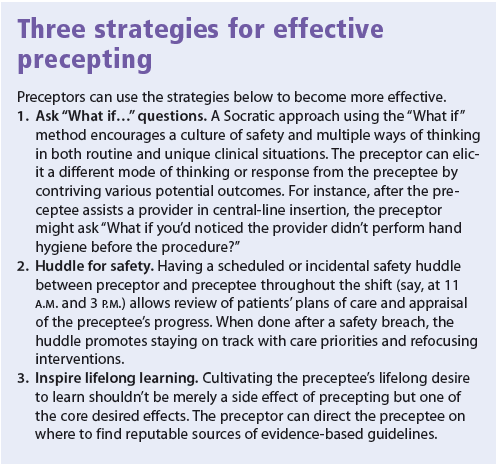
Preparing future preceptors
Seen through the lens of the QSEN competencies, preceptor education prepares future preceptors not only as socializers of novice nurses into the profession, but also as guardians of patient safety and quality care. A conceptual or theoretical framework is an essential foundation for a well-designed preceptor education. In organizations with Magnet designation, creating a preceptor unit practice council fosters an impetus to provide evidence on measurable outcomes.Fidelindo Lim is an assistant clinical professor at New York University College of Nursing in New York, N.Y. Kimberly A. Weiss is a clinical nurse specialist in the postanesthesia care unit and Ingrid Herrara-Capoziello is a clinical education specialist and coordinator in the Office of Professional Development at the Hospital for Special Surgery in New York, NY.
Selected references
American Nurses Association. Fast Facts. The Nursing Workforce 2014: Growth, Salaries, Education, Demographics & Trends. http://goo.gl/uwHPH5
Benner P. From novice to expert. Am J Nurs. 1982;82(3):402-7.
Benner P, Sutphen M, Leonard V, Day L. Educating Nurses: A Call for Radical Transformation. San Francisco, CA: Jossey-Bass; 2010.
Budden JS, Zhong EH, Moulton P, Cimiotti JP. Highlights of the National Workforce Survey of Registered Nurses. J Nurs Regulation. 2013:4(2):5-15.
Dreyfus SE, Dreyfus HL. A Five-Stage Model of the Mental Activities Involved in Directed Skill Acquisition. ORC, 80-2, Operations Research Center, University of California, Berkeley. 1980.
Ramsburg L, Childress R. An initial investigation of the applicability of the Dreyfus skill acquisition model to the professional development of nurse educators. Nurs Educ Perspect. 2012;33(5):312-6.
Tanner CA. Thinking like a nurse: a research-based model of clinical judgment in nursing. J Nurs Educ. 2006;45(6):204-11.
U.S. Department of Health and Human Services. Health Resources and Services Administration. Bureau of Health Professions. National Center for Health Workforce Analysis; April 2013. The U.S. Nursing Workforce: Trends in Supply and Education. http://goo.gl/ZjvLJs
U.S. Department of Health and Human Services. Health Resources and Services Administration. The Registered Nurse Population: Findings from the 2008 National Sample Survey of Registered Nurses. 2010. http://goo.gl/1iyvPO
Subscribe to:
Posts (Atom)