| The career handoff: Intentional sharing of knowledge and wisdom
Chapter from The Career Handoff, an STTI book.
|
| By Kathy Malloch and Tim Porter-O'Grady |
|
This chapter from The Career Handoff: A Healthcare Leader's Guide to Knowledge & Wisdom Transfer Across Generations examines the
critical components of successful communication, transition, handing
off, and succession planning in the healthcare profession.
“Tell me and I forget, teach me and I may remember, involve me and I learn.”
–Benjamin Franklin
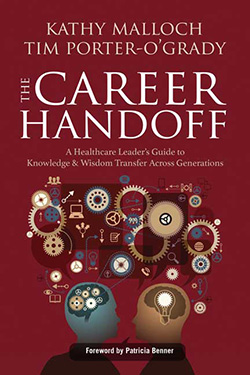 Every
year, Tim and I schedule time for a retreat to plan what we are going
to focus on in the next year. We select a special place where we can
both think and play and do something special. At our latest retreat at
the Ojai Valley Inn & Spa in California, we found ourselves
wondering how many more revisions of our work we could do—and how much
longer our ideas and strategies would be relevant for healthcare
organizations. And then came the even tougher question: What would
happen to our textbooks? Would Quantum Leadership just sail
into the sunset? We humbly wanted the information that would be
meaningful to future generations not to be lost; we did not want future
generations to rediscover what we had already identified and shared.
These questions got us to think about how to hand off our successful
ideas to younger colleagues and selectively discard that which is no
longer relevant. From that conversation, we began to strategize and
learn about how to hand off knowledge and wisdom to younger generations,
and this book is a result of those ideas. Every
year, Tim and I schedule time for a retreat to plan what we are going
to focus on in the next year. We select a special place where we can
both think and play and do something special. At our latest retreat at
the Ojai Valley Inn & Spa in California, we found ourselves
wondering how many more revisions of our work we could do—and how much
longer our ideas and strategies would be relevant for healthcare
organizations. And then came the even tougher question: What would
happen to our textbooks? Would Quantum Leadership just sail
into the sunset? We humbly wanted the information that would be
meaningful to future generations not to be lost; we did not want future
generations to rediscover what we had already identified and shared.
These questions got us to think about how to hand off our successful
ideas to younger colleagues and selectively discard that which is no
longer relevant. From that conversation, we began to strategize and
learn about how to hand off knowledge and wisdom to younger generations,
and this book is a result of those ideas.
We realized from our consulting practices that highly successful
professionals are often reluctant to consider retirement, and many
people avoid the thought of moving away from active engagement with
colleagues in sharing knowledge and wisdom. It is even more challenging
to figure out how to hand off or give one’s intellectual property to
another colleague. As an unprecedented number of baby boomers move
closer to retirement, there is much to share with succeeding
generations. There is also some content or intellectual property that
might not be applicable in future generations. We believe a formalized
process for sharing and designating intellectual property and products
would be helpful to not only our baby boomer colleagues but also to
other generations of colleagues.
The Need for Generational Sharing
Our professional consulting focus has been on the importance of leadership and in helping others to learn as much as possible about leadership—to embrace new ideas to become the most successful leaders possible. Our belief has always been that everyone is a leader, regardless of whether they have a formal leadership title. Whenever two individuals are together, one person begins the dialogue or movement in the simplest way, and leadership is evident. Each one of us has some special knowledge and expertise that future generations should or might want. Creating a culture as well as validating the science that assists others in handing off and nourishing our colleagues with our wisdom is important to both of us. Cultivating a culture of giving to others with minimal expectations of receiving something in return will allow future generations to grow and move on with what is vital to them. Our focus has shifted from figuring out what to give and how to instruct them to “love our stuff” to identifying interested colleagues and turning our work over to them to sort out and retain what is deemed valuable. It is also time for us to get out of the way of future leaders and shift from driving the boat to creating a safe space for others learning how to manage the boat’s journey!
Soon after our retreat, I was invited to keynote a leadership
summit group; my focus was on this topic of generational sharing.
Participants at this meeting included successful professionals from
three generations, including chief executive officers, nurse executives,
consultants, real estate executives, and physicians. As part of the
keynote, I presented the plan Tim and I developed to hand off two of our
books (see the feature that follows) and the discussion began to flow.
Participants were highly interested in learning more and becoming
involved in advancing the science of both giving and receiving
intellectual property and the wisdom of ages.
Reflecting on these ideas, we created a book proposal with the interested retreat participants. We now had a team of wisdom experts to join us on this journey and, most importantly, the authors represented three generations of interested professionals. We realized quickly that the importance of sharing generational wisdom was significant and that there was much interest from younger generations in learning more about our work and how to keep the useful knowledge alive and contemporary. Rather than seeing ourselves as the fading generation, it is time to see ourselves as a generation who now has much to share with the younger generations! We believe we created a talented team of wisdom managers to assist in this work.
Further dialogue with the contributing authors
provided clarification and enhancement of our ideas and solidified the
importance of documenting and sharing generational wisdom, successes,
and strategies that we would not repeat. We believe formalizing this
process and providing guidelines for colleagues will be an important
contribution to professional nursing practice. Each one of our authors
has included specific discussion on what the handoff is, some practical
tips for sharing knowledge, and exemplars to demonstrate personal
experiences (and, of course, some irreverent humor; we all need to laugh
and enjoy the nuances of our journey!).
This book reflects our commitment to professional
coaching, mentoring, and assuring that our young nurses are not chewed
up by the system but are supported proactively. Mentoring is a vital
professional behavior and an ethical obligation to our profession; we
need to nourish our young rather than engage in the proverbial “eating
our young.” In the next section, we share our personal and scholarly
connections to the art and science of mentoring.
Life Journey: Membership in the Profession
Transitions and transformations are a fundamental part of the journey of life. Naturally, as we age and grow, we gather information, skill, insight, and wisdom that accumulate and aggregate in a way that becomes a part of our characters and personalities. As professionals, one of the most important considerations is the responsibility that membership in the nursing profession brings. Who we are and what we are become a part of our professional identity such that our person and profession become one and the same thing (Malloch & Porter-O’Grady, 2010). As we journey through our careers and our lives and are recognized as professional nurses, we essentially become the “person of the nurse.” As professionals, we integrate our work, our relationships, and our individual persona in a way that creates the frame for who we are and provides the substance of the image we present to the world. Consider a notice you might see in a newspaper about the appointment of a position to an administrative or public role—the writer acknowledges the relationship between the person and profession by identifying the particular individual as a “physician.” However, when a nurse is appointed in a similar fashion to an administrative or public role, he or she will more frequently be identified as a “former nurse.” For the physician the identity is singular; for the nurse the same identity is dual (a nurse is a job different from the administrative or public role and, therefore, cannot be identified in singular terms).
“I am not a teacher, but an awakener.”
–Robert Frost
One of the joys of this life journey is the
increased knowledge, insight, and skill we develop as we aggregate
experiences and learning relationships. If we have had an open attitude
in all these arenas, we have been available to the opportunities to
deepen our insights and understandings and broaden our awareness in a
way that helps us develop expertise that advances our talent as
professionals. One of the urges this dynamic generates is the desire to
share and to extend these insights and talents in a way that benefits
others who are also eager for learning and personal development. This
desire to share knowledge and skill is an outgrowth of our own openness
and availability to learning and personal development. Those individuals
who understand this dynamic also recognize that embedded in it is the
give-and-take reflected in the interaction of all who share a commitment
to growing, learning, and deepening their knowledge and understanding.
|
Monday, June 13, 2016
Taking the Next Steps...Planned Succession

Monday, June 6, 2016
Poetry by Nurse Monique A. Shaw
Molestation,
a sad plight
It's
not enough to keep me up at night.
Projects,
shelters, even evictions
Is
that enough to make me lose my conviction?
The
witness of a horrible stabbing,
Domestic
abuse and a kidnapping.
She’s
your mom! Yes, I know!
But the
paperwork said she let me go!
All
this before the age of ten
At
what age will this tragedy end?
Brighter
days must soon be near
Off
to San Diego where the skies are clear.
Is
it here that this will all end
Is
my triumph about to begin?
No,
not now I’ll have to wait
Let’s
pile some more upon my plate.
ADDICTION!
Why mom? Why did you choose
Drugs
will surely make you lose.
Our
home, our friends, our money, our things
You
smoked them, you snorted and shot them up.
Walking
the Downtown streets late at night
Nowhere
to go, we spot a light.
Is
that a sign? A vacancy?
Yale
Hotel on F Street, our new home to be.
It
is here where friends become family
And,
of course, more tragedy.
NO!
STOP IT! IT ISN'T SO! MY MOM DOES NOT HAVE HIV!
STOP
TALKING! I'M NOT LISTENING! STOP LYING TO ME!
Off
we move and leave our friends
The
family that stays with me through thick and thin.
Now,
In-Home Nurses and medication
I’m
only in Junior High School, I need a vacation.
The
drugs, they’re just too strong
She
can’t let go and continues to succumb.
Now
three little letters turn into four
AIDS
came tapping at my mother’s door.
DEATH!
Two times in a one year span
First
dad now mom, it’s too much man!
Junior
High, High School and College is the future for me
Constantly
holding a 3.0 to a 3.33.
Life
has many twists and turns and crooked paths
As
we often learn.
Love
provides an interruption
But
abandoning college was never my solution.
Marriage
at age twenty and a new place to call home
Military
life in Illinois is where I'll roam.
Also
Virginia and Mississippi
The
love is now gone, there’s nothing here for me.
Back
to San Diego from where I came.
Time
to pack up and start again.
Now
a single mother, I must go back to school
Go
back to the path which I always knew was cool.
A
Medical Assistant I’ll quickly become
To
make decent money to try and move on.
Child,
work and school that’s my daily routine
Working
hard to fulfill my lifelong dream.
Along
comes the news I’ve patiently waited for
Two
long years or maybe more.
Monique,
you’ve made it, your name has come up
Are
you ready for Nursing School? Of course, there’s a but.
But
I’m pregnant with another child, over ten years later.
Its
OK, we’ll see you next year but not any greater.
The
year came and went quick as a flash
Nursing
School is here, time to attend class.
The
toughest two years I really must say
But
I remember my past and what I endured many days.
I
persevered and progressed and completed the program
And
walked across the stage with my kids looking on.
And
knew that although life sometimes seemed bleak
That
this was the TRIUMPH I always did seek.
So you
may ask, “Do you think this scholarship can help you live your dream?”
Yes
in many ways, one can only imagine
Higher
education is the goal and is my passion.
From
RN to BSN this is now my desire
This
scholarship will help me live my dreams and aspire.
Monique A. Shaw, R.N.
Monique is a registered nurse in the Southern California area. She is currently working on her BSN while balancing the busy life of work and mom.
Monday, May 30, 2016
Celebrating Nurses with the Top 10 Nurse Phrases
Top 10 phrases that nurses say most

Shutterstock | racorn
We’ve conducted the World’s Most Unscientific Survey! It’s amazing: Our methodology was completely arbitrary. Little, if any, effort went into ensuring rigid scientific standards were observed. In fact, we thought, “Hmmm…isn’t there supposed to be a control group for this type of thing?”
No matter!
We’ve talked to approximately 37,034,686 nurses, give or take a few million, and we asked them: What is the single phrase you say most during the day? Now, some of the nurses gave us practical, useful answers, and we didn’t like those, so we threw those right out, as clear outliers.
Examining the remaining answers (approximately 65,023), we discovered that the following phrases cross nurses’ lips more frequently than any others:
10. “No problem! I’d be happy to change your TV station again. What else would I do with all of my free time?”
9. “Sorry, your insurance doesn’t cover the good Tylenol.”
8. “You won’t feel a thing.”
7. “You’ll have to ask your doctor that. And after he answers, could you clue me in?”
6. “This won’t hurt a bit. Trust me, all the times I’ve attended this procedure, I’ve never felt a thing!”
5. “Ring that call bell one more time and just see what happens.” (Generally not said very loudly.)
4. “No, I will not give you a sponge bath.”
3. “And how do you wipe your butt at home?”
2. “You’re going to feel a little prick…unless you don’t settle down, in which case it’s square needle time…those suckers hurt!”
And number one, always said with a big smile:
1. “I’m sorry to wake you, Doctor…”
Monday, May 23, 2016
Celebrating Nurses with a Little Bit of Poetry
IF MY
STETHOSCOPE COULD TALK
by Kimberley
Ensor, MSN, RN
If my stethoscope could talk what
would it say about me today?
Would it say that I rushed
through my assessment so I could scope out a place at the nurses’ station?
Would it say that I was thorough
or going through the motions?
Did I just kill time until break?
Lunch? End of my shift?
What would my stethoscope say?
If my stethoscope could talk how
would my listening skills be evaluated?
Did I actually hear my
patient? When medications were refused
or when the patient expressed they had enough, would I actually listen?
As my stethoscope moved across
their body, did I notice a change that needed to be addressed in the plan of care
or did I just do business as usual?
Was I listening to my patient and
their family members’ concerns or did I just perform lip service as from a
script.
What would my stethoscope say?
If my stethoscope could talk
would it say that I had my eyes open as I took care of my patient?
Did I completely understand the
physician’s orders? When my patient
addressed me did I provide eye contact or was I too busy looking at monitors
and equipment?
Did I notice something and speak
up as an advocate for my patient or did I leave it for the next shift to
handle?
What would my stethoscope say?
If my stethoscope could talk
would it say I half-heartedly gave education and explanations about
medications?
Would what I speak actually come
from a desire to be a help to my patient or just to look good as an authority
figure?
Did I form my words to be culturally sensitive or did I disregard my
patient’s views, beliefs and preferences?
When I spoke to colleagues or
interacted with the multi-disciplinary staff was I a source of encouragement.
Did I include my unit assistants
in the plan of care for the patient? Did
I recognize my charge nurse as a valuable resource? Did I appreciate my unit clerk for their
invaluable help?
What would my stethoscope say?
If my stethoscope could talk,
would it say that I am an example of patient centered care?
Did my care come from my passion
to be a nurse or am I just hanging around for a paycheck?
Did my body language speak I care
about you or was I stand offish and couldn’t be bothered?
Was I first to the room when an
IV or bed alarm sounded or did I say ‘that’s not my patient and turn a deaf ear
and go about my day?
Did I make myself available to my
colleagues, to my patient or was I nowhere to be found during busy periods?
Did I take a moment to step
outside and let the sun touch my skin, reminding me of why I wanted to be a
nurse in the first place?
What would my stethoscope say?
My stethoscope would say,
I bring my joy and positive
spirit with me each time I step on the unit.
It would say I strive to listen
with open ears and see with both eyes.
It would say I try to be an asset
to my unit and an instrument of excellent care.
It would say I utilize evidence
based practices when answering patient questions and use simple languages.
It would say I work daily to be
an advocate, a hand to hold, and an empathetic ear.
My stethoscope would say I am a
nurse and I put my heart into everything I do.
I wear my stethoscope with pride.
Monday, May 16, 2016
Celebrate Nurses by Mentoring
Follow These 10 Tips To Be A Great Mentor To Student Nurses

|

Despite years of classes and studying, new nurses really have no idea what they are up against until they finally hit the floor on their own. That’s when reality strikes, and they realize exactly how much responsibility they really have.
You may have already forgotten those days, when you second-guessed every decision and feared the wrath of the more experienced nurses coming down on you. Now that you are in the more experienced pack, you have a great opportunity to mentor new nurses, show them the ropes, and set them on a course towards nursing excellence.
To be a good nurse mentor you need to be willing to work closely with new nurses. This is a time and energy investment that not only benefits the nurse you have under your wings, it will benefit the entire industry in the long run. If you are willing to take on that challenge, maximize the experience for both you and your student nurses by following these tips:
- Be Willing to Share Your Expertise – A good nurse mentor cannot be greedy with the expertise they have obtained by their time in the field. Share the knowledge and skills that you have gained over the years freely, providing them with valuable information that will not only help them in their career, but that could help improve their quality of patient care.
- Stay Positive – No one wants to be trained by someone who clearly is not happy in that role. Maintain a positive attitude with your mentee, even when they mess up a little. A good training rule to follow when you have to offer criticism is to cushion one negative remark with three positive. This type of feedback lets the new nurse know that you are just as aware of the good things you do as you are of the bad.
- Hear What They Have to Say – When your mentee is talking, listen carefully. Not only to the words, but to how they are saying them. Read their body language for signs of nervousness or apprehension and gauge the tone of their voice. A new nurse may try and put up a brave front when faced with having to do something new, but if you can get a sense of how they really feel, you will be in a better position to guide them.
- Make it Personal – The more you know about your nursing mentee, the easier it will be to instruct them. Don’t be shy about sharing personal anecdotes, and encourage them to do the same. This opens up the lines of communication to make them feel at ease in asking you anything. Have your lunch with them, or just share a cup of coffee at the start of the shift. You will learn a lot about the nursing student during these casual encounters that can help you to better instruct them.
- Lighten Up – Yes, being a nurse is serious business, but try and lighten the mood when you can. Show your enthusiasm for the position and laugh during your shifts with your student nurse and they will soon learn to love working alongside you.
- Accept That You Might Not Know Everything – While you have the experience under your belt, a newly graduated nurse has the book smarts at the forefront of her mind. Since it may have been a (long) while since you’ve picked up a nursing text book, accept that they may have learned a new trick or two that you don’t know.
- Keep it Confidential – Practice the same privacy policies you have with your patients with a nurse in training. As much as you may want to share with your peers the mistakes of the day, remember, you at one point were making those same errors. If you lose the trust of your student nurse by sharing their trials and tribulations, you lose the chance to help make them a valuable member of our industry.
- Walk the Walk – Nurses interact with dozens of people during one shift. From patients and family members to doctors and radiologists. Set a good example by consistently being respectful with everyone you come into contact with. You don’t want a new nurse to believe that it is acceptable to ridicule a patient behind their back or talk down to another staff member. Set the right tone now to avoid any problems in the future.
- Be Available – Not on your off days of course, but when you are on shift, make sure that you are always accessible and responsive to your student nurses. Your experience has likely taught you that it only takes a split second for disaster to strike. To avoid having your mentee stuck in the middle of one alone, never let them go too far out of your reach.
- Take a Break – Mentoring student nurses can be mentally exhausting, so if you feel like you need a break, ask for one. No one will blame you for wanting to work a shift once in a while without having to be responsible for teaching at the same time. Mentoring burn-out will only lead to bad mentoring, which will result in a negative experience for the student nurse.
Monday, May 9, 2016
Celebrating Nurses with a Travel Through History
Historical Moments For African American Nurses

As a African-American registered nurse, I find it important to pay homage to those who paved the way by breaking down barriers and forcing out inequality. I attended the historically black college, Hampton University, formerly the Hampton Institute. This college experience provided me with a great education in nursing science and a rich education in African American History. I have the honor of being a part of an influential nursing magazine, so it is incumbent upon me that I share some of the history that allowed me to work in the capacity that I do today..
African American Nursing History Timeline
1855-1856: Mary Grant Seacole is denied the opportunity to enlist Crimean War . She travels to Crimea herself and establishes boarding houses where sick and wounded soldiers from both sides of the war can be treated.
1861 – 1865 Harriet Tubman served as a nurse during the American Civil War and used her knowledge of herbal medicine to treat wounded soldiers on the island of Port Royal off the coast of South Carolina. After the Civil War, Tubman helped found a home for the elderly.
1879: Mary Eliza Mahoney becomes the first black to graduate from an American nursing school. She is known as the first professional black nurse in America.
1881: The first school of record for black student nurses is established at Spelman Seminary (renamed Spelman College) in Atlanta, Georgia.
1891: The Kings Chapel Hospital for Colored and Indian Boys, Abbey Mae Infirmary, and the Hampton Training School for Nurses were started on the campus of Hampton Institute. Alice Bacon was instrumental in starting the Hampton Training School for Nurses. The school was commonly called Dixie Hospital, and its first graduate was Anna DeCosta Banks.
1891: Dr. Daniel Hale Williams establishes the Provident Hospital and Training School for Nurses, the first black-owned and first interracial hospital in the United States.
1908: The National Association of Colored Graduate Nurses (NACGN) is established.
1918: Eighteen black nurses admitted to the Army Nurse Corps after the armistice of World War I and assigned to Camp Sherman, Ohio, and Camp Grant, Illinois.
1932 : Chi Eta Phi Sorority, Inc (ΧΗΦ) is a professional association for registered professional nurses and student nurses. Chi Eta Phin is a sorority that both women and men may join. Chi was founded due to concerns of the founder about the restrictions in employment of black nurses to segregated facilities and to positions where there was little or no chance of advancement
1941: Lieutenant Della Raney Jackson becomes the first black nurse to enter the military service during World War II.
1951 :NACGN- National Association of Colored Graduate Nurses was dissolved when it’s members voted to merge with the American Nurses Association.
1967: Lawrence Washington became the first male ever to receive a regular commission in the U.S. Army Nurse Corps.
1971: National Black Nurses Association was founded by Lauranne Sams, former dean and professor of nursing at Tuskegee University
1979: Brig. Gen. Hazel W. Johnson-Brown becomes the first black woman in the Department of Defense to become a brigadier general and the first black to be chief of the Army Nurse Corps.
1991: Brig. Gen. Clara Adams-Ender becomes the first black woman and nurse to be appointed commander general of an Army post. As the highest-ranking woman in the Army, she commanded more than 20,000 nurses serving in the Persian Gulf War.
1992: State Senator Eddie Bernice Johnson (D-Texas) is elected to the U.S. House of Representatives—the first nurse, black or white, elected to Congress.
Monday, May 2, 2016
Celebrating Nurses with a little Blast from the Past!
10 Old-School Nursing Skills You Don’t See Anymore

Nursing, along with the rest of the medical field, is constantly evolving to ensure better patient outcomes. Nursing skills, in particular, have changed quite a bit over the last several decades. Some skills have even been discarded completely for the sake of safety or efficiency. Here are 10 interesting examples of old-school nursing skills that have either drastically changed or are no longer practiced:
- Reusing syringes and urinary catheters
- Charting patient care on paper
- Using urine dipsticks with sliding-scale insulin
- Regulating IV fluids manually
- Palpating for blood pressure
- Shaving patients prior to surgery
- Shaking mercury thermometers
- Cutting urinary catheters during removal
- Irrigating NG tubes with Coca-Cola
- Treating congestive heart failure (CHF) with rotating tourniquets
Are there any old-school nurses working with you on your unit? If so, do they still practice a few of the skills mentioned in this article? Leave a comment below and let us know!
Subscribe to:
Posts (Atom)