Showing posts with label #mindful. Show all posts
Showing posts with label #mindful. Show all posts
Thursday, April 12, 2018
Adapting to Overnight Shifts: 5 Common Mistakes and How to Avoid Them
Adapting to Overnight Shifts: 5 Common Mistakes and How to Avoid Them
Mar 30, 2018 | Blog, Minority and Community Health
Working overnight shifts is a big change for many nurses, but it’s also extremely common. With the 24-hour demands of the bustling, modern health care system, there’s a good chance you’ll have to work the night shift at some point in your career, especially when you’re starting out. But don’t fret! There are many ways to ensure that the transition from day to night goes as smoothly as possible.
All nurses need to be on their A-game with technical medical skills and emotional resilience no matter what time of day they’re working. Night shift nurses have to shoulder even more burdens because they often work mostly or entirely alone for their shift. While there’s no one “right” way to adapt to the night shift, there are several common mistakes that you’ll want to avoid to build good habits.
Common Mistakes to Avoid When Switching to the Night Shift
Going against your circadian rhythm is no small task. However, resorting to quick fixes will only make your shifts more difficult in the long run. Avoid these five common mistakes and you’ll adapt to the swing of a night shift quickly.
1. Not getting enough rest before starting a shift.
As a nurse, it’s important to always be sharp on the job. The staff at Gurwin Jewish Nursing and Rehabilitation Center emphasize that not getting enough rest is the number one mistake that new night shift workers make, and it’s one of the most dangerous. Since shifts are often upwards of eight hours long, there’s no safe way to “power through” on too little sleep. This goes for both on-shift work and driving when sleep-deprived.
How to Avoid It:
Install blackout curtains where you sleep and get a fan or white noise generator.
Turn off your phone, get a “Do Not Disturb” sign, and inform loved ones of your schedule.
Staying up for a few hours to relax and take care of yourself may be easier for some nurses than going straight to bed at the end of a shift. You’ll figure out what works for you with time, so don’t be afraid to experiment.
Take proper care of your legs and feet while on your shift, so you won’t be troubled by pain or soreness when you’re trying to sleep.
Light soothing candles and practice stretches to relax yourself before bed.
2. Leaning on sugary foods, alcohol, or caffeine instead of proper nutrition.
It can be tempting to snack on chocolate or chug coffee to keep yourself going through your night shift. Keep in mind that, if consumed in excess, coffee can lead to jitters at first, followed by a crash. You’ll be far better off if you instead focus on getting more sleep.
How to Avoid It:
Plan and pack your meals ahead of time to avoid relying on vending machines.
Schedule your heavy meals so they won’t interfere with sleep.
3. Letting your personal life fall into disorder.
Sometimes it’s hard to keep your personal life in order while working the night shift. Errands, social gatherings, and childcare all battle for your attention when you’re not at work. This reduces your ability to get good sleep and, in turn, to focus at work.
How to Avoid It:
Yoga and meditation help you relax and leave work behind so you can be present when you’re engaging with family or friends.
Establish a schedule for sleep, chores, and activities. This will reduce the stress of missing out on things.
Plan gatherings ahead of time with friends and family to ensure you can make it to fun gatherings.
4. Not asking for help or feeling like you have to “do it all.”
Yes, there are fewer resources available overnight at the hospital. This can lead to superhero-esque thinking, where you refuse or even genuinely forget to ask for help. Being honest about needing a hand is better than dropping the ball because you’re juggling while tired.
How to Avoid It:
Get to know the others who work nights so you can trade favors.
Get to know the resources available to you during your shift.
Ensure that your roommates or family are sharing the load with you at home.
Choose sleep over chores when possible at home. Others can help you with chores, but they can’t sleep for you!
5. Missing out on workplace bonding, training, or resources due to night shifts.
It’s easy to feel forgotten when working the night shift. Try not to miss out on opportunities for bonding, continuing education, or extra support because of your schedule. It can be hard to make time or schedule changes for these opportunities, but they’re integral to your career development down the line.
How to Avoid It:
Check announcement boards and learn about opportunities available at your workplace.
Make it known to your boss and coworkers that you’re interested in additional training, support, resources or team bonding even if you work the night shift.
Ask if there are online resources available for any opportunities that you simply cannot attend.
Your job as a nurse is important. Don’t let working the night shift get in the way of providing the best care possible to your patients and yourself. Getting enough sleep is integral to your job performance and personal health, but that’s not always enough. You also need to make sure you’re practicing good self-care and focusing on your health along the way. With these great tips, you’ll adapt to the night shift in no time!
Deborah Swanson is a medical office professional with two decades of experience helping small practices and large hospitals alike improve efficiencies. She recently started consulting with allheart.com providing insight into the daily activities of medical professionals and how best to serve them.

Monday, April 4, 2016
How To Finally Stop Procrastinating (For Real This Time) by Bob Nease, PhD
Note from Nurse Kim:
I found this very interesting. As a strong type A, I hated working in groups because I knew I would have to work with at least one person that thought tomorrow was better than today. Ugh! Anyway these suggestions would have been great to help me motivate, um encourage my teammates when important deadlines were on the horizon.
How To Finally Stop Procrastinating (For Real This Time)
Your brain has a neocortex and a limbic system, and sometimes they fight. Here's how to get them to play nice.
Think about all the stuff you've been putting off—really, go ahead. Chances are you've been putting off thinking about the stuff you've been putting off, right? It's not that you don't think those things are important, or even that you believe they’ll go away if you ignore them. So why are you procrastinating, and how can you stop that?
It Isn't As Bad As You Think
For starters, you probably procrastinate far less than you think. If we stop to think about it, there are lots of things that need to get done that almost always do get done, some way or another: eating when we’re hungry, drinking when we’re thirsty, going to sleep when we’re tired—you get the idea.No one has to nag us to eat, drink, or nap. These are all things that are good for us in the long run. But so are turning that report in on time and changing the oil in the car. In other words, not every beneficial behavior causes us to procrastinate.
There’s only one factor that seems to separate the good behaviors that we do easily from those we routinely put off doing: how good they feel. In other words, we seem to have no problem doing things that are in our our long-term interest as long as they feel good in the here and now. It's only once those behaviors impose upfront effort or unpleasantness that the jig is up. It’s as if all our brains care about is whether something feels good right this moment than whether it will turn out to be good for us later.
This Is Your Brain Procrastinating
And indeed, that's pretty close to the truth, cognitively speaking, and it matters when we get down to figuring out a lasting solution to procrastination. To simplify things slightly (but only slightly), there’s a part of the brain that accurately weighs the benefits of a behavior against its costs. This is your neocortex, and it’s one of the newest and shiniest parts of our brains. Very often, the neocortex comes to quite reasonable conclusions—that, for instance, the benefits of exercising outweigh the costs.But there’s another part of your brain that’s been around for millions of years—the limbic system—and it only seems to care about what’s happening right now. So if a behavior incurs more upfront hassles than upfront benefits, the limbic system isn’t interested in participating.
It's usually only when something that’s good in the long run is also good in the present that these two systems agree with each other. Hungry? Eating seems right to both systems—no problem. When they disagree, the neocortex plays the role of the angel on one shoulder ("Exercise, it’s good for you!") while the limbic system plays the tempting devil ("Relax pal, that exercise sounds like a lot of work").
Things get even more interesting when you look into how the brain works when it's planning on good behavior later. For example, when you’re making a decision about whether to exercise in the future, the limbic system couldn’t care less, and leaves that issue up to the neocortex. But when it actually comes time to make good on that choice, the limbic system is suddenly very interested—and usually not too happy.
The interplay and occasional competition between these two systems explains why we earnestly plan to behave better and just as earnestly put off doing so when the time comes. When it comes to planning, the neocortex calmly notes that the benefits outweigh the costs, while the limbic system takes a nap. And when it comes to doing, the limbic system screams so loudly about the present costs that the neocortex has little chance of pulling through.
How To Help Your Neocortex Help You
So how can you give your neocortex a leg up over a recalcitrant limbic system in order to break the cycle of procrastination? Try these three strategies.1. Outsource the upfront hassles of a beneficial behavior. Sometimes it's easy: If you're always late paying your utility bill because it just never makes it to the top of your to-do list, sign up for automatic billing. Ditto when it comes to saving for retirement. The more routines and processes you don't look forward to that you can automate, do it.
2. Change the present-day stakes. Remember: As far as one really powerful part of your brain is concerned, it’s all about the present. Make the right behavior more attractive in the here and now, and the tempting but undesirable choice less so. For example, to boost your chances of exercising, listen to music while you work out, join a group that exercises together, or play a sport where your team relies on you. That way the beneficial behavior—exercise—becomes a side effect of something inherently fun. You can also try to make a contract with a friend that will force you to pay a penalty each time you fail to engage in the behavior you desire. Don't want to enlist a friend? Just download an app like stikK, Pact, or Beeminder.
3. Aim low, then ramp up. Reduce the upfront cost of doing the right thing by scaling back the immediate goal a little bit at first. For example, if your plan is to run four miles, and you’re having a tough time rolling out of bed and hitting the pavement, focus instead on running just two. That can increase the likelihood that you’ll get started and decrease the amount of pain you'll experience that might make you fall short. You’ll also find that once you’ve started down the path, re-upping the goal (a couple extra miles after the two you committed to) will be a lot easier.
Bob Nease, PhD, is the former chief scientist of Express Scripts, and the author of The Power of Fifty Bits: The New Science of Turning Good Intentions into Positive Results (HarperCollins) as well as over 70 peer-reviewed papers.
Monday, February 29, 2016
Mindful Nursing
Mind/Body/Spirit
Mindfulness is an increasingly common topic in both popular and professional literature. In clinical populations, evidence suggests mindfulness-based interventions (MBIs) can reduce symptoms linked to various conditions, including cardiovascular disease, cancer, and depression. Among healthcare professionals, mindfulness training can reduce psychological and physiologic stress, emotional distress, and burnout while improving empathy, job satisfaction, and sense of well-being. This article gives an overview of mindfulness and MBIs and discusses how mindfulness practices can benefit nurses both personally and professionally.
What exactly is mindfulness? It’s the capacity to intentionally bring awareness to present-moment experience with an attitude of openness and curiosity. It’s being awake to the fullness of your life right now, by engaging the five senses and noticing the changing landscapes of your mind without holding on to or pushing away what you’re experiencing.
Being mindful doesn’t mean stopping your mind from thinking or trying to be relaxed and peaceful. Nonetheless, many people who practice mindfulness regularly report feeling more calm and clearheaded. You can develop the ability to be more mindful in everyday life through mindfulness meditation and other mindfulness practices.
Living on automatic pilot
Throughout our lives, we develop beliefs, judgments, and habitual thinking patterns that may result in living in an automatic or habit-driven way. Many of us are on “automatic pilot,” with our bodies operating in a routine pattern while our minds are somewhere else—usually anticipating future events or ruminating over something that has happened. This “mindless” way of living can limit how we experience life, the choices we make, and the quality of our relationships. It also can exacerbate feelings of stress.Mindfulness practices can help us recognize mental habits that limit our understanding of something or restrict our options for action. Consider, for example, how negative self-talk can grip your attention and circle in your mind like a hamster in a wheel. By being able to notice when your mind is engaged in these common but unhelpful thinking patterns, you can bring attention to the feeling of the breath as it’s moving in and out of your body or noticing the physical sensations of your body as it is right now. This intentional shifting of the mind to present-moment experience can help interrupt stressful thinking and may enhance your sense of calm and centeredness.
How does mindfulness work?
The mind is busy. It constantly processes memories and plans, rehashes past events, and takes in and processes information from the senses and internal body. At the same time, it orchestrates the activities that allow us to function in daily life. The mind also must respond to the challenge of our ever-expanding and complex technological environment, which bombards us with a relentless stream of information from electronic devices and social media—increasing our mental distraction and stress.Neuroscience research shows mindfulness training can enhance the brain regions responsible for attention and executive function (problem-solving and intentional action) while modulating the amygdala, the brain area that identifies threats and triggers such emotional responses as fear and anger. Mindfulness practices can enhance your ability to pay attention and notice what’s actually happening, particularly in stressful situations. This ability to notice attentively and see situations more clearly can help you respond thoughtfully rather than react. This has particular relevance for nurses in terms of self-care and optimal care of patients.
Learning to be more mindful
In 1979, Jon Kabat-Zinn at the University of Massachusetts Medical School developed the seminal mindfulness training program known as mindfulness-based stress reduction (MBSR), in an attempt to reduce suffering in patients with chronic pain. This highly structured, 8-week group program includes training in exercises to increase the capacity to be more mindful. Core mindfulness practices in the MBSR program include the body scan (learning to mentally tune in to body sensations), gentle yoga (moving the body with attention and kindness), and breath awareness (focusing on the sensations and experience of breathing). Research examining the effects of MBSR training found significant improvements in the health and well-being of participants with various medical conditions.Hundreds of hospitals, universities, and community settings across the country and around the world offer MBSR training. Also, MBSR and other related MBIs have been developed to target specific nonclinical populations, such as business leaders, professional sports teams, schoolteachers, and students. Instructional books, websites, compact discs, and personal device applications are available to help people learn more about mindfulness practices.
Mindfulness and nursing
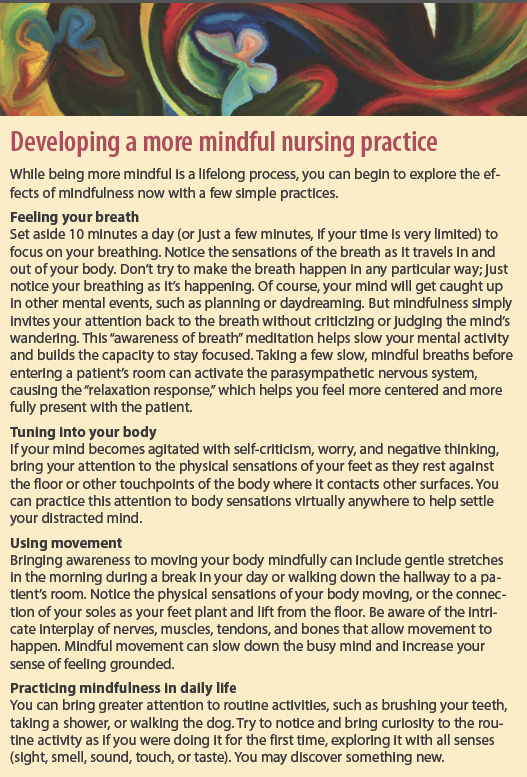
How can mindfulness help nurses? Greater awareness and less distraction in the clinical setting can improve your assessment skills (for instance, allowing you to identify subtle changes in a patient’s condition) and your performance of complex technical procedures that may reduce the risk of clinical errors. Mindfulness can enhance your communication with patients and other healthcare team members by bringing a greater awareness to how and what others are communicating. Listening and speaking with greater attention can lead to more effective communication and better clinical outcomes, particularly in crisis situations.Moreover, research shows mindfulness training can help nurses cope more effectively with stress and reduce the risk of professional burnout. One randomized, controlled trial of nurses found those who participated in an 8-week mindfulness training program had significantly fewer self-reported burnout symptoms, along with increases in relaxation, mindfulness, attention and improved family relations, compared to nurses in a control group. (See Developing a more mindful nursing practice.)
Wiser and more compassionate care
Mindfulness is a way of living with greater attention and intention and less reactivity and judgment. You can learn and develop mindfulness through regular mindfulness practices. Consider integrating mindfulness into your self-care plan to reduce stress and minimize burnout.Being more mindful and bringing receptivity to whatever is happening can deepen your understanding of clinical situations, relationships with colleagues, and ultimately yourself. With this understanding comes the possibility of providing wiser and more compassionate care for your patients and yourself.
Lois C. Howland is an associate professor at the University of San Diego and a senior teacher at the Center for Mindfulness at the University of California, San Diego. Susan Bauer-Wu is the director of the Compassionate Care Initiative and the Tussi & John Kluge Endowed Professor in Contemplative End-of-Life Care at the University of Virginia School of Nursing in Charlottesville.
Subscribe to:
Posts (Atom)