Showing posts with label #advise. Show all posts

Monday, March 7, 2016

RN and a Healthy Lifestyle

yoga cross leg stuff

 Living a healthy lifestyle

Publication Date: March 2014 Vol. 9 No. 3
Author: Beth Battaglino, RN, BSN


As nurses, we know how to check blood pressure, administer medications, and counsel patients about healthy living. But let’s face it—some of us don’t practice what we preach. At the end of a long shift taking care of others, we sometimes fail to take the best care of ourselves.

It doesn’t have to be that way. Take it from me—a busy practicing nurse, chief executive officer of a women’s website, a wife, and the mom of a 1-year-old boy: You can fit healthy habits into your life. You just have to want to. And once you do, you’ll see how much better you feel, physically and emotionally. As a bonus, exercise and healthy eating habits improve your cardiovascular health—a major concern as we age. (Heart disease is the #1 killer of women.) If improving your own health and well-being isn’t reason enough, keep in mind that getting healthier can help you take even better care of patients.

The power of exercise: Working out your body and your stress

I learned at a young age I’m not one of those women who can eat whatever they want and stay thin. I also discovered I can’t simply cut calories to lose weight; I need to exercise, too. For weight and overall fitness, I can’t stress enough the importance of physical activity. As a country, we exercise more today than we did 10 years ago—yet obesity rates are higher than ever. Why? Researchers suggest diet and other lifestyle changes are also components to maintaining a healthy weight.
Most people need to exercise (and eat well) to keep weight off and stay fit. The American Heart Association recommends at least 150 minutes of moderate exercise or 75 minutes of vigorous exercise each week, or a combination. This comes to at least 30 minutes, 5 days a week—a good goal.
What form of exercise is right? Like me, you might want to mix up your workouts to keep your mind and body challenged. I run one day, do kickboxing the next, and go to boot camp the next. (Kickboxing and boot camp are great ways to relieve work stress, by the way.) I also do strength training a few times a week.

To stay motivated, I exercise with friends. It’s much harder to make excuses for skipping an exercise session when you know others are counting on you. Once you show up, friends will push you to give it your all. I run with a group of 40+ moms every Saturday morning. Last year, I trained with the group and completed a half-marathon and three triathlons. Running is a great therapy session, too. One of us might say, “Hey, I’ve been having this problem at work”—and get great feedback from friends while running.
During the week, I fit my workouts in early—at 5:30 in the morning, while my husband stays home with the baby. He gets his turn to work out at night. It’s all about juggling and balancing your schedule to fit exercise into your life.

Nurse Nutrition 101

I plan my meals ahead of time. Healthy eating is crucial to controlling weight and promoting cardiovascular health. Research has deemed the Mediterranean diet a winner for a healthy heart. With this diet, you consume a lot of vegetables, fruits, beans, whole grains, and olive oil, plus a weekly intake of fish as the primary protein—but very little red meat or other sources of saturated fat.
To follow both the Mediterranean diet and U.S. nutritional guidelines, try to eat fish high in omega-3 fatty acids, such as tuna, salmon, or mackerel, at least two or three times a week. As an added bonus to its heart-healthy benefits, fish may improve brain function and fight depression. (And in nursing, we all know the power of a clear head and a positive mood.)
Here are more nutrition tips:
  • Always eat breakfast. To be on your feet all day taking care of patients, you need the proper fuel. I never miss breakfast. My regular breakfast is instant, high-fiber maple oatmeal with walnuts. If I go out for breakfast, I order an egg-white omelet with cheese and ham.
  • Keep healthy snacks with you at all times. Unless you plan ahead, a busy shift can leave you reaching for the worst convenience foods. Mix a pouch of tuna with low-fat Greek yogurt topped with avocados (hold the mayo). Sprinkle this over your lunch salad or make a sandwich packed with super foods. Also, I never leave home without an apple, yogurt, an energy bar, and a package of almonds.
  • Don’t set yourself up for a binge. Fight the urge for a peanut-butter cup. If my sweet tooth beckons, I give in—but just a little. If I really feel as if I need something sweet, a few Twizzlers or Swedish fish usually do the trick. (Editor’s note: If you work shifts, read “Nutrition for night-shift nurses” for more ideas on how to eat healthy.)

No need for extremes

You don’t have to go on an extreme fad diet or exercise 3 hours a day to become a model of health for your patients. Healthy living isn’t hard. Go online and bookmark webpages that offer tools on how to eat right and maintain a healthy lifestyle. If you incorporate small, enjoyable steps into your life, before long you’ll see a real difference in how well you work and play.
Click here for a list of selected references.

Beth Battaglino is the chief executive officer of Healthywomen.org, a nonprofit organization providing objective, in-depth, medically approved information on a broad range of women’s health issues. In addition to her BSN, she holds degrees in political science, business, and public administration from Marymount University (Virginia) and the University of Oklahoma. Ms. Battaglino currently serves as an educational consultant to the National Fisheries Institute, a nonprofit organization that offers a health-focused website with fish tips and recipes.

Monday, February 29, 2016

Mindful Nursing

Mind/Body/Spirit

Mindfulness

 The mindful nurse

Publication Date: September 2015 Vol. 10 No. 9
Author: Lois C. Howland, DrPH, MSN, RN, and Susan Bauer-Wu, PhD, RN, FAAN

Mindfulness is an increasingly common topic in both popular and professional literature. In clinical populations, evidence suggests mindfulness-based interventions (MBIs) can reduce symptoms linked to various conditions, including cardiovascular disease, cancer, and depression. Among healthcare professionals, mindfulness training can reduce psychological and physiologic stress, emotional distress, and burnout while improving empathy, job satisfaction, and sense of well-being. This article gives an overview of mindfulness and MBIs and discusses how mindfulness practices can benefit nurses both personally and professionally.
What exactly is mindfulness? It’s the capacity to intentionally bring awareness to present-moment experience with an attitude of openness and curiosity. It’s being awake to the fullness of your life right now, by engaging the five senses and noticing the changing landscapes of your mind without holding on to or pushing away what you’re experiencing.

Being mindful doesn’t mean stopping your mind from thinking or trying to be relaxed and peaceful. Nonetheless, many people who practice mindfulness regularly report feeling more calm and clearheaded. You can develop the ability to be more mindful in everyday life through mindfulness meditation and other mindfulness practices.

Living on automatic pilot

Throughout our lives, we develop beliefs, judgments, and habitual thinking patterns that may result in living in an automatic or habit-driven way. Many of us are on “automatic pilot,” with our bodies operating in a routine pattern while our minds are somewhere else—usually anticipating future events or ruminating over something that has happened. This “mindless” way of living can limit how we experience life, the choices we make, and the quality of our relationships. It also can exacerbate feelings of stress.
Mindfulness practices can help us recognize mental habits that limit our understanding of something or restrict our options for action. Consider, for example, how negative self-talk can grip your attention and circle in your mind like a hamster in a wheel. By being able to notice when your mind is engaged in these common but unhelpful thinking patterns, you can bring attention to the feeling of the breath as it’s moving in and out of your body or noticing the physical sensations of your body as it is right now. This intentional shifting of the mind to present-moment experience can help interrupt stressful thinking and may enhance your sense of calm and centeredness.

How does mindfulness work?

The mind is busy. It constantly processes memories and plans, rehashes past events, and takes in and pro­cesses information from the senses and internal body. At the same time, it orchestrates the activities that allow us to function in daily life. The mind also must respond to the challenge of our ever-expanding and complex technological environment, which bombards us with a relentless stream of information from electronic devices and social media—increasing our mental distraction and stress.

Neuroscience research shows mindfulness training can enhance the brain regions responsible for attention and executive function (problem-solving and intentional action) while modulating the amygdala, the brain area that identifies threats and triggers such emotional responses as fear and anger. Mindfulness practices can enhance your ability to pay attention and notice what’s actually happening, particularly in stressful situations. This ability to notice attentively and see situations more clearly can help you respond thoughtfully rather than react. This has particular relevance for nurses in terms of self-care and optimal care of patients.

Learning to be more mindful

In 1979, Jon Kabat-Zinn at the University of Massachusetts Medical School developed the seminal mindfulness training program known as mindfulness-based stress reduction (MBSR), in an attempt to reduce suffering in patients with chronic pain. This highly structured, 8-week group program includes training in exercises to increase the capacity to be more mindful. Core mindfulness practices in the MBSR program include the body scan (learning to mentally tune in to body sensations), gentle yoga (moving the body with attention and kindness), and breath awareness (focusing on the sensations and experience of breathing). Research examining the effects of MBSR training found significant improvements in the health and well-being of participants with various medical conditions.
Hundreds of hospitals, universities, and community settings across the country and around the world offer MBSR training. Also, MBSR and other related MBIs have been developed to target specific nonclinical populations, such as business leaders, professional sports teams, schoolteachers, and students. Instructional books, websites, compact discs, and personal device applications are available to help people learn more about mindfulness practices.

Mindfulness and nursing

How can mindfulness help nurses? Greater awareness and less distraction in the clinical setting can improve your assessment skills (for instance, allowing you to identify subtle changes in a patient’s condition) and your performance of complex technical procedures that may reduce the risk of clinical errors. Mindfulness can enhance your communication with patients and other healthcare team members by bringing a greater awareness to how and what others are communicating. Listening and speaking with greater attention can lead to more effective communication and better clinical outcomes, particularly in crisis situations.
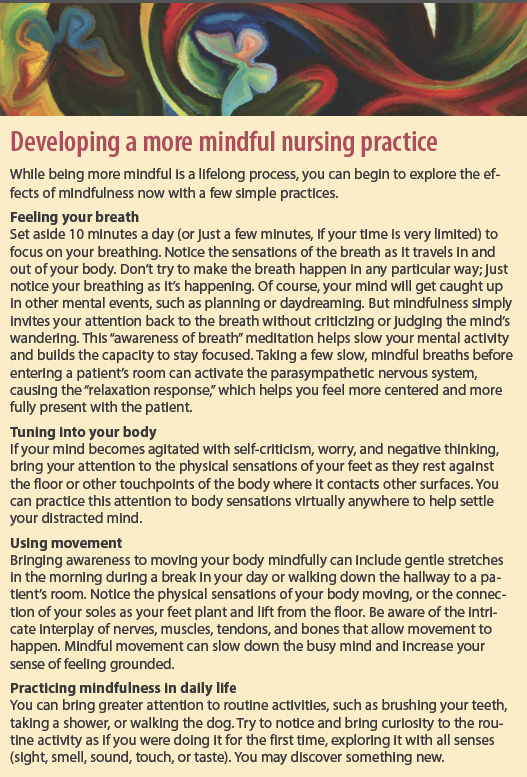
Moreover, research shows mindfulness training can help nurses cope more effectively with stress and reduce the risk of professional burnout. One randomized, controlled trial of nurses found those who participated in an 8-week mindfulness training program had significantly fewer self-reported burnout symptoms, along with increases in relaxation, mindfulness, attention and improved family relations, compared to nurses in a control group. (See Developing a more mindful nursing practice.)
Developing a more mindful nursing practice

Wiser and more compassionate care

Mindfulness is a way of living with greater attention and intention and less reactivity and judgment. You can learn and develop mindfulness through regular mindfulness practices. Consider integrating mindfulness into your self-care plan to reduce stress and minimize burnout.
Being more mindful and bringing receptivity to whatever is happening can deepen your understanding of clinical situations, relationships with colleagues, and ultimately yourself. With this understanding comes the possibility of providing wiser and more compassionate care for your patients and yourself.

Lois C. Howland is an associate professor at the University of San Diego and a senior teacher at the Center for Mindfulness at the University of California, San Diego. Susan Bauer-Wu is the director of the Compassionate Care Initiative and the Tussi & John Kluge Endowed Professor in Contemplative End-of-Life Care at the University of Virginia School of Nursing in Charlottesville.

Monday, February 15, 2016

4 health benefits of reading

Read this: 4 health benefits of reading

Health News Team
Benefits of reading
In a sea of streaming video and ever-present screens, binge-watching is now the entertainment of choice above the more old-school option of reading a book.
Michelle Milles, behavior change expert and wellness coach for Sharp Health Plan, says this should not be the case. “Reading can provide a healthy distraction from life’s day-to-day worries and pressures, while at the same time, making us smarter, happier and even more empathetic toward others.”
These studies show why you should incorporate reading into your daily routine:
Keeps your brain from slowing down
A 2013 study by Rush University Medical Center discovered that adults who spent their free time in intellectual activities such as reading or puzzling experienced a 32 percent slower rate of cognitive decline.
Relieves stress
In a 2009 British study at Sussex University, researchers asked participants to engage in an anxiety-filled activity and then either read, listen to music or play video games for six minutes. The stress levels, heart rate and muscle tension of those who read dropped 68 percent — more than any of the other activities.
Can lessen depression
A University of Manchester analysis published in 2013 showed people with severe depression benefited from low-intensity interventions, such as reading self-help books and interactive websites. Also, an additional study published in PLOS ONE demonstrated that patients who read self-help books in combination with traditional therapy sessions for a year lowered their depression level than those who only sought standard treatment.
Helps stave off Alzheimer’s disease
Like any organ, the brain needs activity to remain strong. In a study published in the journal Proceedings of the National Academy of Sciences, researchers determined adults who engage in brain-based activities like reading are less likely to be diagnosed with Alzheimer’s disease.
Milles offers three ways to build reading into your schedule:
Start a book club at work
Milles suggests bringing the benefits of reading into your work. “In addition to building camaraderie and teamwork among employees, a book club can improve relationships between staff across different departments, encourage continuous learning and offer all employees the opportunity to practice leadership roles by leading the book club. It can also contribute to overall employee satisfaction, motivation and retention,” she says.
Ditch the eReader at night
In a 2014 study, researchers found that evening use of eReaders negatively affected sleep patterns, circadian timing and next-morning alertness. It’s best to use a small light next to the bed and a hard-copy book to rid yourself of the disruptive light from electronic devices.
Try reading for 15 minutes before work
It will help you start your morning focused and prepare you for the rest of your day.

Monday, February 8, 2016

Compassion fatigue: Are you at risk?

compassion fatigue

Compassion fatigue: Are you at risk?


Publication Date: January 2016 Vol. 11 No. 1
Author: Kate Sheppard, PhD, RN, FNP, PMHNP-BC, FAANP

For many of us, nursing isn’t just what we do; it’s who we are. Most of us became nurses because we care about people and want to make a difference in their lives.
Over time, nurses develop a nursing intuition and a working knowledge of disease and trauma. Our intuition, knowledge, and caring don’t automatically shut off when we leave work. For example, have you ever seen a worrisome mole on a complete stranger? Have you felt concern about a friend’s weight or a neighbor’s smoking habits? Have you ever been in a public place when you heard someone coughing—and wondered at what point you might intervene? These experiences are common among nurses. Yet, inability to shut off our knowledge and caring may leave us feeling emotionally saturated and raise our risk for compassion fatigue.

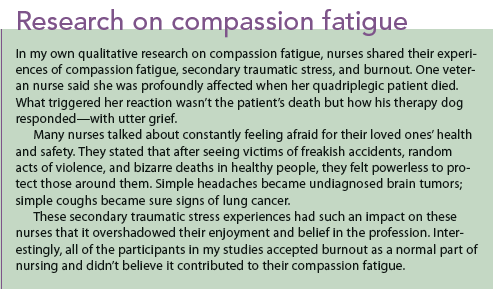
Ideally, as nurses, we should feel satisfied with our work and derive satisfaction from providing excellent care. Compassion fatigue has been defined as loss of satisfaction that comes from doing one’s job well, or job-related distress that outweighs job satisfaction. Sometimes, merely being exposed to another’s traumatic experience leaves us feeling emotionally distraught. Called secondary traumatic stress, this is a part of compassion fatigue. As our sense of job satisfaction decreases, we may feel more burnout. A reaction to our work environment, burnout can stem from such conditions as short-staffing, long work hours, workplace incivility, and feeling dismissed or invalidated. (See Research on compassion fatigue.)
Research on compassion fatigue

Who gets compassion fatigue?

Compassion fatigue can happen to any nurse—and it can be unpredictable. We know that nurses who work in oncology or see more patient deaths may be at greater risk. Also, when we form close, caring relationships with patients (especially if we lose our personal boundaries), we may be putting ourselves at higher risk.
Sometimes a particular patient or a patient’s family member may remind us of someone important in our lives. If that patient or family member has died, we may be triggered emotionally. Many nurses I interviewed in my research described being triggered unexpectedly and profoundly by a smell (caring for a child with second- and third-degree burns over 50% of his body), a sound (a mother screaming with grief when told her 3-year-old child had coded and died), or a sight (a dog on the hospital bed with his head across his master’s chest). Nurses who skip breaks, take extra shifts, or come in on their days off out of a sense of duty may be more at risk for compassion fatigue. One of the greatest risks for compassion fatigue comes when nurses forgo their own self-care.

What does compassion fatigue feel like?

In many cases, the first symptoms are emotional. Nurses talk about feeling bored with their work or feeling detached and distant from patients and colleagues. They may realize they’re irritable and short-tempered. They may feel they’ve failed to relieve a patient’s pain or to help a patient get well, losing their sense of pride in being a nurse.
Frequently, nurses with compassion fatigue talk about sleepless nights as they worry about what they forgot to do at work or replay disturbing events in their minds. They may be forgetful at work, in school, or at home. As compassion fatigue progresses, physical symptoms typically arise. Most nurses describe feeling physically and mentally exhausted, and many report headaches or backaches. Frequently, I hear nurses say they feel queasy just driving to work, and those feelings intensify as they walk in the door.
What happens to nurses who don’t deal with compassion fatigue symptoms? First, their work performance changes; for example, they may be at risk for medication errors. Without realizing why, they may start to call in sick more frequently. They may be short-tempered, sarcastic, or rude to colleagues and even to patients or families. They may appear tired and may become more easily startled.
Unfortunately, they may attempt to reduce their emotional saturation through alcohol or drug use. Ultimately, when emotional saturation becomes too intense, some nurses may view leaving the profession as the only means of escape.

Can you have compassion fatigue but still feel compassion?

Absolutely. In my studies, some nurses volunteered that they felt symptoms of compassion fatigue, yet stated, “But I also still feel compassion.” Clearly, a nurse can have symptoms of compassion fatigue while still feeling compassion. If anything, the more compassion a nurse feels, the greater the risk that she or he will experience emotional saturation or compassion fatigue.

Reducing compassion fatigue

What can you do to reduce or even prevent compassion fatigue? Start by being aware of how you feel physically and emotionally. If you realize, for example, that interactions with a specific colleague often feel uncomfortable or unpleasant, reflect on that a bit. Explore what’s beneath that feeling.
Perhaps you feel overlooked, ignored, invalidated, unfairly treated, or criticized—but instead of accepting those feelings and trying to make a change, you compound your feelings with guilt and shame. When you experience negative emotions, pay attention to how you feel physically. By bringing physical and emotional feelings to the surface, you can more efficiently address the underlying cause.

Establish healthy boundaries.

Establishing healthy boundaries is an important way to reduce the risk of compassion fatigue. Many of us face minor boundary issues frequently without really considering the consequences. Examples might include answering a question you feel uncomfortable with, sharing personal information you’d prefer to keep private, doing a favor for someone not because you want to but because you feel you have to, having someone hug or touch you in a way that makes you uncomfortable, and tolerating a rude or pushy person. By slowing your response and doing some self-reflection, you can address these issues with firm but courteous responses.

Make self-care and self-compassion priorities.

Perhaps the most important way to prevent or reduce compassion fatigue is to take care of yourself. As nurses, we work hard and really need our breaks. We need to eat, and to take time for ourselves without being interrupted by alarms, patients, or colleagues. We also need our time off, for our mental and physical well-being.
Before you were a nursing student and nurse, you probably had hobbies or activities you enjoyed. But later, between working long hours and trying to balance your personal and professional lives, those hobbies and activities were probably the first things you let go of. So try to bring them back into your life. Take the dog for a walk every day, listen to music, read a book for pleasure, go for a hike, call a friend—do something for yourself every day.
Self-compassion is important, but it may be hard to attain. Start noticing how you talk to yourself when frustrated, upset, or angry. Do you berate or criticize yourself? Try replacing that talk with kindness, just as you might talk to a loved one.

Practice self-reflection and mindfulness.

Parts of your job may make you feel frustrated because you feel powerless. As burnout and compassion fatigue build, your emotions may grow so strong that they become an overwhelming blur of anger, resentment, frustration, or helplessness.
Thoughtful and quiet self-reflection away from work may help you slowly separate events, interactions, and experiences. By examining each event or interaction, you can become more aware of your triggers (specific people, situations, or events) and address each one individually. Even if you can’t change your work environment, you can find power within by listening to your emotions with kindness and approaching colleagues and others from a wise and centered perspective.
Mindfulness is an important part of self-compassion. Although mindfulness has its roots in Buddhist meditation, it’s also a secular cognitive practice in the form of mindfulness-based stress reduction.
To practice mindfulness, take note of the present and pay attention with kindness and curiosity. You may notice physical or mental feelings of pain, fatigue, or pleasure. If you feel pain, ask yourself what your body or mind is trying to tell you—and address those concerns. By engaging in mindfulness, you can learn to identify which areas of your body react to your emotions. Mindfulness can reduce stress and anxiety and improve your physical and mental well-being. Through self-reflection and mindfulness, you allow yourself to consider events and triggers, learn from them, forgive yourself, and move forward.

Taking action

We can all reduce our risk of compassion fatigue and emotional saturation by reflecting on our triggers, practicing mindfulness, replacing self-criticism with kind self-talk, and engaging in daily self-care activities. Finally, if you’re suffering from sleeplessness, poor self-care, loss of interest, or other symptoms of distress, reach out for help from an employee assistance program or a mental health provider.

Kate Sheppard is a clinical associate professor and the psychiatric–mental health nurse practitioner specialty coordinator at the University of Arizona College of Nursing in Tucson.

Selected references
Hinderer KA, VonRueden KT, Friedmann E, et al. Burnout, compassion fatigue, compassion satisfaction, and secondary traumatic stress in trauma nurses. J Trauma Nurs. 2014;21(4):160-9.
Maiden J, Georges JM, Connelly CD. Moral distress, compassion fatigue, and perceptions about medication errors in certified critical care nurses. Dimens Crit Care Nurs. 2011;30(6):339-45.
Neville K, Cole DA. The relationships among health promotion behaviors, compassion fatigue, burnout, and compassion satisfaction in nurses practicing in a community medical center. J Nurs Adm. 2013;43(6):348-54.
Sheppard K. Compassion fatigue among registered nurses: connecting theory and research. Appl Nurs Res. 2015;28(1):57-9.