Tuesday, January 26, 2016
 Almost
weekly, I am asked about my choice to pursue a Doctor of Philosophy in
nursing. The frequency of this makes me wonder if the general public
only sees nurses as bedside handmaidens who take orders from physicians.
The more frustrating thing is when these probing questions come from
other PhD students.
Almost
weekly, I am asked about my choice to pursue a Doctor of Philosophy in
nursing. The frequency of this makes me wonder if the general public
only sees nurses as bedside handmaidens who take orders from physicians.
The more frustrating thing is when these probing questions come from
other PhD students. What
do you do with a PhD in nursing? Whatever you want! There are
PhD-prepared nurses who teach, conduct research, evaluate programs,
write books, lead health care organizations and work for the government.
With a doctoral degree, the sky is the limit. One thing I doubt most
nurse PhDs want to do is work full time in direct patient care. At the
doctoral level, nursing is less about hands-on patient care and more
about the abstract thinking that helps move the profession forward. More
than anything else, a nurse with a PhD has the training needed to
conduct research and add to the body of available nursing research
knowledge. While not all PhD-prepared nurses choose to work as
researchers, all have been exposed to great amounts of research and have
had to demonstrate their ability to conduct high-quality research on
their own.
What
do you do with a PhD in nursing? Whatever you want! There are
PhD-prepared nurses who teach, conduct research, evaluate programs,
write books, lead health care organizations and work for the government.
With a doctoral degree, the sky is the limit. One thing I doubt most
nurse PhDs want to do is work full time in direct patient care. At the
doctoral level, nursing is less about hands-on patient care and more
about the abstract thinking that helps move the profession forward. More
than anything else, a nurse with a PhD has the training needed to
conduct research and add to the body of available nursing research
knowledge. While not all PhD-prepared nurses choose to work as
researchers, all have been exposed to great amounts of research and have
had to demonstrate their ability to conduct high-quality research on
their own.
Thursday, January 21, 2016
From ‘Dr. ColeMAN NURSE,’ an RNL blog, Push that reset button every day!
|
Why be content with going nowhere?
|
| By Christopher Lance Coleman |
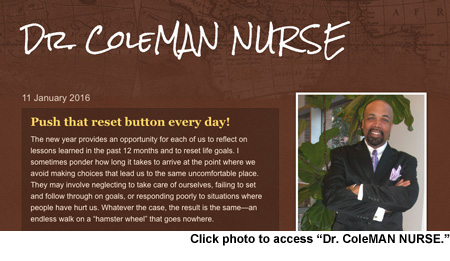 The new year provides an opportunity for each of us to reflect on lessons learned in the past 12 months and to reset life goals. I sometimes ponder how long it takes to arrive at the point where we avoid making choices that lead us to the same uncomfortable place. They may involve neglecting to take care of ourselves, failing to set and follow through on goals, or responding poorly to situations where people have hurt us. Whatever the case, the result is the same—an endless walk on a “hamster wheel” that goes nowhere.  For
me, this past year has brought increased awareness of how quickly time
is passing and how easy it is to not make the most of the time we have. I
remember my beloved grandmother who firmly believed that taking time
for granted is an irreversible mistake. By the time we realize our
mistake, we find ourselves on the other side of an event that has
disrupted our foundations. Clearly, we cannot stop time or reverse
events that have already occurred. For
me, this past year has brought increased awareness of how quickly time
is passing and how easy it is to not make the most of the time we have. I
remember my beloved grandmother who firmly believed that taking time
for granted is an irreversible mistake. By the time we realize our
mistake, we find ourselves on the other side of an event that has
disrupted our foundations. Clearly, we cannot stop time or reverse
events that have already occurred.
Tragic world events of 2015 remind us all that we cannot take
life for granted. Time is a gift we should use for good, not for
engaging in unproductive or destructive activities. Perhaps you are
among those who pledged at the beginning of 2015 to use your talents and
gifts to improve lives around you. Or you made a commitment to exercise
more or eat better. If you’re like most, the result has been a mixed
bag of successes and failures. The point is, we often find ourselves
pivoting away from life-improving goals toward places of familiarity
that do not move us forward.
How do we stay engaged in working toward goals that move us
forward? We push the reset button every day! Each day, we resolve to be
our best, fully committing ourselves to excellence in all we do, whether
it’s exercise, work, developing friendships, or nurturing family
relationships. Like you, I have learned many lessons over the years. One
is, if I don’t take care of myself, I can’t improve the lives of those
around me.
As you ponder what you want to accomplish in 2016, remember
to invest in yourself so you can be that change agent who positively
impacts the lives of others. RNL
Christopher Lance Coleman, PhD,
MS, MPH, FAAN, is Fagin Term Associate Professor of Nursing and
Multicultural Diversity and associate professor of nursing in psychiatry
at the University of Pennsylvania (UPenn) School of Nursing. He is
senior fellow in the Center for Public Health Initiatives at UPenn and
Institute on Aging Fellows in the Family and Community Health Division,
Department of Psychiatry, School of Medicine at UPenn. He is also the
author of Man Up! A Practical Guide for Men in Nursing, published by the Honor Society of Nursing, Sigma Theta Tau International.
|
Tuesday, December 22, 2015
A great article from Nurse.com

Nurses speak out about gender pay gap
14The Greek philosopher Heraclitus’ doctrine that everything changes and nothing stands still doesn’t seem the case when it comes to equal gender pay in nursing, a profession where men have steadily out-earned women since 1988. In fact, nurse researchers report in the March 24/31 Journal of the American Medical Association that there has been no narrowing of the gender pay gap across settings, specialties and job titles for about a quarter century.
This isn’t the first paper to document higher salaries for male RNs, but it does offer a previously unstudied view of the pay gap, according to lead author Ulrike Muench, PhD, RN, of the University of California, San Francisco. “There have only been a couple of studies that have looked at gender earning differences in nursing,” Muench said. “They were conducted over 10 years ago and didn’t examine data over time. Our study is the first to examine a trend over time, and our goal was to include more [updated]data.”
The study reflects data from nearly 88,000 RNs from the National Sample Survey of Registered Nurses from 1988 to 2008, as well as 205,825 RNs from the 2001-2013 American Community Surveys. Men represented 7% of both data sets. Both samples showed male RNs’ salaries were higher than female RNs’ salaries every year.
While researchers estimated the overall adjusted earnings difference was $5,148, they found larger and smaller gaps in different settings. The salary gap dropped to $3,873 for RNs working in hospitals, but rose to $7,678 in ambulatory care. Pay gaps varied among the seven specialties studied: cardiology, psychiatry, neurology, pediatrics, med/surg, orthopedics and chronic care. The gap was biggest in cardiology, at $6,034.
“It is important to remember that our study didn’t capture all clinical specialties that nurses work in, such as immunology, gynecology or infectious diseases,” Muench said. “This is for two reasons: The surveys didn’t include all specialties in every survey year …. Other specialties, such as gynecology, had too few men to be included as a separate specialty.”
Largest gap
Gender pay gaps also varied by position, with nurse anesthetists standing out with a gender pay gap of $17,290.The fact that nurse anesthesia is the highest paid nursing specialty and attracts more men than any other area in nursing offers no explanation as to why there is such a significant pay gap between male and female CRNAs, according to Sharon Pearce, CRNA, MSN, president, American Association of Nurse Anesthetists.
“From a practice standpoint, all nurse anesthetists — male and female alike — receive the same education and training, and they all provide the same safe, high-quality patient care for every type of procedure requiring anesthesia,” Pearce said. “The AANA and the profession, as a whole, would like to see this gap eliminated, because there’s no acceptable reason for there to be such imbalance in the pay scales.”
The gender pay gap, while it’s making headlines in nursing, is relatively narrow compared with other professions. For example, women who are financial advisers make only 61% of what their male colleagues make, according to Ariane Hegewisch, a study director at the Institute for Women’s Policy Research, Washington, D.C.
Nurses, on the other hand make 90% of what their male counterparts make, according to IWPR’s calculations based on the U.S. Bureau of Labor Statistics Current Population Survey. IWPR published its fact sheet “The Gender Wage Gap by Occupation 2014 and by Race and Ethnicity” in April 2015. “But it is nevertheless quite shocking that [nursing]does have a gap, given that hospitals often are either in the public sector or are more likely to be unionized,” Hegewisch said. “Typically, there is greater transparency in the way people are appointed and the ways they are paid and promoted.”
What’s causing the gap?
So, why the lag in female nurses’ pay? “Practice pattern differences, career choices and educational differences explain most, if not all, of the gender gap in nursing,” said Linda H. Aiken, PhD, RN, FAAN, FRCN, professor in nursing and sociology and director of the Center for Health Outcomes and Policy Research, University of Pennsylvania in Philadelphia, who has studied the nursing workforce in the U.S. and other countries.“Men work more hours, which is an important factor since a large share of nurses are paid on an hourly basis,” said Aiken, who was not involved in this study. “They are more likely to practice in geographic areas with higher compensation, including the two coasts and large cities. They are more likely to select highly compensated clinical specialties …. Men are more likely to have a bachelor’s degree or higher, and education is associated with compensation.” Research on male and female nurses suggests that male nurses tend to move up the career ladder faster than female nurses, according to Hegewisch. This phenomenon is referred to as the glass escalator, according to a May 21, 2012, article on Forbes.com. Women climb the ladder in a female-dominated profession, like nursing, while men glide to the top on an invisible escalator.
Caren Goldberg, PhD, an assistant professor of management at American University said in the Forbes article that part of that phenomenon occurs because women are more likely to experience career interruptions, including taking time off to care for children or elderly parents.
Closing the gap
Aiken said there are solutions that would help narrow any gender gap in nurse compensation, including realigning Medicare, Medicaid and private insurance payment policies to fairly compensate nursing care across settings and specialties. “Nurse practitioners still get only 85% of the payment that MDs receive for exactly the same services, and primary care providers are compensated less than in rapidly growing clinical specialties such as nurse anesthesia,” Aiken said. “Payment policies for long-term care including mental health services require nurses to sacrifice their incomes to provide much needed care.”Hegewisch suggests nurses start a discussion about pay — that is, if they can talk about salaries. “Nationally, 60% of private sector workers say they are either prohibited by contract or strongly discouraged by their management from discussing salaries,” Hegewisch said.
Nurses can go to websites, such as Glassdoor.com or Monster.com, to share and compare salaries, according to Hegewisch. They also can talk among their peers; then, decide whether to approach management about any gaps in pay. “Be proactive,” she said.
Hegewisch said research has shown men are more likely than women to hustle for pay increases, and when women do negotiate, they may be perceived less positively than when men negotiate.
More research is needed to study possible explanations for gender pay gaps in nursing, Muench said. In the meantime, employers can introduce open-pay policies that increase transparency in compensation. For example, the U.S. Department of Labor offers “An Employer’s Guide to Equal Pay,” which includes useful tips on addressing questions about pay discrepancies.
Pearce said the AANA will be looking closely at the research from various sources and considering strategies for educating its members and their employers to ensure that all CRNAs are being compensated equitably.
“I am hoping that our study can raise awareness on this issue and that nurse employers will use our results to examine their pay data to see if differences in earnings exist in their organizations,” Muench said. “If not, then this is a great outcome; if yes, employers can assess if there are legitimate reasons for paying men more than women.”
Lisette Hilton is a freelance writer.
Saturday, December 5, 2015
10 Ways for Nurses to Get Promoted
10 Ways for Nurses to Get Promoted
Are you stuck in a rut at work? If so, it might be time to
consider a promotion. You may not have the authority to make that happen
exactly, but you shouldn’t wait around expecting to be noticed either.
You can—and should be—your strongest supporter. If you’re ready to take
charge, here are 10 proactive ways to help you take that next step in
your career.
1. Don’t Wait to Get Started
Don’t put off getting your career going, advises Beverly Malone, PhD, RN, CEO of the National League for Nursing (NLN) in New York City. “A lot of young people in particular will say, ‘I don’t know exactly what I want to do, so I’m going to wait before I make a move,’” she explains. “My advice is get started, even if you have to change directions later.”
For Malone, starting her career moves early made it possible to have a highly varied and distinguished career. The eldest of seven siblings, she was raised by her great-grandmother in rural Kentucky. As a young nurse, she worked in a psychiatric unit. Later, she served as dean and vice-chancellor of a historically black college. Then she became president of the American Nurses Association (ANA). And before taking the helm of the NLN, she lived in London, serving as general secretary of the Royal College of Nursing.
One of the hardest decisions for young nurses is choosing a field of study for a degree. “Don’t be too concerned about what kind of degree you get,” Malone advises. “There will always be something you can do with it later.” For example, she no longer works as a psychiatric nurse, but she says her experiences in the field still serve her well.
2. Be a Team Player
You can’t rise through the ranks without being a team player, argues Kanoe Allen, RN, MSN-CNS, PHN, ONC, executive director of nursing at Hoag Orthopedic Institute in Irvine, California. “Understand the staff you are working with,” she suggests. “The team can make or break you.” She also recommends volunteering for extra duties. “It allows other people to see you,” she says.
Raised in a family of Chinese, Japanese, and Hawaiian descent, Allen rose rapidly as a young nurse. Taking a job at a critical care ED, she was named charge nurse within a year and became interim administrator a year after that. A rapidly rising young nurse might have ruffled a lot of feathers among older nurses, but Allen thinks she “garnered some good will from the staff.”
Allen puts a lot of emphasis on social skills. “You need to understand the interplay between personalities and departments and work in a collaborative manner,” she advises. She still finds these skills invaluable as an administrator. “You have to really listen to your team,” she adds.
3. Find a Mentor
Finding a mentor is important to your career, because mentors know about “the back stairs,” Malone says, referring to the secrets of getting ahead in a large organization like a hospital. As a floor nurse, “you know there’s a door to go up, but you don’t know where the door is until a mentor shows you it.”
Sasha DuBois, RN, MSN, a 29-year-old floor nurse at Brigham and Women’s Hospital in Boston, relies on several mentors to show her the way. She acquired her first mentor in nursing school, when she heard her making a speech. “I walked up to her afterwards and struck up a friendship,” DuBois recalls. “She’s invested in seeing me grow.” They get together at least once a year.
Allen advises young nurses to cultivate people who are very accessible to them and can serve as career coaches. “A coach is someone who can be honest and tactful,” she says. “She can provide supportive feedback and help you with your own critical thinking.”
4. Follow Your Passion
You can’t have a successful career unless you are passionate about your work, argues Maria S. Gomez, RN, MPH, founder of Mary’s Center for Maternal & Child Care in Washington, DC. “If you want to achieve anything, you have to have a passion,” she says. “If you only care about your own job, it’s easy to get burnt out. You just go to work and come home.”
As an immigrant from Colombia at age 13, Gomez did not know any English except “thank you.” When she went to work in a large organization as a young nurse, she was unable to find a mentor. ‘The older nurses I worked with didn’t like their work,” she says. “I couldn’t wait to move on.”
She found her calling working at a public health department. “I saw a lot of injustices, and I wanted to make a difference,” she explains. In 1988, she founded Mary’s Center as a shelter for women immigrants from Latin America. Today, the organization has a budget of $39 million and provides care at six locations for low-income women, children, and men in the DC area.
5. Go Back to School
Going back to school to get a higher degree or certification is really about “creating opportunities for yourself,” says Kerry A. Major, MSN, RN, NE-BC, chief nursing officer for Cleveland Clinic Florida. “A degree can open multiple doors and help you find out what your passion is,” she says. “A lot of young nurses don’t realize all the choices that are out there.”
A degree makes you more competitive, Major says. At many hospitals, a master’s degree is a requirement for entry into management. But apart from spiffing up your resume, a degree is an opportunity to learn new skills. “The literature shows that a degree produces a more rounded nurse,” she explains.
Major notes that school is a great opportunity to mix with nurses from other walks of life who you might never have met within your own institution. “You can get an idea of all the opportunities that are out there,” she says. “You’ll meet someone who works in public health, and someone else is an operative nurse.”
6. Nurture Your Communications Skills
Speaking and communications skills become more important the further you move up the career ladder, says Glenda Totten, RN, MSN, CNS, PHN, director of nursing service at Kaiser Permanente Los Angeles Medical Center.
Totten is constantly honing her skills. She identified a senior manager with a great communication style and started paying attention to what he says and how he says it. “I listen intently,” she says. “He’s very precise. He doesn’t beat around the bush when answering questions. He’s able to give bad news in a realistic way, without sugarcoating it or kowtowing. And he’s open to feedback.”
Totten can practice her communication skills in many ways, including serving on a nursing quality improvement committee. She is also responsible for coming up with tools to quickly inform frontline nurses about changes in the hospital policies.
7. Read Voraciously
Don’t forget to read. It can help you improve your communications skills, find new role models, and get on-the-job training. “Reading increases your written and verbal comprehension, improves your vocabulary, and widens the topics you can talk about,” says Totten.
Through reading, Malone says she discovered a new mentor named Mary Seacole, a Jamaican-born nurse who worked in 19th century Britain. In a parallel career to that of Florence Nightingale, Seacole tended to troops in the Crimean War. “Sometimes having a mentor just means having that person in mind when you’re trying to accomplish something,” Malone explains.
Reading is also a good way to pick up new skills. Consider checking out The Nurse Manager’s Survival Guide: Practical Answers to Everyday Problems by Tina M. Marrelli, which is now in its third edition.
You can also take webinars. The “Nurse Manager Development Series” was designed by Lippincott’s Nursing Management journal and ANA to help new nurse managers develop their skills. Topics include retaining talent, managing disruptive behavior, conflict resolution, budgeting, and finance.
8. Volunteer for Assignments
Volunteering for assignments outside of your department helps broaden your skills and makes you a better candidate for promotion, says Juanita Hall, BSN, RN, a nurse manager for cardiology, outpatient treatment center, and dialysis at Providence Hospital in Washington, DC. “Get experience in different departments,” she advises. “Volunteer to be the float nurse.” For example, Hall volunteered to work in dialysis, where she didn’t have much background.
As a young nurse, Hall didn’t initially seek promotion, but she was always willing to learn new things. “I wanted to know what was going on,” she says, and because she was involved in many activities, “my name would come up to the nurse manager.” Even though Hall didn’t have a master’s degree, she got a job as an assistant nurse manager.
“It’s important for nurses to be willing to absorb,” Hall says. “Take in all you can from others. Ask questions [and] show yourself as very interested in what others have to say, so that people feed the information to you.”
9. Don’t Let Ambition Get Out of Control
Hard work and dedication are always welcome, but sometimes a person’s ambition ends up alienating others. “My position is that good things will come to you,” says Hall. “You don’t have to beat anyone up to get to them.” An associate minister in her church, Hall relies on her spirituality to center herself.
Nurses can also be susceptible to burnout if they take on too many assignments. The prime time for burnout comes when studying for an advanced degree while still holding down a full-time job. When DuBois was studying for her master’s degree, she was working 36 hours a week and taking three classes each semester. “I didn’t get burnt out, but I can see how it could happen,” she says. “Everyone has to figure out how much you can handle. It’s about balance.”
Even with her studies completed, DuBois still maintains a busy schedule, including a morning workout in the gym on off-days. “A lot of my friends look at my calendar and think I’m crazy,” she says. But she also reserves time for fun. “I like going out to a party or birthday. I feed off of that. That’s my time to let my hair down.”
10. Use Your Organization’s Career Ladder
Many organizations offer career-ladder programs, which offer higher pay or more responsibilities to nurses who demonstrate their skills, according to Shawana Burnette, OB-RNC, MSN, CLNC, a nurse manager on High Risk Post Partum and High Risk OB at Carolinas Medical Center in Charlotte, North Carolina.
Burnette’s hospital’s ladder process rates bedside nurses on engagement and certification and rewards them with a higher pay level. Nurses who achieve the next rung of the ladder, RN II, get a 10% raise. At higher levels, nurses may be asked to be a preceptor and orient new hires or a nursing student. “The focus is to encourage professional growth and to reward highly engaged nurses in your facility,” she explains.
The ladder process encourages earning certificates in various fields. Burnette is currently studying for a nurse leadership certificate. She says her hospital strongly encourages certification and even provides tuition reimbursement to take review classes to prepare for the certificate exam.
Enjoy the Journey
Nurses who continuously nurture their careers will reap great benefits as they advance up the ladder, argues Allen. “Your nursing career is a journey,” she says. “It’s an incredible journey. It will involve hard work and reaching something meaningful to you.”
Leigh Page is a Chicago-based freelance writer specializing in health care topics.

Leigh Page
Saturday, November 28, 2015
From stall to start: Don’t let fear stop you from writing
| From stall to start: Don’t let fear stop you from writing | ||
| By Kathleen T. Heinrich | ||
Stymied when you try to write? Can’t get your thoughts on paper? Break the writing barrier by applying these proven strategies.
 Stories?
Do nurses have stories! So, with all the writing material we accumulate
in a day, why don’t more of us write about the amazing things we do?
We say we lack the time or the credentials (Steefel, 2007), when really
what we lack is self-confidence, know-how or support (Heinrich, 2008).
Whether you want to write a narrative for clinical advancement, an
article for publication or an abstract for a conference presentation,
find out what’s slowing your progress. Stories?
Do nurses have stories! So, with all the writing material we accumulate
in a day, why don’t more of us write about the amazing things we do?
We say we lack the time or the credentials (Steefel, 2007), when really
what we lack is self-confidence, know-how or support (Heinrich, 2008).
Whether you want to write a narrative for clinical advancement, an
article for publication or an abstract for a conference presentation,
find out what’s slowing your progress.Kelley, Rhett and Jennifer are three nurses who are seeking ways to move their writing projects from stall to start. In the stories that follow, note how their fondest wishes and their greatest fears unmask specific writing challenges. What helps them overcome roadblocks to writing just might work for you. KelleyKelley’s been a nurse for 10 years, and her manager is encouraging her to pursue clinical advancement. Kelley’s stumbling block is writing a clinical narrative that showcases her nursing care. She tells her manager: “Every time I think of a story, I get all excited. Then I ask myself, ‘What did I do for that patient and family that any nurse wouldn’t do?’ Poof! My excitement’s gone and I’m back to square one.” Kelley’s fondest wish: If I could pinpoint what’s special about the care I give, it would be easier to write my clinical narrative. Her greatest fear: I know I’m a good nurse, but I’m afraid I won’t be able to find the words to convince reviewers that my practice merits clinical advancement. Kelley’s writing challenge is lack of confidence in her ability to do verbal justice to the quality of her nursing care. RhettNursing is a second career for Rhett. After trying his hand at real estate, he returned to school and recently graduated with his BSN. Not only is it a relief for Rhett to have a steady paycheck and regular hours, but he’s also loving his first nursing job. A journalist from the local newspaper asks him to write a short piece about finding a new career in tough economic times. Rhett knows he’s the perfect person to write the article; he’s just not sure where to begin. Rhett’s fondest wish: If I just had a framework to follow, writing this article could be fun. His greatest fear: I’ll spin my wheels, and all I’ll have to show for it is a wastebasket full of crummy drafts that never get published. Rhett’s not lacking self-confidence. His writing challenge is lack of know-how. He doesn’t have a systematic approach to writing. JenniferJennifer is an energetic school nurse who is passionate about “green cleaning.” She wants to present a poster at her state organization’s upcoming conference to help school nurses educate students about safe environmental practices that keep their carbon footprints small and their health strong. The only hitch is writing the one-page abstract that sells conference planners on her poster idea. Jennifer knows that, if she spoke with them for five minutes, they’d be begging for her poster, but her problem is writing an abstract that’s irresistible. Jennifer’s fondest wish: If I could talk my ideas out with someone, I might be able to write an abstract that’s persuasive enough to be accepted. Her greatest fear: I won’t be able to get the word out about something I really care about, because I can’t write like I speak. Jennifer’s writing challenge is lack of support from colleagues or friends. What’s your writing challenge?As you read about these nurses’ writing projects, whose wish sounded the most like yours? Was it Kelley’s search for what makes her nursing care special, Rhett’s desire for a systematic approach or Jennifer’s yearning for someone to listen? What, in other words, is your fondest wish for your writing project? What’s your greatest fear? Lack of self-confidence? Lack of know-how? Lack of support? A combination of these? Naming your greatest fear(s) can help you anticipate writing challenges. Now that you’ve identified your writing challenge, let’s find out how these three nurses trounce their challenges. Strategies for breaking the writing barrierDuring the last 20 years, I’ve developed strategies that help nurses meet writing challenges by allowing their wishes to overcome their fears. Applying these strategies move Kelley, Rhett and Jennifer’s writing projects from stall to start. To bolster her self-confidence, Kelley rereads notes and letters from grateful patients and families in search of words or phrases that describe her “something special” (Heinrich, 2008). The phrase “caring for the whole family” pops up everywhere and resonates with Kelley’s sense of what’s special about the care she gives. With this knowledge, she’s prepared to write a clinical narrative that showcases the special kind of care she provides. Rhett compensates for his lack of know-how by identifying the four essentials common to all writing projects—idea, reader, vehicle and slant. Focusing on a single idea, he writes for a particular group of readers who read a specific vehicle, and he communicates his idea using a slant or angle that his audience can’t resist (Heinrich, 2008). For the article he has been asked to write, Rhett identifies the following: Single idea: Finding a new career in tough economic times Particular group of readers: Those who read our local newspaper Specific vehicle: Our local newspaper Slant: Retooling tips for the resilient in a rough economy Identifying these four essentials upfront helps keep Rhett’s writing project on topic. Jennifer is an extrovert who does her best thinking out loud. Unfortunately, her usual circle of colleagues and friends is not providing the sounding board she needs. To compensate for that lack of support and make writing the abstract a social activity, she seeks out a good listener who asks insightful questions and tape-records their conversation. From the recording of that verbal give-and-take, Jennifer crafts an abstract that describes her poster. She refines her draft by soliciting feedback from a colleague known for writing winning conference abstracts. Jennifer enjoys these interactions so much that she decides to turn her poster presentation into an article for her organization’s newsletter—with the help, that is, of a few good listeners and peer editors. Two important questionsThe next time you want to move a writing project from stall to start, ask yourself two questions: What is my fondest wish for this project? What is my greatest fear? Your responses will tell you whether you’re lacking self-confidence, know-how or support. This lack is your writing challenge. Refer back to your wish, and you’ll find the clue for compensating for this deficiency. Make up for what’s lacking, and you are well on the way to overcoming your writing challenge. As you do, you’ll catch a glimpse of how writing can open up new career opportunities, touch lives far beyond your workplace and influence the profession in ways that nothing else can. Don’t let your nursing stories go untold! Allow your wishes to overcome your fears, so you can write about the amazing things you do every day. RNL
|

Saturday, November 21, 2015
Want to write for publication but intimidated by the process?
| Want to write for publication but intimidated by the process? | |||
Saver brings together 15 of nursing’s top writing experts to answer the most common questions asked by nurses who are interested in writing but intimidated by the publishing process. The 256-page book, which covers topics ranging from peer review and online submission to mind-mapping and social media, includes a foreword by Diana Mason, PhD, RN, FAAN, editor-in-chief emeritus, American Journal of Nursing. “Communication is defined as a process by which we assign and convey meaning in an attempt to create shared understanding,” Saver says. “By learning how to write clearly and effectively, nurses can share their knowledge with policymakers, journalists, hospital administrators, nursing educators and the general public, which will benefit everyone.” “If you are looking for a comprehensive text on writing for publication, from A to Z, look no further,” says Tim Porter-O’Grady, DM, EdD, ScD(h), senior partner of Tim Porter-O’Grady Associates Inc. “Anatomy of Writing for Publication is a great contribution to all nurses, from novices to scholars,” observes Pam Cipriano, PhD, RN, NEA-BC, FAAN, editor-in-chief, American Nurse Today.
STTI has also just published Take Charge of Your Nursing Career by Lois S. Marshall, PhD, RN, which includes advice on pursuing potential career options. Both books are available at www.nursingknowledge.org/ STTIbooks. |


Saturday, November 14, 2015
Ready, set, write: 5 tips for becoming a better writer
| Ready, set, write: 5 tips for becoming a better writer
For this writer, the first step was to start running
|
| By Tiffany M. Montgomery |
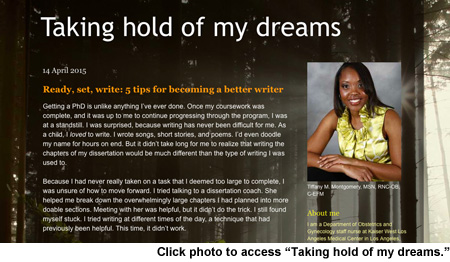 Getting a PhD is unlike anything I’ve ever done. Once my coursework was complete, and it was up to me to continue progressing through the program, I was at a standstill. I was surprised, because writing has never been difficult for me. As a child, I loved to write. I wrote songs, short stories, and poems. I’d even doodle my name for hours on end. But it didn’t take long for me to realize that writing the chapters of my dissertation would be much different than the type of writing I was used to.
Because I had never really taken on a task that I deemed too
large to complete, I was unsure of how to move forward. I tried talking
to a dissertation coach. She helped me break down the overwhelmingly
large chapters I had planned into more doable sections. Meeting with her
was helpful, but it didn’t do the trick. I still found myself stuck. I
tried writing at different times of the day, a technique that had
previously been helpful. This time, it didn’t work.
 I
began to feel that the only way to conquer this formidable task was to
take lessons I had learned from overcoming other obstacles and apply
them to my writing. The problem was, I didn’t have a plethora of
previously conquered obstacles to choose from. Until then, I had led a
pretty safe life, taking on only those things I knew I could achieve.
So, as a way to train for writing, I started to think of a new,
self-inflicted obstacle I could overcome. It didn’t take long before I
decided that running would be that obstacle. I
began to feel that the only way to conquer this formidable task was to
take lessons I had learned from overcoming other obstacles and apply
them to my writing. The problem was, I didn’t have a plethora of
previously conquered obstacles to choose from. Until then, I had led a
pretty safe life, taking on only those things I knew I could achieve.
So, as a way to train for writing, I started to think of a new,
self-inflicted obstacle I could overcome. It didn’t take long before I
decided that running would be that obstacle.
I have never enjoyed running. Never ever. I used to get in
trouble during physical education class for refusing to run. I didn’t
mind participating in other forms of physical activity, but running was
always tough for me. Several asthma attacks had been triggered by
running in cold weather, and those experiences made me hate running even
more. I used to say, “If you see me running, you had better start
running, too, because there’s probably something chasing me.” As I said,
I hated running.
I don't remember the day I decided to run, but I remember
exactly how I felt. I thought I was going to die! Upon reaching the end
of that first section of bike trail, I was proud of myself. I didn’t
die. I didn’t even pass out! And I had achieved a goal I once thought
unattainable. As I walked the next section of the trail, my breathing
slowed, my heart didn’t beat so fast, and I was ready to run again. I
continued to alternate between running and walking each new section of
trail, and, by the time I made it back home, I was beaming with pride. I
did it! Now that I knew the truth of what could be, there was no
stopping me.
Every time I went for a jog—more accurately, a jog-walk—I had
to mentally prepare myself. “You can do this. You won’t die. Just keep
moving. Whatever you do, don’t stop.” And every time I arrived back
home, I was proud of myself. Once again, I had accomplished something I
was truly scared to do.
I used the lessons I learned while jogging to help me become a
better writer. There is an endless list of tips I could give to help
any new jogger or writer, but I’ve chosen five to share with you:
1. Go at your own pace.
You don’t have to do what everyone else does. Quite honestly,
you shouldn’t want to. This is your race. You aren’t competing with
anyone but yourself. Almost every runner on the trail moves at a faster
pace than I do. I don’t care. I’m not running in a competition. My only
goal is to do better this week than I did last week. That’s it! When I
started walking regularly, my pace was 22.5 minutes per mile. Today, I
jog at a pace of 15 minutes per mile. My goal is to get below 12 minutes
per mile, and it will happen. I just have to keep going. I’m committed
to staying in my own lane, no matter how fast others around me are
running.
The same is true with writing. Not everyone will write at the
same pace. Even if we did, the dissertation chapters, journal articles,
and class papers wouldn’t be the same length or word count. Some people
have more references than others. Some people’s methods are more
complicated than others. Nothing about a PhD program screams
“competition.” I completed my dissertation proposal and advanced to
candidacy a full year after some of my classmates. It doesn’t matter. In
the grand scheme of things, my job was to write and defend my
proposal—and I did. As hard as it is, try not to compare yourself to
others. It doesn’t help you progress any faster, and, ultimately, it
takes your focus away from the task at hand. In most cases, wearing
blinders isn’t a good way to approach a situation. In this case, it’s
OK.
2. Use the proper tools.
As I have become a more experienced runner—(I use the term
“experienced” lightly—I’ve learned to use proper tools, which keep me
from having sore ankles or becoming so irritated while running that I
stop midstride. Not too long after beginning to run, I bought my first
pair of running shoes. I thought it was the only tool I’d need. I was
wrong. When I began running, my keys were in my hand, and the sun beat
into my eyes. When it was cold, I wore a very thin warm-up jacket that
did nothing to keep cold air from getting to my lungs. After running
more than enough days feeling like my chest was on fire, I purchased a
light, but very warm, running jacket, and I made sure it had zippers so I
could safely secure my keys, phone, and ID.
When it rains, I put the hood on. On warmer days, when I
don’t wear my jacket, I put all my belongings in my running pouch. If
running after sunrise, I wear a baseball cap or sun visor. Finally, I
use the Run Keeper app. It tracks the length of my runs and allows me to
comment on my friends’ workouts, as well. These and other tools are
staples for “real” runners.
As I’ve become somewhat of an experienced writer, I have also
found several writing tools I can’t live without. One of these is
EndNote, a reference manager. Once I began using EndNote, I was mad at
myself for not discovering it earlier. It’s a true writing assistant! I
no longer have to manually enter in-text citations or entries to my
reference list, and I am able to group my 750-plus references for easy
identification. I can attach article PDFs directly to the references,
and EndNote saves the highlights and notes I make on the electronic
copies of the articles. It’s an amazing tool, indeed! I’m not suggesting
that everyone go out and buy EndNote. It’s the reference management
software I like to use, but there are plenty of other software programs
that can help organize your references.
Another tool I use, though not as regularly as I did when writing my proposal, is my Pomodoro app. The Pomodoro method
of writing says that, for every 25 minutes of writing, you should take a
five-minute break. Then, for every two hours of writing, including
those brief breaks, you should take a longer break of about 15 to 30
minutes. This technique has been shown to increase productivity for
many, including me. There’s an entire science behind this method, which I
won’t go into now, but it’s worth checking out.
3. Find a group to encourage you.
Running was OK when I was alone, but it became really fun
when I started running with a group. Earlier this year, I began to power
walk and run with a local Black Girls Run (BGR) group. BGR has running
groups all over the country. Members meet at various times and locations
to work out together. One of the things I love about this group is
their motto “No woman left behind.” Whether you are a walker, jogger, or
runner, you will not have to go it alone.
I experienced this the first day my running partner couldn’t
make it to our morning running group. I can’t run as fast as some of the
ladies, but they promised not to leave me, and they didn’t. They’d run
laps around me, run to a tree, then back to me, or just run alongside me
at my pace. There’s something special about doing things with a group.
Running is no different.
Just as running groups help you run, writing groups help you
write and develop healthy habits. During my third year at UCLA, I joined
a writing group on campus. We didn’t actually write together, but we
met weekly to report our writing experiences during the previous week,
give advice to each other, and thus help increase our writing efforts.
We set what we thought to be attainable goals each week. Sometimes we
met our goals, sometimes we didn’t, but I loved the community that was
built among our group, and I remained in the group for the duration of
my third year.
In addition to in-person writing groups, there are tons of group-writing websites, such as AcademicLadder.com and the Text and Academic Authors Association.
Social media sites, such as Twitter, also encourage group writing
through hashtags that include #AcWri (academic writing), #amwriting
(early morning writing), and #shutupandwrite. Anytime you can write in
the presence—or virtual presence—of another person, you will be
encouraged to do your best. If you have become distracted from writing, I
urge you to join a writing group. If nothing else, the group members
will hold you accountable. You’ll either get with the program, or you’ll
leave the group.
4. Do it even when you don’t feel like it.
If I had a dollar for every time I said, “I don’t feel like
running today,” I’d be able to buy myself a nice pair of Jimmy Choo
pumps. Whether or not I feel like running when I begin, I always feel
great after my run is complete. And never have I regretted getting out
of bed at 4:30 a.m. to go for a run. That’s right, my running group
takes off at 5:15 a.m. I have plenty of excuses to stay in bed, but
getting my run in early has yet to negatively affect my plans for the
day. So I run, no matter how I feel.
Like running, writing is not something that comes easy for
most people. Even among those for whom writing does come fairly easy, we
aren’t always in the mood to write. While completing my proposal, I
discovered something about writing: You don’t have to be in the mood to
write to be a productive writer. The best way to become a great writer
is to write as often as possible. Every day you don’t write is a 24-hour
period closer to never writing again. That said, write when you want to
write and especially when you don’t. I promise, once you get started,
it’s not so bad. The first five or 10 minutes of writing are always the
most difficult. After that, your ideas become more organized, and the
words just begin to flow.
5. Quiet the mind-chatter.
Running is the most physical thing I have ever done. However,
I have learned my mind will give up long before my body does. One of my
friends who runs gave me the best advice ever. She told me, “Just keep
moving your arms.” She was right. As long as I kept moving my arms back
and forth, no matter how badly I wanted to quit, I kept running. At this
point in my running journey, I don’t even listen to the negative
thoughts anymore: “You’re not going to make it.” “You’re going to pass
out.” “Your legs can’t take this.” My mind says these things, but my
body hasn’t failed me yet.
Just like running, writing is more mental than physical. Your
mind will keep you from writing long before you ever sit down to type.
You can’t allow yourself to listen to those negative thoughts. You have
to sit down at your desk, at the kitchen table, or wherever else you
write and think like the Nike slogan: “Just do it!” While it’s important
to take mental health breaks, don’t let negative mind-chatter talk you
out of writing altogether. Even if it’s for only 15 minutes, write
something! If you manage to write for 15 minutes, you can probably write
for 15 more. Once you look up, two or three hours will have gone by,
and you’ll be done with your writing for the day!
These tips are but a few that may help you become a better
writer. I am no expert, by far, but each of the aforementioned tips has
been of great help to me. If you are struggling to write—and even if you
aren’t—I encourage you to take on a new and challenging activity, and
use the lessons you learn to help you become a better writer.
For me, it was running. For you, it may be swimming,
knitting, dancing, or hiking. It may also be something like jigsaw
puzzles, computer games, or a musical instrument. Whatever you decide to
take on, if you stick with it, you won’t be disappointed. Your writing
will be much improved, and you’ll find a new hobby along the way. RNL
Tiffany M. Montgomery, MSN,
RNC-OB, C-EFM, a women’s health nurse since 2005, initially worked as a
labor and delivery nurse before broadening her focus to obstetrics and
gynecology. She is now pursuing a PhD in nursing at UCLA.
|
Subscribe to:
Posts (Atom)